Industry leaders shared career advice with RMIT students, highlighting the skills, technologies and opportunities shaping the future of construction and infrastructure.
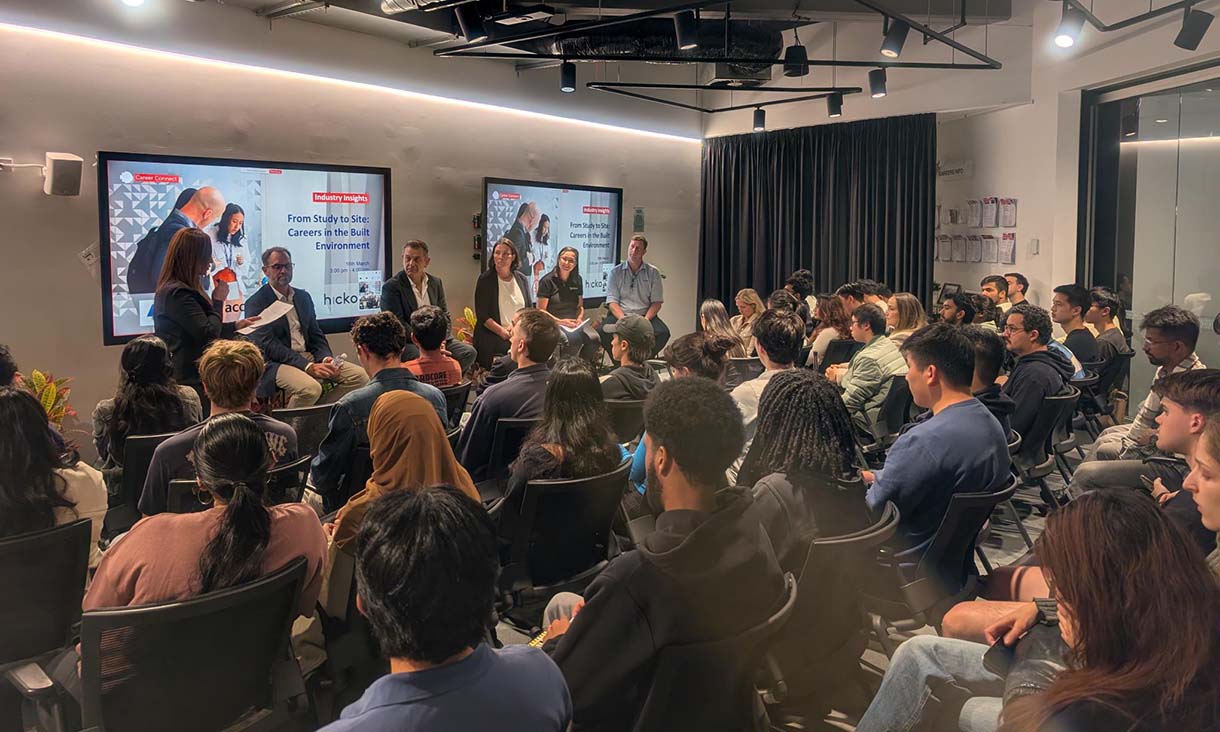
On 16 March 2026, students from the School of Property, Construction and Project Management (PCPM) connected with industry leaders to discuss the evolving landscape of construction and infrastructure. The session explored employability trends, emerging technologies and the future direction of built environment careers.
Facilitated by Associate Professor Guinevere Gilbert, the panel featured a cross-section of industry expertise:
- Pete Howell, Hickory, Chief People Officer
- Sian Taylor, ABN Group, Talent Acquisition Business Partner
- Ben Lody, Acciona, Recruitment Advisor
- Sebastian Giacchi, Better Living Group, Associate Director Construction
The discussion highlighted a shift in recruitment priorities. While technical knowledge remains important, employers increasingly seek graduates who demonstrate strong communication skills, adaptability and a commitment to continuous learning.
Communication and attitude key
While universities provide technical foundations, the panel stressed that employers also value interpersonal skills and workplace attitude. Industry leaders noted that technical skills can be developed on the job, but motivation, professionalism and a positive approach are critical from the outset.
Communication was repeatedly identified as essential in construction environments, where professionals coordinate with colleagues, suppliers, subcontractors and clients.
Students were encouraged to build these skills through part-time work, volunteering and university group projects. Experience in hospitality, retail or student organisations can help develop teamwork, resilience and leadership — all valued by employers.
Sustainability creating opportunities
The panel also explored how sustainability is reshaping the built environment and creating new career pathways.
Sustainability is now embedded in many major construction projects, driving demand for roles focused on environmental performance, reporting and innovation. Companies are increasingly investing in research partnerships with universities to develop new materials and lower-emissions construction methods.
Students involved in sustainability projects or research were encouraged to highlight this experience when applying for roles.
AI and digital skills transforming construction
Another key theme was the rapid adoption of artificial intelligence and digital technologies across the industry.
AI is already being used for tasks such as estimating, scheduling and project analysis, significantly reducing the time required for many processes. As these tools become more common, graduates are increasingly expected to understand how digital technologies can improve productivity and decision-making.
Technologies such as robotics, automation and digital project management systems are also becoming more widely used across construction sites and offices.
Innovation tackling housing challenges
The panelists also discussed emerging construction approaches. Modular and prefabricated construction methods are gaining traction, allowing building components to be manufactured off-site and assembled more quickly.
These methods may be particularly valuable in regional areas where labour shortages can slow housing delivery.
Connecting students with industry
The event concluded with students networking with panel members and learning about employment opportunities through RMIT PCPM’s Employer of Choice program and Career Centre job platform.
Organisers encouraged students to take advantage of these resources and gain practical experience alongside their studies, helping strengthen the connection between education and the workforce.
The School would like to thank the industry panellists for generously sharing their time and insights with RMIT students, and the Career Connect team, particularly Bilge Sahin, for their support in delivering the event.



