

Improving local content prominence on smart TVs

Improving local content prominence on smart TVs

RMIT University researchers examined the visibility of local content and services on smart TVs, amid the digital transformation of television and growing influence of global streaming services.

Key points

  • RMIT researchers investigated the discoverability of local Australian content and services on connected TV devices like smart TVs.
  • They identified significant barriers to local content discoverability compared to international streaming services.
  • The research directly influenced the federal government’s new television prominence framework which will ensure that local TV services are easy for Australian audiences to find on connected TV devices.   

Summary

Concerns about local content discoverability on Smart TVs were highlighted in the Australian Government’s 2023 National Cultural Policy. This included a commitment to ensuring Australians could ‘see and hear quality home-grown content, regardless of which platform they are using.’

Responding directly to this issue with the report “Smart TVs and local content prominence”, researchers Dr Alexa Scarlata, Professor Ramon Lobato (now at Swinburne University), and Dr Bruno Schivinski also investigated the implications for Australian audiences, broadcasters, and policymakers.

The report found that smart TV operating systems are evolving in ways that warrant policy intervention and advocated that a robust must-carry framework be implemented in Australia ‘to protect Australia’s national investment in public-service broadcasting and to ensure a fair and competitive marketplace.’

Dr Scarlata and Professor Lobato were invited to share their findings as evidence at the Federal Parliamentary Inquiry into Prominence for Connected TV Devices at Parliament House in February 2024. This informed the Australian Government’s policy development and new legislation (commencing in 2026), ensuring smart TVs sold in Australia will automatically and prominently display free local broadcaster video-on-demand (BVOD) services.

Research background and methodology

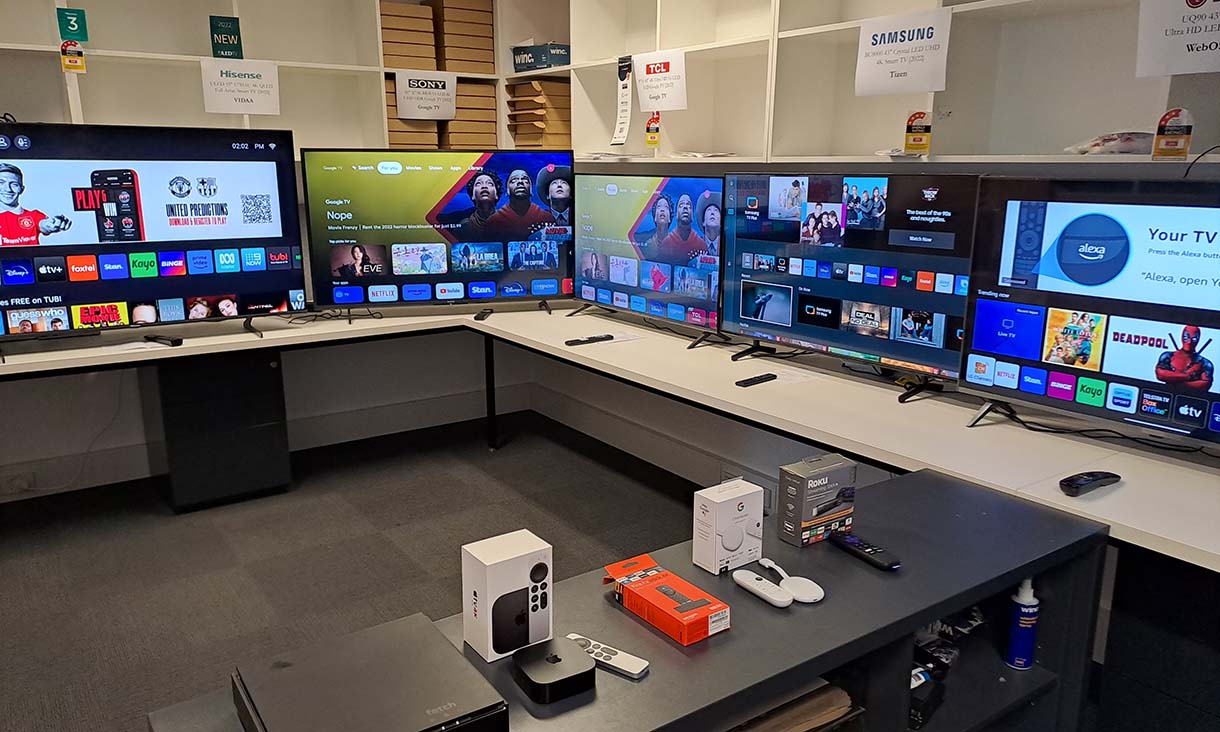
The research combined diverse methods to gather detailed data on local service visibility and user behaviour, including smart TV lab testing at RMIT; a nationally representative survey of smart TV users to explore audience exposure, expectations and navigation journeys; interviews with electronics retailers; and industrial analysis.

“While there is widespread enthusiasm for connected TV culture in Australia, smart TV operating systems are evolving in ways that warrant regulation,” said Dr Scarlata.

The researchers found that global services were receiving far greater prominence on connected TV devices, and being preferenced during search, as compared to local Australian platforms.

“For example, international services like Netflix and Disney+ are doing big global deals to be front and centre on every major smart TV, to sometimes be unmoveable or undeletable, and to have a shortcut button featured on the remote control,” said Dr Scarlata.

“However, the pre-installation and visibility of Australian services on smart TVs was patchy,” she said.

Dr Alexa Scarlata, School of Media and Communication at RMIT

Key findings

The team found evidence of ‘widespread self-preferencing, partner-preferencing, search and recommendation bias, poor integration of third-party apps, and prioritisation of advertiser content over relevant local content in smart TV interfaces.’

Dr Scarlata said that this is particularly problematic because Australian smart TV users vary widely in their competencies and confidence.

“Our research found that a quarter of Australian smart TV users do not know how to download apps, adjust their privacy settings, or customise the order of apps on their TV. These users, what we call ‘defaulters’, are the group most impacted by a smart TV’s default settings – if their Samsung or LG smart TV does not come with ABC iview already pre-installed, they may not have access to this key service.”

Research activity and engagement

Dr Scarlata said that after conducting the Australia-first empirical research on smart TV interfaces and users, the team worked with stakeholders to translate these findings into actionable policy.

Activities included:

  • Briefings on the research findings to the ABC, SBS, Free TV, ACCC, ACMA, Department of Communications, Screen Australia, and Screen Producers Australia.
  • Submitted the "Smart TVs and local content prominence" report to the Government’s Prominence Framework for Connected TV devices.
  • Dr Scarlata and Professor Lobato were invited to provide evidence about this research at the Senate Inquiry into the Communications Legislation Amendment (Prominence and Anti-siphoning) Bill 2024.

Key recommendations to boost local content discoverability

The research insights informed the team’s policy recommendations to regulators and government, providing essential guidance amidst debates between broadcaster and manufacturer stakeholders over visibility and revenue control.

Key recommendations included:

  • Manufacturers should be required to pre-install BVOD apps on all smart TVs and designated connected TV (CTV) devices sold in Australia.
  • An ABC iview shortcut button should be required to be installed on the remote controls of all smart TVs and CTV devices, where 2 or more shortcuts exist.
  • An ad labelling system should be introduced so that consumers can distinguish between paid advertising and organic recommendations in smart TV devices
  • Government should work with the ACCC to introduce prohibitions on self-preferencing in smart TV recommendations and search results, ensuring a level playing field between in-house and third-party services.

Research outcomes and impact

The research findings were key to informing the Australian Government’s new legislation introduced in 2024, which ensures that smart TVs prominently display local content and provide easy access to free BVOD services.

“In our view, the purpose of such regulation is threefold: to ensure a minimum level of visibility for Australian broadcasters, and especially for public-service broadcasters; to enhance consumer welfare for smart TV users; and to minimise misleading and deceptive practices by manufacturers and platforms,” said Dr Scarlata.

“Regulation needs to achieve these objectives while respecting user autonomy and minimising market distortion,” she said.

Next steps

Given Australians are increasingly accessing free-to-air television via BVOD services, Dr Scarlata and team are now expanding their research, conducting a comprehensive analysis of these unregulated services to gain insights into their operation, use and impact.

Funding acknowledgement

The project formed part of the Australian Research Council Future Fellowship project, ‘Australian Television in the Smart TV Ecology’ (led by Professor Ramon Lobato) and responded to the Australian Government’s Prominence Framework for Connected TV Devices Proposals Paper.

The TV testing lab at RMIT

Key contacts

SDGs

sdg11
sdg11
sdg11

Read related RMIT impact stories


Connect with RMIT Research

If you're not sure how you can best work with us, our team can explain what's possible and put you in touch with the right person. 

aboriginal flag float-start torres strait flag float-start

Acknowledgement of Country

RMIT University acknowledges the people of the Woi wurrung and Boon wurrung language groups of the eastern Kulin Nation on whose unceded lands we conduct the business of the University. RMIT University respectfully acknowledges their Ancestors and Elders, past and present. RMIT also acknowledges the Traditional Custodians and their Ancestors of the lands and waters across Australia where we conduct our business - Artwork 'Sentient' by Hollie Johnson, Gunaikurnai and Monero Ngarigo.

More information