Vice-Chancellor's Indigenous Doctoral Fellow (VCIDF) Scheme


Applications for RMIT Vice Chancellor’s Indigenous Doctoral Fellow (VCIDF) Scheme is now OPEN
or contact the VCIDF recruitment team at VCIDF@rmit.edu.au.
The Vice-Chancellor’s Indigenous Doctoral Fellow (VCIDF) position provides an opportunity for emerging researchers to undertake research activities directed towards the completion of a PhD with concurrent appointment to a 4-year fixed-term Level A position. VCIDF candidates/employees will be required to meet all requisite PhD milestones and complete their PhD within the appointment term.
VCIDF scheme supports Aboriginal and Torres Strait Islander scholars to lead research that shapes knowledge, communities, and institutions. It responds to national priorities to boost Indigenous participation, retention, and success in higher education, as outlined in the Universities Australia Indigenous Strategy and the Australian Universities Accord.
By investing in Indigenous-led research from the very start of the academic journey, RMIT's VCIDF scheme ensures fellows can set their own research agendas, advance Indigenous knowledges, and influence institutional culture. Aligned with RMIT’s ‘Grow Our Own’ strategy, the scheme provides structured early-career pathways, combining mentorship, professional development, and cohort-based support to tackle barriers like isolation, underrepresentation, and limited tailored guidance.
Through the VCIDF scheme, RMIT is helping meet national targets for Indigenous HDR enrolments and completions, while fostering long-term academic leadership and research excellence.
The scheme is offered under the ‘Special Measures’ provision of the Equal Employment Opportunity Act 2010 and is open exclusively to Aboriginal and/or Torres Strait Islander applicants. Confirmation of Aboriginal and/or Torres Strait Islander heritage is required once an offer is made.
This is the VCIDF PhD and Employment Lifecycle:
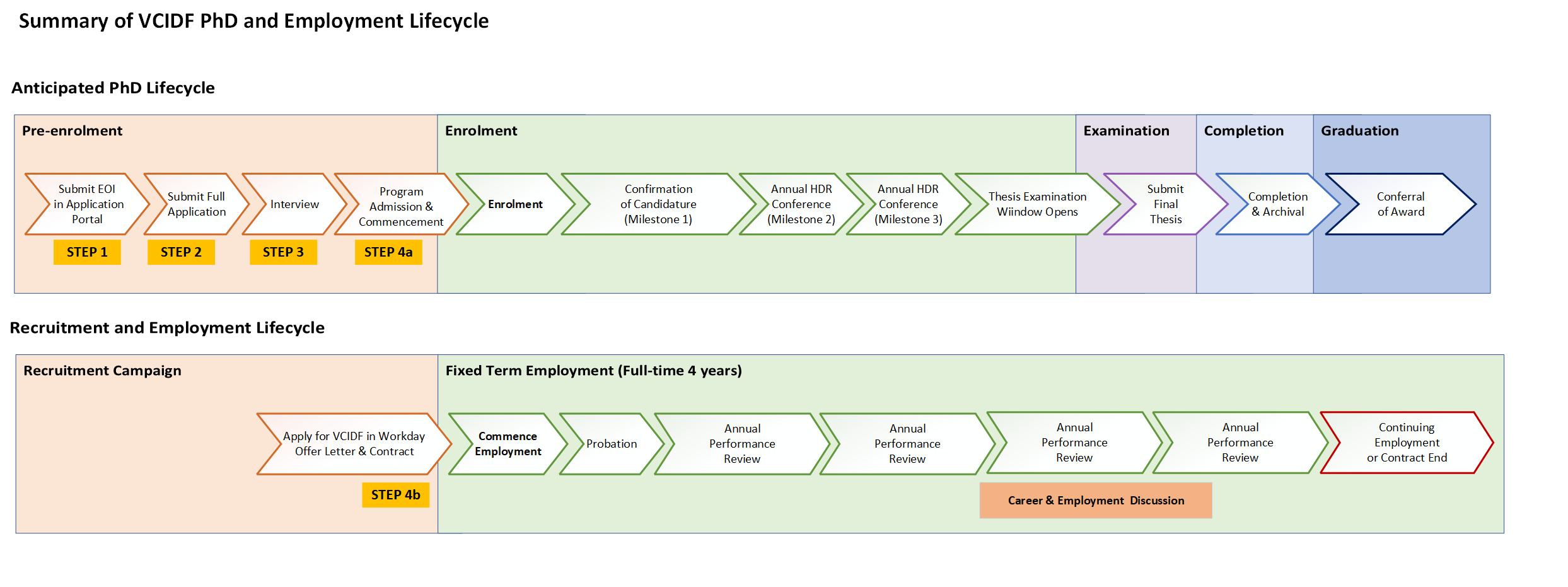
To be eligible for a VCIDF applicants must meet the following requirements:
*At RMIT a grade of distinction represents academic achievement of 70% or higher and a high distinction is 80% or higher.
For assistance on determining your eligibility, please contact the SGR Admissions and Scholarships team via email at VCIDF@rmit.edu.au.
Do you already know your preferred research area or topic?
Alternatively, if you haven’t identified a specific project, explore the Available Research Projects list to discover potential topics and supervisors.
Download the VCIDF Position Description (PDF 235KB) to determine your suitability for the role based on defined Selection Criteria, duties and responsibilities.
The Statement of Purpose template needs to be uploaded to the PhD application portal as one of the supporting documents.
Download the Statement of Purpose (SoP) template (PDF 291KB)
Our graduate research and recruitment specialists are here to guide you through every step of the process.
If you require support or have questions, please contact the recruitment team at VCIDF@rmit.edu.au.
There are two key processes you will follow (see diagram above).
More information and entitlements about the RIHS can be found here.
|
|
Key Dates |
|
2027 Scheme opens for Expressions of Interest (EOI) for the role of Vice-Chancellor’s Indigenous Doctoral Fellow |
27 July 2026 |
|
Deadline for submission of Expression of Interest (EOI) and all associated documents |
30 September 2026 |
|
Full application Deadline |
31 October 2026 |
|
Interviews by Selection Panel |
From 18 November 2026 |
|
School of Graduate Research sends Conditional Letters of Offer for admission into PhD program |
From 27 November 2026 |
|
Successful Prospective VCIDFs- Apply via HR application portal |
27 November 2026 |
|
HR Application (Workday) application Closing Date |
4 December 2026 |
Submit a scanned copy of a valid certified identification document with your photo (passport or equivalent).
Prospective candidates must apply using their full legal name (as reflected in their passport) or a valid identification document.
Your CV should clearly indicate the starting and end dates and country of all our education, work and research experiences. This can also include scholarships and awards, relevant employment, and publications/exhibitions/performances.
Publications where applicable should be included in your CV. You can only include publications that have been accepted, are in-press or have been published.
Supporting documents can include:
A copy of your CV/resume, Proof of acceptance or publication of peer reviewed article, or book/book chapter, copies of conference abstracts and the front pages (including contents page) for each publication.
Provide scanned copies of your official academic transcripts for all completed qualifications.
Transcripts must display grades achieved during exam periods, along with dates corresponding to completed degrees.
Include an explanation of the scoring system (minimum and maximum grades), clearly indicating the passing threshold. This can be satisfied by providing the University with a grading scale from your institution(s).
Academic records not written in English must be accompanied by a certified English translation.
Preferred translations are those made by NAATI-qualified translators or official translation services.
If you are still completing a qualification, upload a provisional degree certificate or a document from your institution confirming your current status.
Once completed, you must submit your final transcript and any examiners’ reports (if applicable).
If you have completed an ungraded Research Masters, upload examiners’ reports along with your academic transcript (if available).
Along with your research proposal, you will need to clearly indicate your proposed research title or area of interest. Please also specify the supervision team involved in your supervision team across both institutions.
Supporting documents required can include: Invitation to Apply, Research Proposal, Sponsorship/scholarship letter (where applicable).
Certified English Proficiency Certificate or other proof of English proficiency, if English is not your first language. Please not that "English as a first language" refers to being a citizen in a country that has English as their primary language. You can qualify as "English as a first language" if you are a citizen from any of the countries that are listed on our recognised qualifications page.
Note: If your English proficiency certificate is not yet available, you may attach evidence of your commitment to present a valid test (proof that you booked the test). Failure to submit a valid certificate that complies with the minimum criteria may lead to rejection of your application.
All applicants must meet RMIT’s English language Proficiency (ELP) requirements. English tests must be valid at the point of commencement.
Supporting documents required can include evidence of meeting ELP requirements, if applicable (e.g. test report form, letter from institution confirming studies were completed in English).
A: Language Proficiency Test taken within the last 2 years, please view our English language proficiency test page for RMIT accepted tests.
B: Successful completion of a postgraduate qualification from an accredited university or institution where:
i. English was the medium of instruction and assessment of study, and
ii. the final year of university study was completed during the five years immediately prior to the commencement of study at RMIT University.
(you must attach a letter from your university that clearly indicates that medium of instruction was in English)
C: Successful completion of at least two years of full-time (or part-time equivalent) university study from an accredited university or institution where:
i. English was the medium of instruction and assessment of study, and
ii. the final year of university study was undertaken during the two years immediately prior to commencement at RMIT.
(you must attach a letter from your university that clearly indicates that medium of instruction was in English)
D: Evidence of professional experience and/or academic publications in English, such as:
i. sustained work for two years immediately prior to commencement at RMIT in a country where English is an official language
ii. authorship or co-authorship of at least two English language peer-reviewed journal articles or a book chapter written and published in English within the three years prior to commencement at RMIT.
(you must attach copies of your published papers)
Some of the documents that are sent during your application must be certified.
When you apply through a RMIT-registered agent, they will send certified documents to RMIT University directly- so they may work with you on certifying documents as part of your application.
To submit a copy of a document, you need to get a trusted person to verify that the copy you’re providing is an accurate reflection of the original. They would do this by sighting the original document, checking that the copy aligns to the original, then certifying each page (this is important) of the documentation.
They should do this by making each page of the copy includes:
For documents submitted from outside Australia, the following people are trusted:
Documents certified by:
A letter of financial guarantee is only applicable if you are an international applicant being sponsored to come to RMIT to complete your research degree.
|
|
Program supported |
Eligibility |
Duration |
Stipend |
Additional |
Tax status |
|
PhD or Masters |
Std PhD or Masters eligibility PLUS Indigenous eligibility |
PhD 3.5 years FT Masters 2yrs FT
|
$47,821 per annum pro rata (full-time study, 2025 rate) |
|
Full-time tax exempt Part-time not tax exempt |
|
|
PhD ONLY |
Std PhD eligibility PLUS Indigenous eligibility |
4yrs |
Level A salary |
|
Not tax exemptFull-time or Part-time |

If you have any questions, please contact:
Andrew Gaff
Manager, HDR Admissions, Scholarships and Examinations
Andrew.gaff@rmit.edu.au


RMIT University acknowledges the people of the Woi wurrung and Boon wurrung language groups of the eastern Kulin Nation on whose unceded lands we conduct the business of the University. RMIT University respectfully acknowledges their Ancestors and Elders, past and present. RMIT also acknowledges the Traditional Custodians and their Ancestors of the lands and waters across Australia where we conduct our business - Artwork 'Sentient' by Hollie Johnson, Gunaikurnai and Monero Ngarigo.
Learn more about our commitment to Aboriginal and Torres Strait Islander peoples