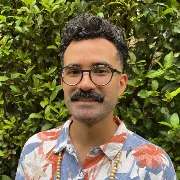
Dr. Alexandre da Silva Faustino
Details
 College: School of GUSS
 Department: School of GUSS
 Campus: City Campus Australia
 alexandre.faustino@rmit.edu.au


Open to
- Masters Research or PhD student supervision
- Collaborative projects
- Join a web conference as a panellist or speaker
- Industry Projects
- Media enquiries
About
Dr Alexandre Faustino (he/him) is a Vice-Chancellor Postdoctoral Research Fellow investigating how waterscapes - the ways humans and more-than-humans relate with water - can be re-imagined, lived and governed with socio-ecological justice.
Coming from Brazil, Alex is based at RMIT University Centre for Urban Research (CUR) in Naarm (Melbourne), having completed a Ph.D. in Urban Geography at the School of Global, Urban, and Social Studies. Alex has experience teaching within the school’s portfolio of Sustainability and Urban Planning, and he currently co-convenes Praxis Lab RMIT, CUR Early Career Academics Network, and is a Deputy Associate Director for CUR’s theme of Geographies of Land, Home and Place. In 2024 he collaborated with Professor Chris Speed in the conceptualisation and development RMIT Regenerative Futures Institute. He is also a founding member of the Alliance for Praxis Research (APR), a scholar and creative activist collective based in Melbourne dedicated to cultivating radical pedagogies and nurture transdisciplinary grassroots networks through practices of university extension.

Research fields
- 4406 Human geography
- 3304 Urban and regional planning
- 41 Environmental sciences
- 440612 Urban geography
- 440601 Cultural geography
- 330405 Public participation and community engagement

UN sustainable development goals
- 6 Clean Water and Sanitation
- 11 Sustainable Cities and Communities
- 13 Climate Action

Academic positions
- Vice-Chancellor Postdoctoral Research Fellow
- RMIT University
- Centre for Urban Research
- Melbourne, Australia
- 25 Feb 2025 – Present
- Research Officer
- RMIT University
- School of Design
- Melbourne, Australia
- 5 Feb 2024 – 23 Feb 2025
- Lecturer in Sustainability and Urban Planning
- RMIT University
- School of Global, Urban and Social Studies / Teaching Portfolio of Sustainability and Urban Planning
- Melbourne, Australia
- 20 Jun 2023 – 20 Dec 2024
- Academic Tutor in Sustainability and Urban Planning
- RMIT University
- School of Global, Urban and Social Studies / Teaching Portfolio of Sustainability and Urban Planning
- Melbourne, Australia
- 20 Jun 2021 – 19 Jun 2023

Research interests
With a background in environmental and urban planning, Alex’s work focuses on urban waterscapes and grassroots activism, through interdisciplinary practise-based research that intersects environmental management, climate action, ecology, planning, urbanism, geography, regeneration, and activism. His academic interests are theories and practices of urban water governance that can deliver regenerative and caring environments, and the role of local communities and grassroots activism in the pursuit of libertarian modes of urban and planetary dwelling.
As part of RMIT Vice-Chancellor Postdoctoral Fellowships, Alex has established since 2025 a research program on “Caring with regenerative waterscapes”.
Intensifying and escalating disasters worldwide – of political, social, economic and ecologic dimensions – assert the current epoch of polycrisis, and the emergence of what has been framed as the regenerative paradigm, a promising way to reposition human societies in late capitalism towards ethics and practices of healing a world in ruination. This research program critically enquiries how the regenerative agenda—focusing on grassroots and community efforts—intersects with, and might be capable, or not, to advance key justice agendas: Indigenous, climate, water and urban.
Based on a case study of Melbourne’s waterscape as a living bioregion, Alex uses a mixed-methods strategy, combining a comprehensive mapping of the metropolitan waterscape (considering socio-economic, bio-geo-physical, historical, cultural and political dimensions) with a detailed and relational qualitative study of the constellation of grassroots and community engagements for restoration, repair and care of waterways socio-ecologies. Grassroots actors—river keepers, community groups, and cultural associations—are already vital players in the regenerative turn.
This program investigates how activism driving regenerative change is shaped by unique social identities, non-dominant economies and it is also catalysed by disruptive processes of reconnection to place. Furthermore, this work pays attention to how these groups are building responsible practices in their regenerative engagements, seeking to expose the barriers that continue to perpetuate harm and marginalisation to human-water relations. This is critical in understanding both the potential and the limitations of the regenerative movement.




