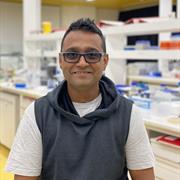
Professor Rajesh Ramanathan
Details
 College: School of Science
 Department: School of Science
 Campus: City Campus Australia
 rajesh.ramanathan@rmit.edu.au
 ORCID: 0000-0002-8500-9148
Open to
- Masters Research or PhD student supervision
- Collaborative projects
- Media enquiries
- Industry Projects
About
Professor Rajesh Ramanathan is an interdisciplinary scientist and research leader working at the intersection of nanotechnology, biosensing, and advanced materials. He is Deputy Head (Research and Infrastructure) in the Department of Applied Chemistry and Environmental Science at RMIT University and co-leads the NanoBiotechnology Research Laboratory.
His research focuses on developing next-generation nanozyme technologies, rapid point-of-care diagnostics, antimicrobial materials, and functional nanomaterials for healthcare and environmental applications. His work combines materials chemistry, biotechnology, and translational engineering to create practical technologies with real-world impact.
Professor Ramanathan has secured more than $22 million in research funding through major national and industry-linked programs, including ARC and CRC-P initiatives, and has established strong collaborations with industry, hospitals, and government agencies. His team develops technologies targeting infectious disease detection, antimicrobial resistance, chronic disease diagnostics, and smart therapeutic materials.
He has authored over 90 peer-reviewed publications, holds multiple patents, and has received international recognition for both scientific excellence and research translation. His work has been featured extensively in global media and continues to shape emerging directions in nano-enabled diagnostics and antimicrobial technologies.
Key Awards
2022 - Hartung Lecturer Award, Royal Australian Chemical Institute VIC Branch
2022 - Rising Star Award, Ruia College Alumni Association & the Ramnarain Ruia Autonomous College, Mumbai, India
2019 - Philip Law Postdoctoral Award for Physical Sciences, Royal Society of Victoria
2018 - AkzoNobel Chemical Start-up Finalist, Imagine Chemistry collaborative innovation challenge (Nouryon)
2017 - Vice Chancellor Research Excellence Award, RMIT University
2017 - Design to Improve Life Award Finalist, INDEX, Denmark (Rated top 50 life changing innovative designs from 1400 nominations across 85 countries)
2016 - Hitachi Social Impact Prize – Connected Health, Hitachi Social Innovation Awards
2016 - Global Media Star, RMIT University

Media

Research fields
- 310607 Nanobiotechnology
- 4018 Nanotechnology
- 340108 Sensor technology (incl. chemical aspects)
- 340301 Inorganic materials (incl. nanomaterials)

UN sustainable development goals
- 3 Good Health and Well Being
- 7 Affordable and Clean Energy
- 11 Sustainable Cities and Communities

Academic positions
- Deputy Head Research and Infrastructure
- RMIT University
- Department of Applied Chemistry and Environmental Science
- Melbourne, Australia
- 1 Apr 2026 – Present
- Professor
- RMIT University
- School of Science
- Melbourne, Australia
- 1 Jan 2024 – Present
- Associate Professor
- RMIT University
- Melbourne, Australia
- 1 Jan 2021 – 31 Dec 2023
- Senior Research Fellow
- RMIT University
- Melbourne, Australia
- 1 Jan 2018 – 31 Dec 2020
- Group Leader, NanoBiotechnology Research Laboratory
- RMIT University
- Melbourne, Australia
- 1 Jan 2017 – Present
- Vice Chancellor Research Fellow
- RMIT University
- Melbourne, Australia
- 1 Aug 2015 – 30 Jun 2018
- Endeavour Research Fellow
- University of Massachusetts Amherst
- Amherst Center, United States
- 1 Nov 2014 – 30 Jul 2015
- Postdoctoral Research Fellow
- RMIT University
- Melbourne, Australia
- 30 Oct 2012 – 30 Oct 2014

Non-academic positions
- Branch President
- Royal Australian Chemical Institute
- North Melbourne, Australia
- 1 Nov 2022 – 30 Nov 2024
- Branch Vice President
- Royal Australian Chemical Institute
- North Melbourne, Australia
- Nov 2020 – Oct 2022
- Branch Treasurer
- Royal Australian Chemical Institute
- North Melbourne, Australia
- Oct 2018 – Nov 2020

Supervisor projects
- NanoZyme sensors for color-based environmental food and clinical analysis
- 15 Jan 2026
- Stimuli responsive nanozymes as a viable alternative to natural enzymes for industrial applications
- 19 Dec 2025
- NanoZyme Sensors for Color-Based Environmental, Food, and Clinical Analysis
- 12 Dec 2025
- Nanosensors for point-of-care detection of environmental, food, agriculture, and clinical analytes.
- 1 Dec 2025
- NanoZyme sensors for Color-based Environmental, Food, and Clinical Analytes
- 1 Dec 2025
- NanoZyme sensors for Color-based Environmental, Food, and Clinical Analytes
- 17 Sep 2025
- Upcycling Polyethylene Terephthalate Waste into Hemostatic and Antibacterial Hydrogel Dressings
- 21 Aug 2025
- Design and Fabrication of Molecularly Imprinted Polymer based Sensors for Detection of Environmental and Biological Analytes
- 13 Aug 2025
- Two-Dimensional Nanocomposites based Electrochemical Immunosensor for Detection of Viral Disease Biomarkers
- 6 Aug 2025
- Green technology for mitigating sulfur emission from fuels using microbial biopolymers and nanozyme based materials
- 5 Aug 2025
- Metal Oxide Coated Laser-Induced Graphene Based Electrodes for Flexible and Highly Efficient Supercapacitors
- 1 Aug 2025
- Development of Electrochemical Sensing Platforms for Health and Environmental Monitoring Applications
- 22 May 2025
- Stimuli responsive dressings for antimicrobial and antibiofilm applications
- 21 Jan 2025
- Performance Optimisation of Molecularly Imprinted Polymers Nanoparticles Based Conductometric Biosensors for Cardiac Biomarker Detection
- 19 May 2024
- Nanosensors for point-of-care detection of environmental food agriculture and clinical analytes
- 30 Oct 2023
- NanoZyme sensors for color-based environmental food and clinical analysis
- 18 May 2023
- Phytochemical(s)-functionalized Molybdenum Oxide in Theranostics: Bio-Nanointerfaced System for Cellular Oxidative Stress Control and Inflammatory Biomarker Detection
- 17 Mar 2023
- Development of Electrochemical and Optical Sensing Methodologies for Food Toxicants
- 5 Jan 2023
- Structural Investigations on Rare Earth Oxides & Scandates under Extreme Conditions of Pressure and Temperature
- 1 Feb 2022
- Metal-Seeded Lithium Niobate Nanoparticles As Hybrid Nanozymes for Mimicking Bioactivity
- 17 Sep 2020
- Plasmonic Modulation of Spatially Confined Reactions on a Silver Nanoprism
- 28 Nov 2019
- Nanozyme-Based Colorimetric Sensors for the Detection of Urinary Biomarkers of Early Onset Diabetes and Renal Deterioration
- 20 Nov 2019
- Free-standing Cu-based NanoZymes for colorimetric sensing of glucose in human urine
- 16 Oct 2019
- Surface-engineered Superparamagnetic Iron Oxide Nanoparticles as Superior Biomedical Imaging Agents
- 7 Jun 2019
- Tuning the Key Determinants of 2-Dimensional Transition Metal Electrocatalysts for Oxygen Evolution Reaction
- 27 Sep 2018
- Understanding the Interactions Between Nanozymes and Aptamers to Rationally Design Aptasensors for the Detection of Ampicillin in Milk Samples
- 25 Sep 2018
- Chemical and Structural Stability of Liquid-Phase-Exfoliated (LPE) Two-Dimensional (2D) Materials
- 25 Sep 2018
- Understanding the Mechanism of AlphaSynuclein Proteotoxicity and Development of Sensor for Detection of Alpha-Synuclein Conformers
- 13 Aug 2018
- Metal-organic Semiconducting Charge Transfer Complexes Based on TCNQFx (x= 0 and 4) for Electron Transfer Reactions
- 27 Oct 2017
- Investigating the Biomolecular Dynamics of Human Serum Components upon Their Interaction with Different Nanoparticles
- 3 Jul 2017
- Nanoparticle-Enabled Efficient Spectroscopic Techniques For Biomolecules Detection
- 15 Feb 2016
- Photomodulation of light responsive materials for biological applications
- 20 Apr 2015
- Modulating the NanoZyme activity for antibacterial and sensing applications
- 2 Mar 2015
- Triethylamine: a versatile ligand to control the properties of nanomaterials
- 5 Jan 2015

Teaching interests
Professor Rajesh Ramanathan is an experienced educator with extensive teaching, curriculum development, and program management experience.
His teaching philosophy focuses on creating engaging, research-informed, and industry-relevant learning experiences that support students from diverse academic and cultural backgrounds. He is passionate about integrating real-world applications, emerging technologies, and translational research examples into teaching to enhance student engagement and employability.
He has contributed to curriculum design and delivery across undergraduate and postgraduate courses in analytical chemistry, nanotechnology, materials chemistry, and biosensing. As Program Manager for the Bachelor of Science, he led initiatives focused on curriculum redesign, student experience, and academic quality enhancement.
Professor Ramanathan has supervised more than 20 HDR completions across interdisciplinary fields spanning chemistry, biology, materials science, and engineering, with graduates progressing into successful academic, industry, and government careers. He is committed to mentoring students and early career researchers and fostering collaborative, inclusive, and supportive research and learning environments.

Research interests
Professor Rajesh Ramanathan’s research focuses on the development of advanced nanomaterials, biosensing technologies, and translational diagnostic platforms for healthcare and environmental applications. His work sits at the intersection of analytical chemistry, nanotechnology, materials science, and biotechnology, with a strong emphasis on translating fundamental research into practical technologies with real-world impact.
Key Research Areas
Nanozymes and Functional Nanomaterials
Design and development of enzyme-mimicking nanomaterials for sensing, catalysis, antimicrobial therapy, and biomedical applications.
Point-of-Care Diagnostics and Biosensing
Development of rapid, low-cost diagnostic technologies using aptamers or antibodies, nanozymes, and nanomaterials for infectious disease detection, antimicrobial resistance profiling, and chronic disease monitoring.
Antimicrobial and Wound Management Materials
Engineering light-activatable and stimuli-responsive antimicrobial materials for infection control, biofilm eradication, and advanced wound care applications.
Laser-Induced Graphene and Electrochemical Technologies
Development of laser-induced graphene-based materials and electrochemical sensing platforms for energy, catalytic, and biosensing applications.
Nano-Bio Interfaces
Understanding interactions between nanomaterials and biological systems, including nanoparticle-protein interactions, biomolecular dynamics, and surface-engineered nanomaterials.
Translational Nanotechnology
Industry-linked development of scalable sensing and diagnostic technologies for healthcare, food safety, environmental monitoring, and wearable systems.
His research has contributed to the development of next-generation diagnostic technologies, smart antimicrobial materials, and nano-enabled sensing systems through collaborations with industry, hospitals, and government agencies.