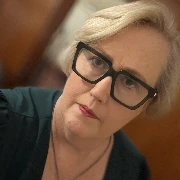
Professor Alexandra Wake
Details
 College: School of Media & Communication
 Department: School - Media & Communication
 Campus: City Campus Australia
 alex.wake@rmit.edu.au


Open to
- Media enquiries
- Masters Research or PhD student supervision
About
Professor Alexandra Wake is a senior academic leader, educator, researcher and media professional whose career spans higher education, journalism, government and international engagement. She is Professor of Journalism in RMIT University's School of Media and Communication, Program Manager of the Graduate Diploma in Journalism, President of the Journalism Education and Research Association of Australia (JERAA), a member of the World Journalism Education Council, and is serving her third term on the RMIT University Academic Board. Her leadership interests centre on academic governance, institutional strategy, policy development, industry engagement and the future of media and communication education.
Over more than four decades, Professor Wake has built a reputation as an influential leader in journalism and communication education, combining scholarly excellence with deep industry engagement and public impact. She has taught and led programs at RMIT University, Deakin University and Dubai Women's College, and has been invited to contribute to curriculum reform, academic quality processes and professional education initiatives in Australia and internationally. Her work has consistently focused on preparing graduates for leadership in rapidly changing media, communication and creative industries.
Professor Wake has extensive experience building partnerships across universities, industry, government and community organisations. She has worked on international development and capacity-building projects in countries including South Africa, Solomon Islands and Myanmar, and has collaborated with media organisations, professional bodies and advocacy groups on initiatives that strengthen journalism, communication and democratic participation. Through leadership roles in national and international organisations, she has contributed to policy discussions, professional standards, curriculum innovation and workforce development.
Before entering academia full-time, Professor Wake spent more than 25 years as a journalist, editor, broadcaster and media executive working across Australia, the Asia-Pacific and the Middle East. She held senior editorial and production roles within the ABC and other major media organisations and has also worked in government as a senior adviser to an education minister. These experiences continue to inform her leadership approach and provide strong connections across industry, government and the wider public sector.
An internationally connected scholar and educator, Professor Wake has held appointments as a Visiting Scholar at Columbia University and an Academic Fellow at the Constructive Institute at Aarhus University. She plays leadership roles in global journalism education networks, including the World Journalism Education Council, and is an active participant in international collaborations focused on higher education, media innovation, gender, technology and democratic communication.
Professor Wake's research examines the intersection of media, communication, leadership, wellbeing, diversity and technological change. She is internationally recognised for her work on journalism and trauma, media ethics, newsroom culture and journalism education, and is committed to research that informs professional practice, public policy and social impact. She is Oceania Co-Leader of the UK-based Journalism Education Trauma Research Group, a member of the Dart Centre Asia Pacific, an adviser to Mindframe for Journalists, and a participant in the UNESCO UniTWIN Network on Gender, Media and ICTs.
Throughout her career, Professor Wake has been a strong advocate for the role of universities, independent media and public-interest communication in democratic societies. Her leadership is characterised by a commitment to academic excellence, industry relevance, collaborative partnerships and creating opportunities for students, staff and communities to thrive in periods of significant social and technological change.
Grants:
Professor Wake is working on a range of Australian Government funded projects, but is equally happy working with small industry partners on significant projects.
Australian Journalism, Trauma and Community (externally led by Monash University). Funded by: ARC Discovery Projects 2023 via Other University from (2024 to 2027)
Mitigating the impact of the media on stigmatising attitudes towards people with severe mental illness (administered by the University of Melbourne). Funded by: NHMRC - Investigator Grants from (2024 to 2028)
Working with an interdisciplinary group she has received RMIT and industry funds to run a pilot program and symposium Carrying the Story: a newsroom trauma prevention program in 2026-27.
Fellowships:
- Visiting Scholar, School of International and Public Affairs, Columbia University
- Academic Fellow, Constructive Institute, Aarhus University, Denmark
- Academic Fellow, Dart Centre for Journalism and Trauma (Asia Pacific), Columbia University Graduate School of Journalism
Awards:
Professor Wake has received multiple awards for industry, teaching, service and research as an individual and as part of larger teams including: RMIT School of Media and Communication Dean’s Award for Indigenous Engagement (2023); Dean’s Award for Impact and Engagement (2022); Top Performer, Media Star Award (Design and Social Context) RMIT University, (2022); Commendation, Media Star Award (Design and Social Context), RMIT University (2021); Dean’s Award for Award for Indigenous Engagement (2020); Dean’s Award for Program for Impact and Engagement (2020); Commendation, Media Star Award (Design and Social Context), RMIT University (2020); Top Performer, Media Star Award (Design and Social Context), RMIT University (2020); Media Star Award (Design and Social Context), RMIT University. (2017); RMIT University Teaching Award for Programs that Enhance Learning (Graduate Outcomes). (2015); Long-listed for a Walkley Grant for Innovations in Journalism, from the national association of Australian journalists the MEAA (2015).

Research fields
- 4701 Communication and media studies
- 470105 Journalism studies
- 470104 International and development communication
- 529999 Other psychology not elsewhere classified

UN sustainable development goals
- 10 Reduced Inequalities
- 4 Quality Education
- 8 Decent Work and Economic Growth
- 9 Industry, Innovation and Infrastructure
- 3 Good Health and Well Being

Academic positions
- Academic Board
- RMIT University
- Australia
- 1 Jan 2025 – 31 Dec 2027

Supervisor projects
- The core tensions between authoritarian regimes and public interest media - a lived experience across the Asia Pacific, North America and Africa
- 17 Jul 2026
- Institutional Messaging and Public Trust in Health Communication
- 11 Mar 2026
- Podcasting against the pipeline: How does misinformation within Australian digital wellness and lifestyle media forge gendered pathways toward tradwife culture and alt-right radicalisation, and how can podcast journalism function as an intervention?”
- 2 Mar 2026
- The Camera Doesn't Lie? Visual Censorship in a Time of War
- 18 Feb 2026
- Meta and Third-Party Fact-Checking: An Insider’s Perspective on Journalism’s Fight Against Mis/Disinformation in the Face of Censorship Narratives
- 9 Dec 2024
- Staying with the trauma: reconsidering how soundwork creators communicate climate change
- 20 Sep 2024
- Saudi Arabia's Public Diplomacy in Enhancing its International Image (Case study of Saudi Arabia Public Diplomacy and International Image in Australia)
- 13 Feb 2024
- Mocking the News: How Australian Satirical News Podcasts Reframe Objectivity, Credibility, and Critique
- 8 May 2023
- Toward Cultural Competence: Health Journalism on Traditional Chinese Medicine in Multicultural Australia
- 22 Mar 2023
- Swimming Beyond Sport: Relationship-Building in the China–Australia Engagement
- 8 Mar 2023
- AI in Saudi newsrooms: navigating new technology in journalism practice
- 5 Dec 2022
- News Businesses and Innovation: An Analysis of Partnerships between Communities and News Outlets
- 10 Sep 2019
- Social Media and Citizen Journalism Challenging Journalistic Practice within the Middle Eastern Context through the Case of Oman
- 16 Oct 2017
- Islamophobia and Resistance: Reflections on Hope in an Age of Hate Crimes
- 27 Feb 2017
- Religion and the Secular Sacred in the Australian Public Sphere: A Media Analysis of the Australian Broadcasting Corporation's (ABC) Q&A Program
- 2 Dec 2016

Teaching interests
With her extensive cross platform journalism experience, Professor Wake has written or taught most journalism subjects at undergraduate and post graduate level at RMIT. She enjoys teaching those who want to work as journalists and has most recently taught:
Graduate Diploma of Journalism
News Reporting and Writing
She currently has a waiting list for PhD candidates, with 10 currently enrolled, three of whom are doing RMIT's special Practice Research Symposium model of PhDs through journalism practice.

Research interests
Professor Wake has broad research interests which are all focussed on improving journalism and working conditions for journalists. These include:
-Journalism
-Journalism practice
-Journalism and trauma
-Journalism education
-International journalism
-Journalism as foreign aid




