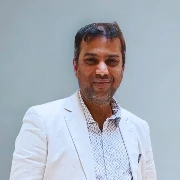
Kesava Kovanur Sampath
Details
 College: School of Health and Biomedical Sciences
 Department: Health and Biomedical Sciences
 Campus: Bundoora West Australia
 kesava.kovanur.sampath@rmit.edu.au
 ORCID: 0000-0001-9908-3659
 LinkedIn
Open to
- Collaborative projects
- Career advice
- Masters Research or PhD student supervision
- Membership of an advisory committee
- Mentoring (long-term)
- Mentoring (short-term)
About
Dr Kesava Kovanur Sampath is an Associate Professor of Osteopathy at RMIT University and a clinician-researcher focused on improving musculoskeletal pain care and clinical education. His research has a strong emphasis on thoracic spine pain, including how these conditions are defined, assessed, and managed in real-world practice. He also works in outcomes measurement (PROMs/PREMs), practice-based research, and evidence translation, partnering with educators, clinicians, and professional bodies across Australia and Aotearoa/New Zealand to develop practical tools and scalable approaches that support high-quality, patient-centred care and graduate readiness for practice.

Research fields
- 420109 Rehabilitation
- 420106 Physiotherapy
- 420899 Traditional, complementary and integrative medicine not elsewhere classified
- 4202 Epidemiology
- 3208 Medical physiology

UN sustainable development goals
- 3 Good Health and Well Being
- 4 Quality Education
- 10 Reduced Inequalities

Academic positions
- Associate Professor
- RMIT University
- Health and Biomedical Science
- Melbourne, Australia
- 28 Apr 2025 – Present
- Visiting Research Fellow
- Health Sciences University
- Bournemouth, United Kingdom
- 1 Nov 2025 – Present
- Leadership Team
- Duke University
- Durham, United States
- 12 Feb 2021 – Present
- Principal Academic Staff Member
- Waikato Institute of Technology
- Hamilton, New Zealand
- 18 Jan 2021 – 18 Mar 2025
- Visiting Research Fellow
- University of Technology
- Sydney, Australia
- 15 Jan 2021 – 31 Oct 2025

Supervisor projects
- Thoracic Spine Pain: Developing Better Evidence for Assessment and Management
- 23 Sep 2026
- Acupuncture for the treatment of advanced cancer pain
- 22 Sep 2026
- Diagnostic framework and clinical information systems in contemporary Osteopathy practice
- 17 Dec 2025
- Osteopathic treatment of the intraabdominal vascular compression Median Arcuate Ligament Syndrome and its associated effects on the autonomic nervous system.
- 2 Dec 2025

Teaching interests
My teaching focuses on preparing students for safe, evidence-informed clinical practice and supporting strong transition-to-practice outcomes. In osteopathy, I have led and coordinated key coursework, serving as Course Coordinator for RHEA2180 Osteopathy Theory and Practice in 2025 and as Course Coordinator for MEDS2208 in 2026 at RMIT University. I also supervise in the student clinic, where I integrate clinical reasoning, communication, risk management, culturally safe practice, and outcomes-focused care into day-to-day teaching and assessment. I draw on extensive prior teaching experience in physiotherapy, which strengthens my interprofessional approach and helps connect foundational science, clinical skills, and contemporary pain evidence to real-world patient care. In 2026, I am supervising two PhD candidates and welcome enquiries from prospective HDR students interested in musculoskeletal pain, clinical education, outcomes measurement, and practice-based research in osteopathy and allied health.

Research interests
My research focuses on improving the quality, safety, and real-world effectiveness of osteopathic and allied health care. A core program of work centres on thoracic spine pain (TSP): how TSP conditions are defined, assessed, and managed in practice, and how large datasets can be used to better understand their epidemiology and service impacts. I also work extensively in outcomes measurement, particularly the development and implementation of patient-reported outcome and experience measures (PROMs/PREMs) to support patient-centred, measurable care. Across my projects, I use practice-based research and implementation approaches to co-design applied studies with clinicians, universities, and professional stakeholders, and I maintain an ongoing interest in mechanisms underpinning manual therapy and how evidence can be translated into education, assessment, and readiness for clinical practice.



