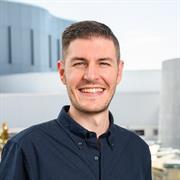
Associate Professor T J Thomson
Details
 College: School of Media & Communication
 Department: School - Media & Communication
 Campus: City Campus Australia
 t.j.thomson@rmit.edu.au


Open to
- Masters Research or PhD student supervision
- Media enquiries
- Collaborative projects
- Industry Projects
- Membership of an advisory committee
- Join a web conference as a panellist or speaker
About
Dr T.J. Thomson is an associate professor and Australian Research Council DECRA Fellow at RMIT University, where he co-leads The News, Technology, and Society Network. In an online environment saturated with visuals, from stock photos and personal snapshots to CCTV vision and AI-generated images, his research helps people understand how images are made, used, and interpreted.
T.J. undertakes research, postgraduate supervision, and media commentary in the following areas:
- visual communication
- visual culture
- visual journalism
- visual generative AI
- generative AI and journalism
- media, visual, and AI literacies
Books (academic monographs and edited collections)
T.J. is the author of a number of books and edited collections, including:
- Generative AI and Journalism: From Production to Perception (Routledge, 2026)
- Everyday Visual News: Audience Expectations, Engagements, and Meanings (Routledge, 2026)
- Living with Misinformation: A Media Literacy Approach (Routledge, 2026)
- The Routledge Companion to Visual Journalism (2025)
- To See and Be Seen: The Environments, Interactions, and Identities Behind News Images (Rowman & Littlefield, 2019)
- In Front of the Lens: The Expectations, Experiences, and Reactions of Visual Journalism’s Subjects (Journalism & Communication Monographs, 2019)
Research funding and fellowships
T.J. has obtained more than $1.5 million in research funding from a number of organisations, including the Australian Research Council, the Australian Academy of the Humanities, the Office of the Queensland Chief Scientist, the University of Nottingham Ningbo China, and the International Visual Literacy Association. He has also been awarded research fellowships in China (Ningbo) and Germany (Berlin and Bochum).
His Australian Research Council-funded research projects include:
- Amplifying Voices from the Royal Commission into Aged Care (DP210100589), focused on how visual and verbal news media coverage of older adults can be improved
- Addressing Misinformation with Media Literacy through Cultural Institutions (LP220100208), focused on identifying ordinary individuals' everyday experiences with misinformation across information modes and on advancing evidence-based responses
- Addressing the Crisis of Local Visual News in Regional and Remote Australia (DE230101233), focused on local visual news in non-urban areas and how the quality of this news can be elevated through local audience insights
Research impact and external engagement
He is one of the world's top 50 scholars in visual communication by number of citations and his research expertise has informed national policy and been sought by Google, News Corp, the Australian Broadcasting Corporation, and the Walkley Foundation. He writes extensively for The Conversation to translate research findings into publicly accessible explainers and is frequently interviewed as an expert commentator on images, visual culture, and visual journalism.
Academic leadership
T.J. is actively involved nationally and internationally in a number of Associations and initiatives that contribute to the interdisciplinary visual communication field. These include serving as the vice-chair (from 2025-27) and the chair (from 2027-29) of the International Communication Association's Visual Communication Studies Division, chairing the International Communication Association's Global Representation and Engagement Committee (2026-2029), serving as the Vice President (Research) of the Journalism Education and Research Association of Australia (since 2024), serving as an international engagement editor of Digital Journalism (since 2024), and serving on the editorial boards of Visual Communication Quarterly (since 2018) and Communication Research and Practice (since 2023).
Previously, T.J. was an officer in a number of national and international journalism and communication associations, including the Journalism Education and Research Association of Australia (as Vice President, Media), the National Communication Association (as Awards Chair of the Visual Communication Division), the Association for Education in Journalism and Mass Communication (as Social Media Chair of the Visual Communication Division), and the International Communication Association (as the international liaison and secretary of the Visual Communication Studies Division). Previously, he was also an associate editor of Visual Communication Quarterly from 2017—2025.
Awards and honours
T.J.'s peers have recognised his research and disciplinary contributions with a number of awards and honours, including the Communication and Ageing Outstanding Journal Article Award from the National Communication Association; the James Edwards Article of the Year Award from the National Communication Association; the Diane S. Hope Book of the Year Award from the National Communication Association; the Anne Dunn Scholar of the Year Award, jointly bestowed by the Australian and New Zealand Communication Association and the Journalism Education and Research Association of Australia; the Distinguished Young Alumnus Award from Chadron State College; the Mizzou Recent Alumni Honoree Award from the University of Missouri; and top paper awards from the Association for Education in Journalism and Mass Communication and the International Communication Association.
In 2022, T.J.'s peers elected him to the Queensland Academy of Arts and Sciences in recognition of his significant contributions to the academy, the professions and/or society as a whole. In 2023, the Australian Academy of the Humanities awarded him the Max Crawford Medal, the country's most prestigious award for achievement and promise in the humanities.
Industry Experience
T.J. has experience with both journalistic and corporate communication. Before entering academia, he worked as a visual journalist and designer for a number of news outlets and organizations and had his work published by The Associated Press, The Washington Post, The Huffington Post, and the Omaha World-Herald, among others.

Media

Research fields
- 4701 Communication and media studies
- 470105 Journalism studies
- 360104 Visual cultures
- 3605 Screen and digital media
- 4602 Artificial intelligence

UN sustainable development goals
- 10 Reduced Inequalities
- 16 Peace, Justice and Strong Institutions
- 4 Quality Education
- 9 Industry, Innovation and Infrastructure

Academic positions
- Digitalization Research Fellow
- Center for Advanced Internet Studies
- Bochum, Germany
- 2024 – 2024
- Digital Transformation Research Fellow
- Weizenbaum Institute / German Internet Institute
- Berlin, Germany
- 2023 – 2023
- Visiting Scholar
- University of Nottingham Ningbo China
- School of International Communications
- Ningbo, China
- 2023 – 2023

Supervisor projects
- Cultural Diversity in Public Interest: Australian Public Service Media in the Era of Personalised News Recommendations
- 21 Sep 2026
- Personalised for the public good: media, audiences, and newsroom design
- 26 Jul 2026
- The Camera Doesn't Lie? Visual Censorship in a Time of War
- 18 Feb 2026
- Towards transformative data journalism: A critical examination of data ecosystems, practices, and outputs in Indonesia and Australia
- 28 Nov 2024
- Re-imagining local journalism: Bridging the gap between practice and expectations
- 14 Dec 2023

Teaching interests
T.J. has taught theory and skills classes across communication and journalism disciplines to both undergraduate and graduate students. These classes include Principles of Journalism, Digital and Data Journalism, Mobile Multimedia Reporting, Visual Editing, Visual Journalism, Introduction to Communication, and Multimedia Design. He has taught in the U.S.A. and Australia, and has guest lectured at the University of Florida, the University of Kansas, Rutgers University, Western Sydney University, the University of Melbourne, Virginia Commonwealth University, and the University of Queensland.
He has won international awards for his teaching, including the Association for Education in Journalism and Mass Communication’s 2021 Visual Communication Teaching Excellence award and the 2022 Linda Shockley Award for Excellence in Teaching.

Research interests
A majority of T.J.'s research centres on the visual aspects of news and journalism and on the concerns and processes relevant to those who make, edit, and present visual news. He has broader interests in digital media, journalism studies, and visual culture and often focuses on under-represented identities, attributes, and environments in his research. T.J. is committed to not only studying visual communication phenomena but also working to increase the visibility, innovation, and quality of how research findings are presented, accessed, and understood.




