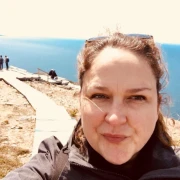
Associate Professor Marnie Badham
Details
 College: School of Art
 Department: School of Art
 Campus: City Campus Australia
 marnie.badham@rmit.edu.au
 ORCID: 0000-0002-4304-5837
 LinkedIn
About
Associate Professor Marnie Badham is known internationally for her expertise in socially engaged and public art, cultural policy and evaluation, and participatory research and creative practice methods. Through dialogic 'forms for encounter and exchange' with attention to relational ethics and care, Marnie’s research partnerships and community pedagogies often bring together disparate groups of people (artists, local communities, government) in dialogue to examine and effect local issues. Her art-research practice is co-created with long term collaborators in the context of Indigenous-settler-migrant relations, critical hospitality and food-art-politics, climate anxiety, affective engagement in public space, and creative cartographies.
Marnie leads complex multi-site and intercultural research partnerships across community, industry, and government, currently leading the interdisciplinary team for Public Art and its role in connecting people and place - The social benefits provided by public art at Sydney Metro stations with iMOVE (2025). With Vicki Couzens she co-leads community projects focused on developing ethical cultural frameworks: Listening to Country, Listening to Community: towards a co-created framework of people and place-based value and values for the Dandenong Creek Art Trail (2020-22); Sharing Oral Knowledge with Genevieve Grieves and GARUWA (2023-24); and with Jody Haines pedagogic films The Power That We Have… Listen Up! (2020) and Revisiting the Possum Skin Cloaks (2019). With Ye Lui, she co-curated the Huaniao Island Public Art Festival (2022, China-Australia) and designed consultation and writing of the NAVA Code of Practice on public art commissioning following review of 27 LGA public art policies (NAVA, 2019).
Marnie co-leads the Cultural Value Impact Network with Bronwyn Coate, is Adjunct Professor, Thompson Rivers University in Canada and serves on the Board of Directora for Res Artis: global network of artist residencies. She co-leads industry research including the ARC Linkage Ambitious and Fair: towards a sustainable visual arts sector with NAVA and AMaGA (McQuilten et al. 2021-24) and is expert advisor for public art, residencies, and funding (Canada Council, Creative Victoria, Nillumbik, Saskatchewan Arts, Cardinia, Australia Research Council, Social Sciences and Humanies Research Council). She has delivered 13 partnered evaluations including: 2025 Sydney Metro (public art and placemaking; 2024, 2022, 2017 All the Queens Men (queer seniors); 2024, 2021, Ngamumu (Indigenous mothers); 2024 MAPCo Fed Square (discovery paper); 2015 Artback NT (Indigenous dance), and 2011 Arts Access Victoria (disability access training). Marnie is widely publioshed and has co-edited books for arts practice, policy and industry Tastes of Justice: the aesthetics and politics of food-art-politics in Asia and Australia (Routledge, 2025), Visual Arts Work: sustainable strategies for the Visual Arts Sector (Springer, 2025), and Making Cultural Count: the politics of cultural measurement (Routledge, 2015).
Marnie has a PhD in Creative Arts and Cultural Policy (University of Melbourne, 2012), a Masters of Community Cultural Development (University of Melbourne, 2008) and undergraduate degrees: Bachelor of Fine Arts, Inter-media and Bachelor of Arts, Art History (University of Regina, 1996 & 1996). In her role as Associate Professor at School of Art at RMIT Univeristy, Marnie is Program Manager of Graduate Certificate of Creative and Cultural Production and specialises in teaching in art, photography, social practice, intercultural partnerships, and cultural industries.
www.marniebadham.com

Research fields
- 360103 Art theory
- 470201 Arts and cultural policy
- 4501 Aboriginal and Torres Strait Islander culture, language and history
- 3606 Visual arts
- 390101 Creative arts, media and communication curriculum and pedagogy

UN sustainable development goals
- 10 Reduced Inequalities
- 17 Partnerships for the Goals
- 8 Decent Work and Economic Growth
- 3 Good Health and Well Being
- 4 Quality Education

Academic positions
- Associate Professor
- RMIT University
- School of Art
- Melbourne, Australia
- 2023 – Present
- Senior Lecturer
- RMIT University
- School of Art
- Melbourne, Australia
- 1 Jan 2020 – 31 Dec 2022
- Vice Chancellor's Post Doctoral Research Fellow
- RMIT University
- School of Art
- Melbourne, Australia
- 1 Jan 2017 – 31 Dec 2019
- Research Fellow
- University of Melbourne
- Centre for Cultural Partnerships, Victorian College of the Arts
- Melbourne, Australia
- 1 Jan 2011 – 31 Dec 2013
- Lecturer
- University of Melbourne
- Centre for Cultural Partnerships, Victorian College of the Arts
- Melbourne, Australia
- 1 Jul 2007 – 31 Dec 2016

Non-academic positions
- Artistic Director/ General Manager
- Common Weal Community Arts
- Regina, Saskatchewan, Canada
- 1 Jan 1998 – 30 Jun 2007
- Visual Art Coordinator
- Organisation of Saskatchewan Arts Councils
- Regina, Saskatchewan, Canada
- 1 Jan 1997 – 31 Dec 2019
- Curatorial Intern/ Installations Officer
- Dunlop Art Gallery
- Regina Public Library, Central
- Regina, Saskatchewan, Canada
- 1 Jan 1994 – 31 Dec 1997

Supervisor projects
- Threads and Undercurrents: curating playful interventions for water-based placemaking and placekeeping
- 5 Sep 2025
- Decolonising action in the Australian arts and cultural sector
- 12 Aug 2025
- The Museum in the Community, the Community in the Museum: Meaningful engagement in art institutions
- 27 Feb 2025
- You’ll Know It When You Feel It: Examining How Co-Created Archives Can Resist Bureaucratic Representations of Women Whose Lives Intersect with the Prison Industrial Complex
- 7 Aug 2024
- Revisiting Lifeworld: Gaining Affective and Environmental Engagement through Socially Engaged Art between China and Australia
- 6 Aug 2024
- From The River Delta: A Journey to Understand my Bangladeshi-Australian Identity through an Interdisciplinary Art Practice by Employing Auto-Ethnography Method.
- 16 Feb 2024
- Calling to Country: Weaving Sounds and Stories of Movement
- 16 Feb 2024
- How Do Aboriginal and Torres Strait Islander Creative Cultural Practitioners in the South East Assert the Multiple Values of Their Culture and Practice to Challenge the Discourse of Indigenous Authenticity Within the Arts and Cultural Ecologies?
- 11 Aug 2021
- We Care a Lot: Artist-led Strategies Towards a New Commons for the Visual Arts
- 11 Aug 2021
- The Unshakable Destiny: A Disjointed Thread Through Hong Kong Diasporic Moving Image
- 22 Jul 2020
- I Used to Walk so Softly on this Land
- 1 Mar 2019
- Formalising the Informal? Investigating the Potential of Repurposed Public Space as Intangible Cultural Heritage
- 2 Jan 2019
- A Cuppa and a Yarn: Reclaiming Known Materialism and Collaboration as Sites of Resistance and Connection in Photo-Media
- 12 Dec 2018
- Transitory Encounters: Embodied Artistic Research to Understand the Lived Experiences of Filipino Domestic Workers in Hong Kong
- 12 Feb 2018
- Fields of Resonance: Towards Embodied Forms of Listening and Looking
- 14 Sep 2017
- Self Surveillance: Performing the plurality of my feminine experience of self.
- 24 May 2017

Teaching interests
Socially engaged arts practice and theory
Public art and placemaking
Contemporary art and photography
Creative and cultural production
Community and cultural development,
Cultural policy, cultural value and evaluation
Artist run intiatives
Expanded curation

Research interests
Socially engaged and public art
Intercultural practices
Community partnerships
Cultural policy and evaluation
Visual Arts and Crafts
Art Theory and Criticism
Policy and Administration
Performing Arts and Creative Writing
Curriculum and Pedagogy




