Carbon and climate
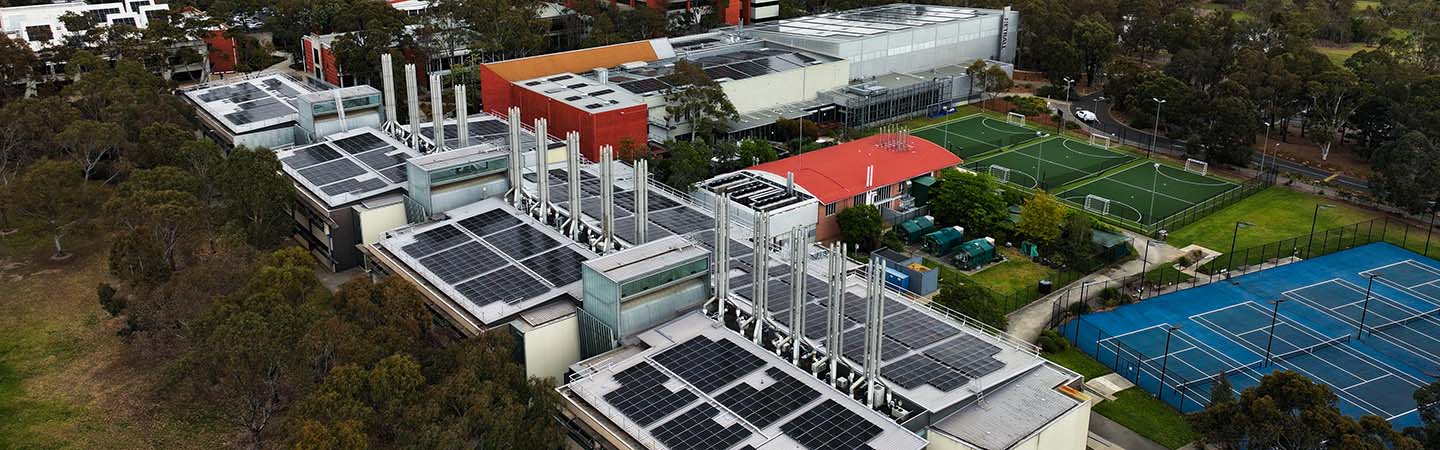
We have a longstanding commitment to climate action and have made significant progress through energy efficiency, renewable electricity, electrification and investment in our campuses. For example, since 1 January 2023, 100% of our all our onshore grid electricity has been sourced from renewables.
We are now building on this foundation by moving towards a science-based net zero pathway and strengthening our approach to climate resilience.
RMIT's approach prioritises practical action to reduce emissions at the source and strengthen resilience to climate change, through innovation, renewable energy, infrastructure improvements and better emissions data.
Our Carbon Management Plan (PDF 7 MB) provides the foundational principles for measuring, reporting and managing RMIT's greenhouse gas emissions.
RMIT follows a carbon management hierarchy that prioritises eliminating emissions from our operations in the first instance, through energy efficiency, renewable energy, electrification and sustainable design. Reducing on-site emissions can require significant planning and capital investment, particularly where existing infrastructure relies on fossil fuels.
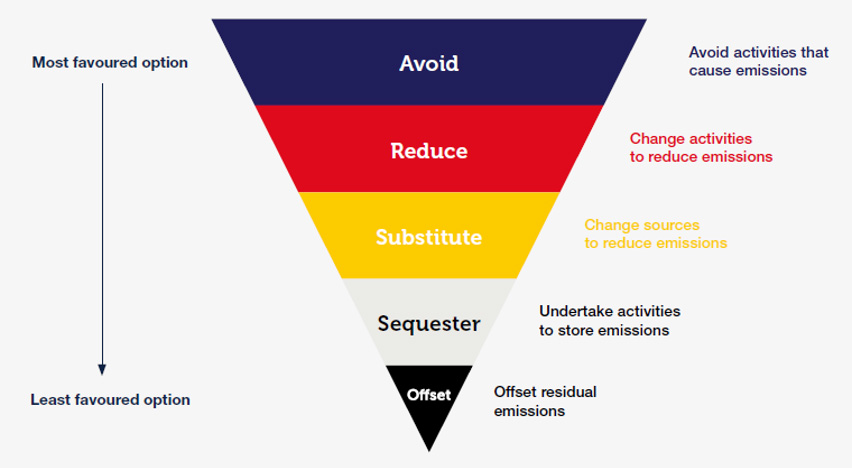 RMIT carbon management hierarchy
In 2025, RMIT undertook a substantial review of its carbon management approach and decided to transition from its previous carbon neutral commitment under Climate Active towards a science-based net zero pathway.
A science-based net zero approach is widely recognised as a credible pathway for meaningful climate action: it prioritises reducing emissions at the source and uses offsets only for residual and unavoidable emissions. Science-based targets establish emissions reduction pathways aligned with reaching net zero by 2050 at the latest, reflecting international benchmarks and Australia's climate targets. Work is underway to develop an integrated Climate Action & Resilience Framework that will guide our next steps.
The Australian Government has since announced that Climate Active certification will end, citing changes in community expectations, corporate sustainability practices and policy settings, maturing international guidance and increased demand for direct emissions reductions. This change in direction nationally validates the pathway RMIT has adopted as we transition from our previous carbon neutrality commitment to a net zero approach.
A new Climate Resilience Framework is in development, bringing together and building on our existing carbon management and climate adaptation approaches. It will establish an integrated framework for progressing towards net zero, managing climate-related risks and opportunities, and strengthening RMIT's resilience to a changing climate.
RMIT continues to take responsibility for its emissions while developing its science-based net zero pathway.
In line with our carbon management hierarchy, reducing emissions at the source remains RMIT's primary focus. High-quality carbon credits play a complementary role in addressing residual emissions, particularly in the short to medium term while longer-term decarbonisation initiatives are planned and implemented. For example, tackling the more complex electrification of existing campus infrastructure and develop the detailed plans needed to quantify and reduce our supply chain emissions.
From 2025 onwards, RMIT will purchase high-integrity carbon credits to offset remaining Scope 1 emissions (direct emissions from RMIT owned or controlled sources) and those Scope 3 emissions (indirect emissions across RMIT’s supply chain) that we can currently measure with confidence, such as business travel. This aligns to our carbon management hierarchy of only using offsets as a last resort
For the 2025 calendar year the University procured 30,000 high-quality carbon credits. These were selected to support credible decarbonisation and climate outcomes in Australia and Vietnam, beyond RMIT's direct operations. One carbon credit is equivalent to one tonne of carbon dioxide equivalent (tCO2-e).
| Project type and location | Project | Credits |
| Savanna fire management, Queensland | Mount Mulgrave | 10,738 |
| Hydropower, Vietnam | Za Hung Hydropower | 10,000 |
| Biodiversity and wind (stapled), Victoria and Vietnam | EcoAustralia Foresters Spring and Hoa Binh 1 – Phase 2 Wind | 6,000 |
| Plantation forestry, Tasmania | Landari Tasmania Blessington | 2,187 |
| Biodiversity and carbon, Victoria | Blackwood Biodiversity and Carbon Project | 863 |
| Biodiversity and carbon, Victoria | Devon Park Biodiversity and Carbon Project | 212 |
Energy efficiency and emissions reduction are embedded in RMIT's approach to improving its built environment.
In 2017, RMIT completed the $128 million Sustainable Urban Precincts Program to reduce energy and water use across our campuses. Works included upgrades to on-site high-voltage networks, high-efficiency boilers and chillers, more than 40,000 LED lights, water-saving fixtures, rainwater harvesting and building management system upgrades. The program delivers more than 30,000 tonnes of emissions savings each year.
RMIT continues to focus on energy efficiency and emissions reduction through capital projects, with sustainable design principles embedded in our Design Standards. We are also piloting an innovative approach to measuring the embodied carbon of our annual building and asset upgrade program, in partnership with our quantity surveyors.
RMIT has installed solar photovoltaic systems across university rooftops to maximise on-site renewable energy generation.
Our existing 596 kW solar PV portfolio includes more than 2,500 panels, with further solar deployment continuing through our capital development program.
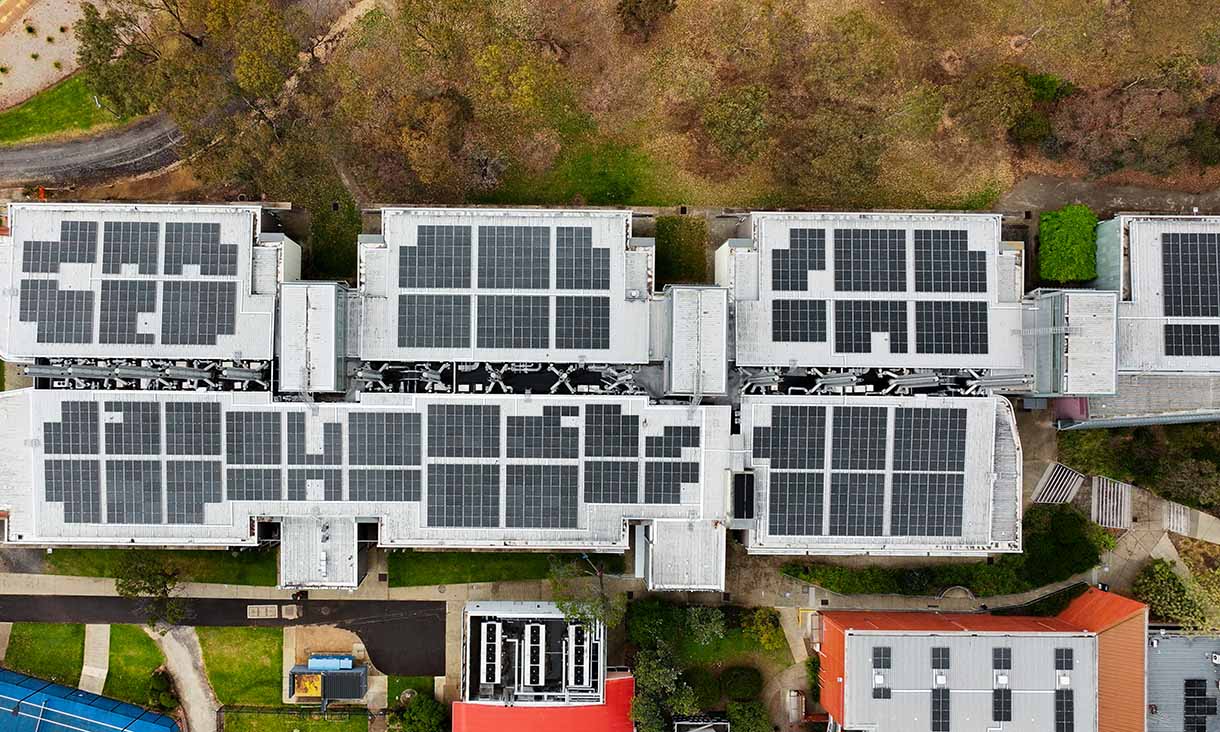 New solar PV panels installed at RMIT Bundoora Campus
Since 1 January 2023, all RMIT's onshore grid electricity has been sourced from renewable energy through the Melbourne Renewable Energy Projects (MREP).
RMIT joined the City of Melbourne and other organisations to establish the first Melbourne Renewable Energy Project in 2017, supporting the development of the 80 MW Crowlands Wind Farm near Ararat. RMIT subsequently led a second group of universities and businesses to secure another long-term renewable electricity agreement through MREP 2, supporting generation at Yaloak South.
Through MREP 1 and 2, RMIT has helped lead large-scale collaborative renewable energy purchasing in Australia. These long-term power purchase agreements have supported new wind energy generation in regional Victoria while also contributing to long-term price certainty. Together, these partnerships demonstrate how organisations can use their collective purchasing power to support renewable energy generation and help accelerate the transition to a low-carbon future.
For more information on this key improvement, visit Melbourne Renewable Energy Project.
 A wind turbine at the Crowlands windfarm. Image credit: Pacific Blue
RMIT is progressively reducing reliance on natural gas across our campuses. We turned off our gas-fired power plants at the end of 2022 and have committed to installing no new natural gas assets, except where required in research laboratories, through our Design Standards.
Completed in 2024, the electrification of Building 80 was the first of RMIT's complex projects to remove natural gas assets as part of a phased program, reducing the building's emissions by over 80%.
Reducing emissions is only part of responding to climate change. Australia is expected to experience more frequent and severe droughts, bushfires, cyclones and floods. As a major public organisation, RMIT is preparing our campuses, operations and communities for changing climate conditions and more frequent and severe extreme weather events.
Our Climate Change Adaptation Plan (PDF 1.7 KB) recognises the potential impacts of climate change on our buildings, infrastructure, people and wider community. It provides a framework for identifying climate risks and implementing adaptation measures to strengthen resilience to future climate shocks and stresses.
Our emerging Climate Resilience Framework will build on this foundation by bringing climate mitigation and adaptation together into an integrated approach to emissions reduction, climate risk, resilience and opportunity.
RMIT measures and publicly reports its greenhouse gas emissions and progress in reducing its operational carbon footprint.
In 2025, RMIT achieved a 92% reduction in Scope 1 and Scope 2 emissions against our 2007 baseline. This reduction reflects significant changes in RMIT's energy profile, including reduced natural gas use and the transition to renewable electricity.
From 1 January 2023, all onshore grid electricity has been sourced from renewable energy. In 2025, the Melbourne Renewable Energy Projects supplied 50,744 MWh of renewable electricity to RMIT.
RMIT accounts for all energy and emissions within its Australian building portfolio, using emissions factors in accordance with the National Greenhouse and Energy Reporting Act 2007.
We are continuing to strengthen the measurement and management of Scope 3 emissions as we develop methodologies to more accurately calculate our supply chain impacts.
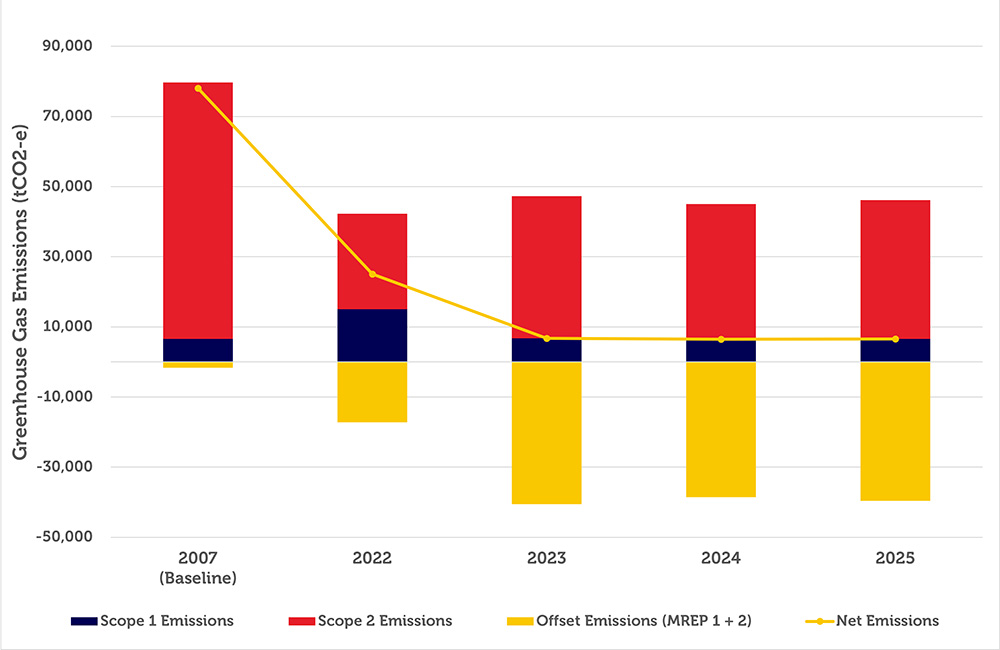 RMIT Australia 2007 – 2025 Carbon Commitment Tracking
All targets are set against a 2007 baseline, with initial emissions at 78,048 tCO2-e. This graph is based on methodology per our previous commitment to pursue carbon neutrality.
We report our emissions and broader sustainability performance through RMIT’s Sustainability Annual Report, providing transparency on our progress and impact


RMIT University acknowledges the people of the Woi wurrung and Boon wurrung language groups of the eastern Kulin Nation on whose unceded lands we conduct the business of the University. RMIT University respectfully acknowledges their Ancestors and Elders, past and present. RMIT also acknowledges the Traditional Custodians and their Ancestors of the lands and waters across Australia where we conduct our business - Artwork 'Sentient' by Hollie Johnson, Gunaikurnai and Monero Ngarigo.
Learn more about our commitment to Aboriginal and Torres Strait Islander peoples