Water
Water is fundamental to life, health, and sustainable development and the education sector has a vital responsibility to sustainable water management as part of its overall efforts to tackle global challenges.
The Times Higher Education (THE) Impact Rankings assess universities’ contributions toward the United Nations Sustainable Development Goals (SDGs), with SDG 6 focusing on Clean Water and Sanitation, recognising that access to safe and reliable water, along with effective sanitation, underpins thriving societies.
Clean drinking water and good hygiene are essential for communities, supporting not only individual wellbeing but also agriculture, aquaculture, and broader economic development.
In Australia, robust local and national infrastructure provides most communities with effective systems for water supply and sanitation, but some regional and remote communities still face challenges with water security. In Vietnam and other countries, however, access can be variable and often challenging, underscoring the importance of collaboration and lasting solutions.
Each year, millions of people, many of them children, lose their lives to preventable diseases caused by inadequate water, sanitation, and hygiene, driven by poor infrastructure and economic hardship. RMIT University is committed to making a measurable impact in this space.
Across our campuses, we are focused on reducing our own water use intensity by prioritising efficiency, water harvesting, and reuse. Through dynamic partnerships with water authorities, governments, and non-governmental organisations, we work to advance research, education, and practical solutions for water conservation, pollution prevention, and securing resilient water systems for the future.
Our efforts contribute to building healthier, more sustainable communities locally and globally, helping to realise the promise of SDG 6.
Water is fundamental to life, health, and sustainable development and the education sector has a vital responsibility to sustainable water management as part of its overall efforts to tackle global challenges.
The Times Higher Education (THE) Impact Rankings assess universities’ contributions toward the United Nations Sustainable Development Goals (SDGs), with SDG 6 focusing on Clean Water and Sanitation, recognising that access to safe and reliable water, along with effective sanitation, underpins thriving societies.
Clean drinking water and good hygiene are essential for communities, supporting not only individual wellbeing but also agriculture, aquaculture, and broader economic development.
In Australia, robust local and national infrastructure provides most communities with effective systems for water supply and sanitation, but some regional and remote communities still face challenges with water security. In Vietnam and other countries, however, access can be variable and often challenging, underscoring the importance of collaboration and lasting solutions.
Each year, millions of people, many of them children, lose their lives to preventable diseases caused by inadequate water, sanitation, and hygiene, driven by poor infrastructure and economic hardship. RMIT University is committed to making a measurable impact in this space.
Across our campuses, we are focused on reducing our own water use intensity by prioritising efficiency, water harvesting, and reuse. Through dynamic partnerships with water authorities, governments, and non-governmental organisations, we work to advance research, education, and practical solutions for water conservation, pollution prevention, and securing resilient water systems for the future.
Our efforts contribute to building healthier, more sustainable communities locally and globally, helping to realise the promise of SDG 6.
The total volume of water used is measured through water retailer meters installed at our sites. Different water retailers service different campus locations and each use specific billing approaches and cycles.
To centrally manage this, RMIT has an online system to track, monitor and manage usage across the University. This system is linked to the smart meters on campuses, which provide detailed and real time information about the volume of water used by campus and by building. As of 2024, there are 40 smart meters installed across the University.
Twelve ML is estimated for reuse based on the capacity of the various catchment systems installed and is included in updated data for THE Impact Ranking reporting.
The water consumption tracking results are reported each year through the Annual Report (Pg. 78), in the Sustainability Annual Report. (Pg. 104–105).
RMIT is committed to reducing water use intensity across its campuses through improved efficiency, harvesting, and reuse strategies. Our Design Standards prioritise water efficiency by setting minimum requirements for fixtures, encouraging water capture and storage, and incorporating water-sensitive urban design in landscaping.
In 2024, RMIT’s global consumption of potable water totalled 233,472 kilolitres, marking a 12 per cent increase from 2023.
The breakdown is as follows:
In 2024, water efficiency in our Australian operations was 2,909 litres per EFTSL, representing a 52 per cent reduction in water consumption intensity compared to a 2007 baseline.
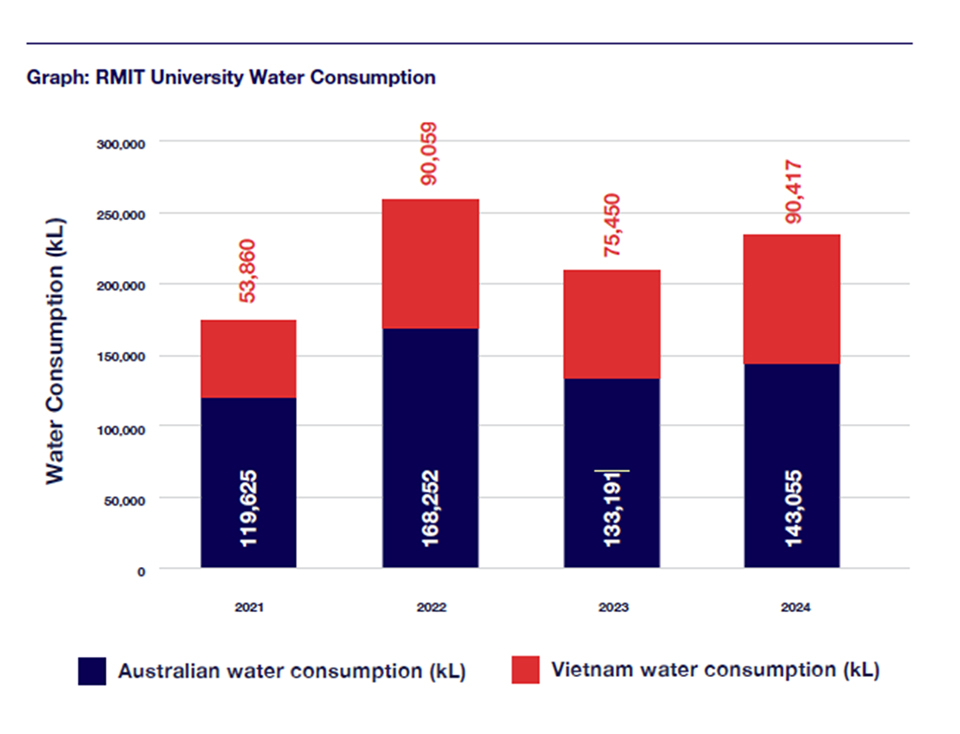 RMIT Australian water consumption rises from 119,625 kL in 2021 to a peak of 168,252 in 2022, then declines to 133,191 in 2023, rising again to 143,055 by 2024. Vietnam consumption increases from 53,860 kL in 2021, peaks at 90,059 in 2022, dips to 75,450 in 2023, and peaks again at 90,417 in 2024. Total water use is highest in 2022.
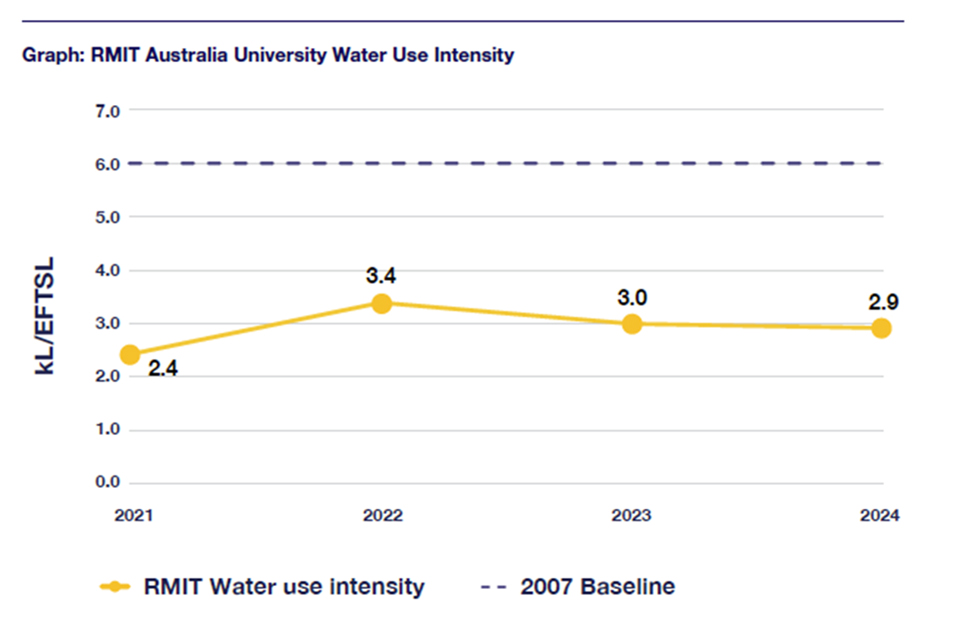 RMIT Australia Water use intensity rises from 2.4 kL/EFTSL in 2021 to 3.4 in 2022, then falls to 3.0 in 2023 and 2.9 in 2024, staying below the 2007 baseline of 6.0.
One hundred per cent of RMIT's wastewater is treated through local infrastructure and captured our water accounts as this is standard practice in our locations in Australia.
All three Melbourne RMIT campuses are connected to central supply and sewerage grid, and all wastewater is collected and treated by Melbourne Water, which is the local water authority, and the three metropolitan water retailers operating in Melbourne (Greater Western Water, Yarra Valley Water and South East Water).
Managing and charging for the safe processing of wastewater is a standard inclusion in billing and this is done by all relevant providers in the market.
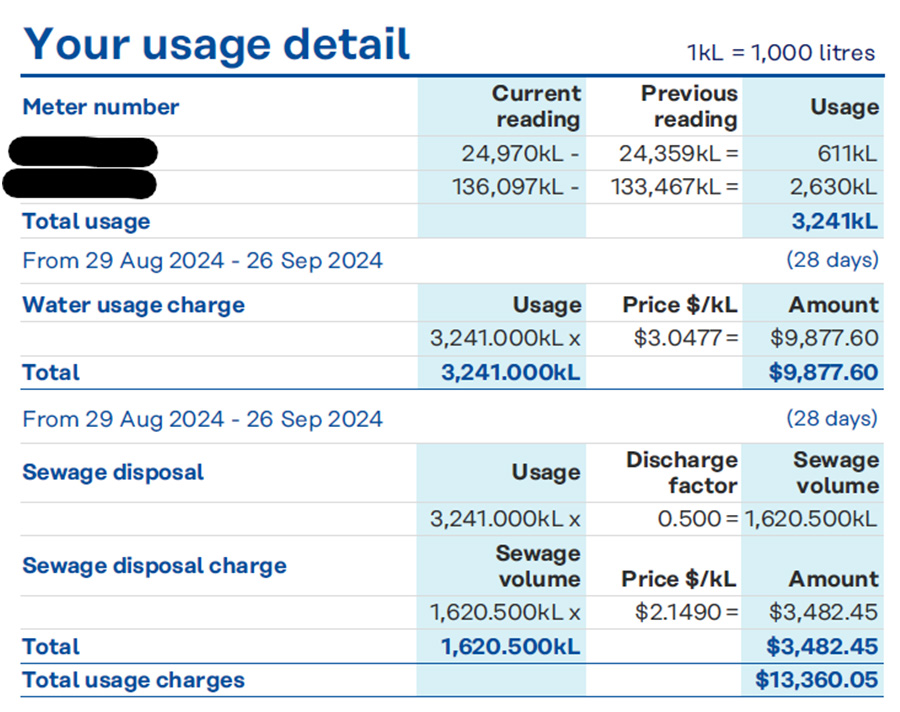 Water usage bill showing total usage of 3,241 kL between 29 Aug and 26 Sep 2024, with charges for water and sewage disposal amounting to $13,360.05. Includes meter readings, price per kL and calculation breakdowns.
RMIT has policies and processes to prevent and manage incidents, including water system pollution.
RMIT Property Services Group has an Environmental Management System (EMS) formally certified and externally audited against ISO 14001. This provides greater assurance of the processes in place to meet our environmental compliance obligations, with a focus on ‘water conservation and sustainable water management, including harvesting, reuse and water-sensitive design’.
Property Services, through its management systems, has a number of elements in place to manage our water systems and control pollution, including:
RMIT provides free drinking water through a network of external and internal hydration stations and drinking water taps to make it easy for students and staff to refill their own reusable bottles.
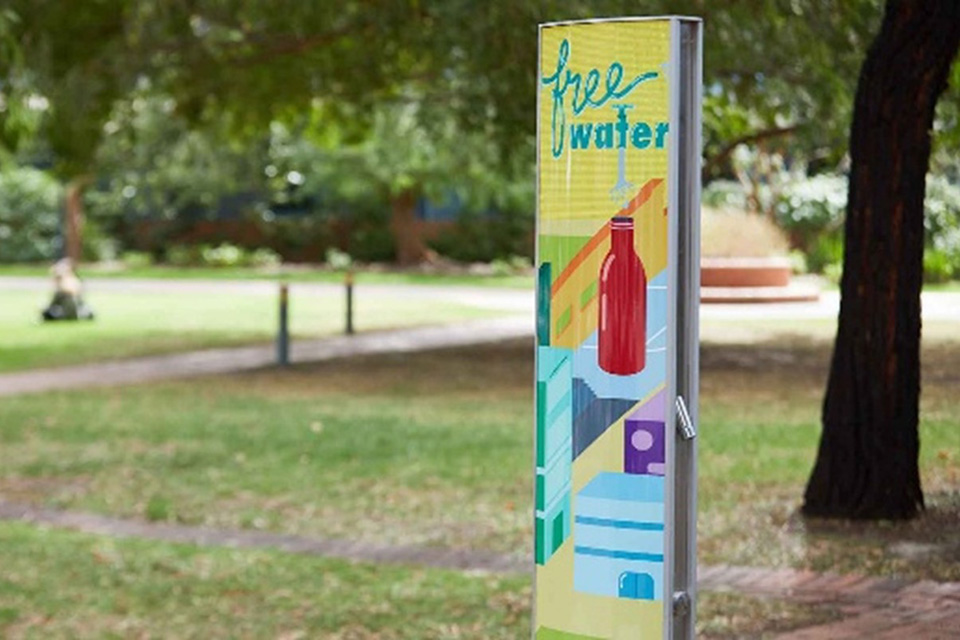
There are over 100 drinking water fountains throughout the campuses with many highlighted with eye-catching yellow graphic signage on the stations which were designed by an RMIT student.
The key locations are included in a campus map and are also included on the RMIT navigator app for students. Campuses are open to the public so visitors also have access to many of these.
There are also free drinking water taps (over 180 in total) provided through facilities such as kitchens, kitchenettes and student break out spaces across the University campuses.
RMIT's Design Standards serve as the practical embodiment of our Sustainability Policy, ensuring key water management commitments are met across all new and refurbished buildings on university-owned or leased premises.
These standards are designed to create sustainable facilities that provide optimal environments for learning and research. They offer clear performance criteria for designers while allowing for innovative solutions that enhance the built environment.
The Design Standards prioritise water use minimisation through efficiency and reuse through responsible management strategies and associated clauses. This includes “responsible water management through capture, reuse, and water-sensitive urban design” (Section 3.4).
Other water related elements addressed in the Standards are Automatic Fire Sprinkler Systems (9.1), Roof Drainage Systems (11.1.10), Stormwater Drainage (11.1.11), Rainwater Harvesting (16.3.9), and HVAC Systems (20.8).
We have installed 40 smart meters across our buildings, providing insights into consumption patterns as well as detecting possible leaks early.
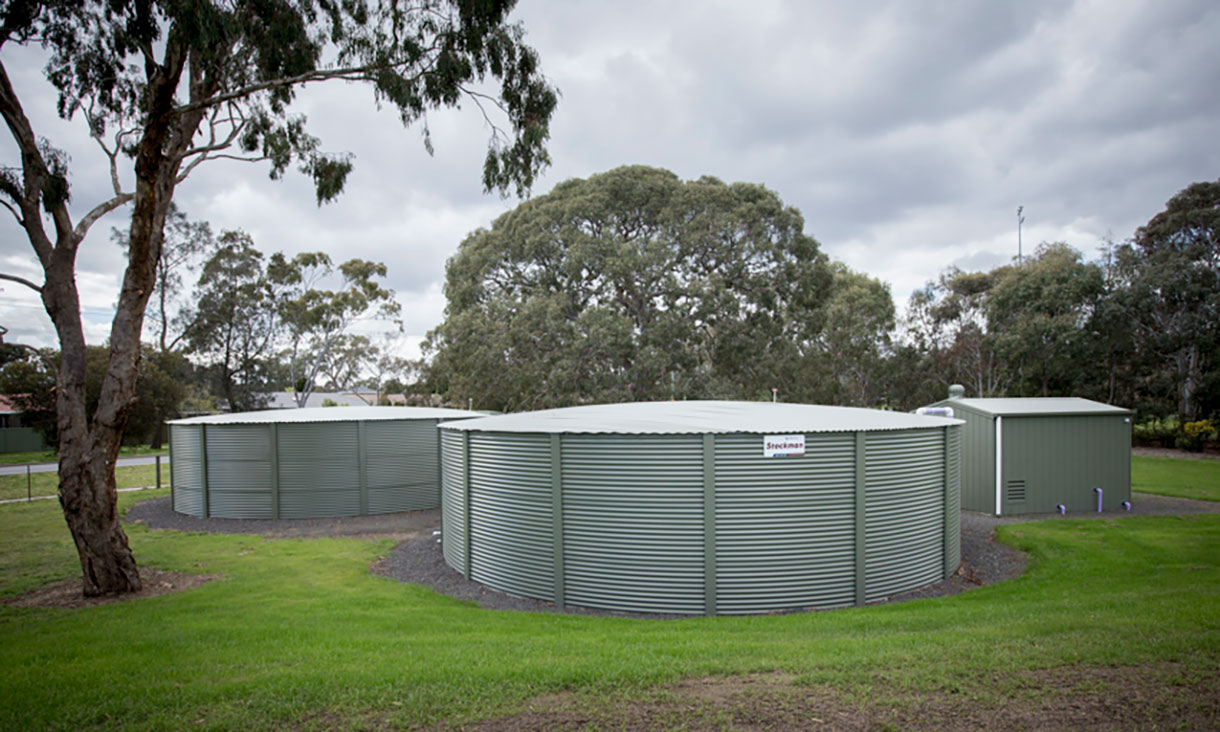
Additionally, we have 1.3 million litres of on-site water storage capacity, reducing potable water demand by capturing approximately an additional 12 ML rainwater and stormwater for toilet flushing and irrigation.
As a part of RMIT’s ongoing asset lifecycle replacement strategy, we identify and replace outdated systems with modern and efficient technologies, reducing consumption and supporting University goals.
Water service issues such as leaks or dripping taps can be reported to the Property Services Desk.
Phone: 03 9925 2111
RMIT supports water conscious planting through its Design Standards (PDF 1,492 KB) including:
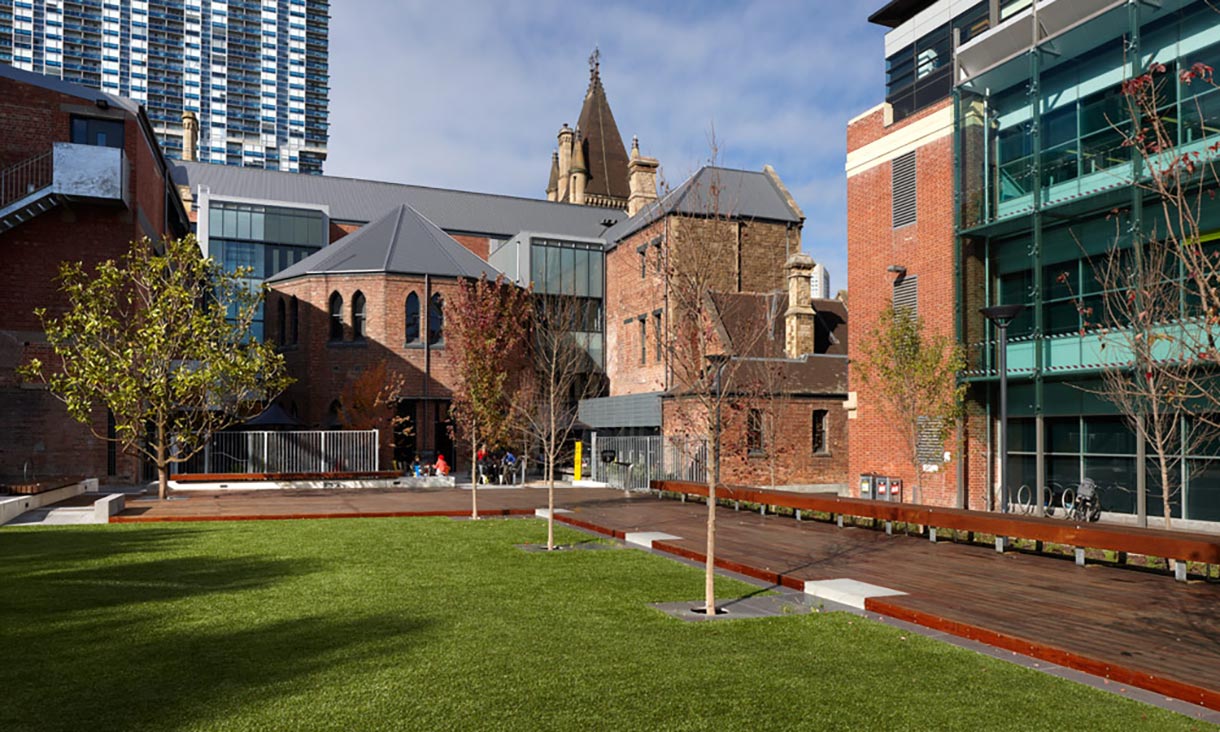
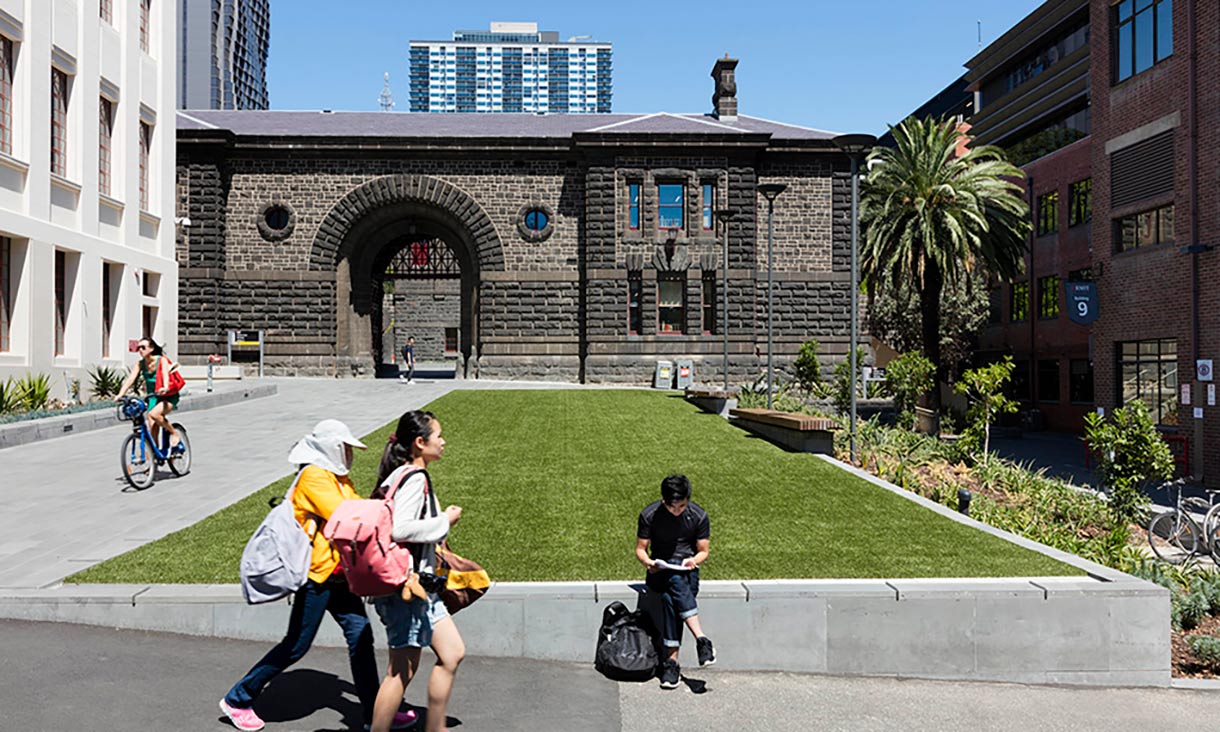
Water Sensitive Urban Design (WSUD) is a key component of our approach to campus planning and landscape design. WSUD is an approach to planning and designing urban areas to make use of valuable stormwater and rainwater and reduce the harm it causes to our rivers and creeks.
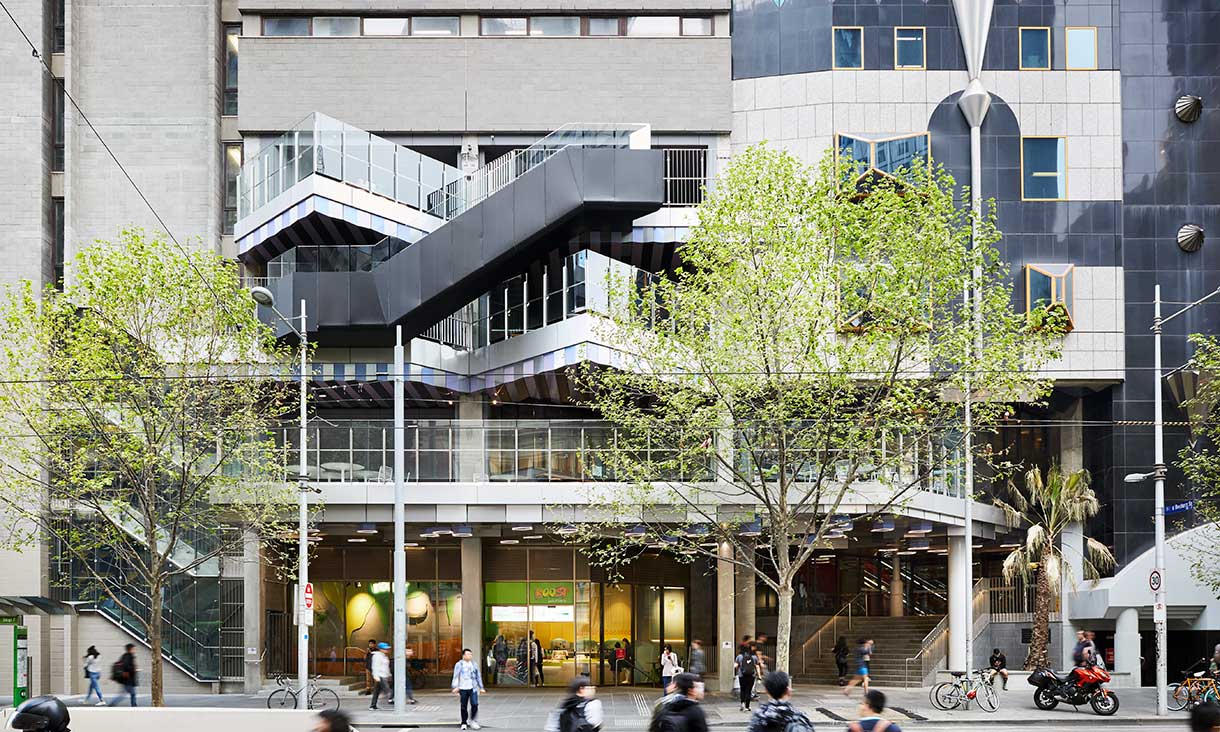
WSUD is a key feature of our City Campus landscaping on Bowen Street which includes rain gardens on around the Garden Building on Bowen Street at the main city campus.
Rooftop garden terraces extensively planted in drought tolerant evergreen plants such as low ferns, bamboos and flowering groundcover.
RMIT undertakes an annual tree audit which in 2024–2025 identified 2,048 trees across the Australian Campuses. In this year, 39 trees were lost while 55 new were planted, resulting in a net gain of 16 trees in 2024.
87 per cent of these were classified as Indigenous, Victorian Native or Australian Native species, which are drought tolerant trees and contributes to our water-conscious planting approach.
The full list of trees and their mapped locations are available in the latest tree audit report which is reviewed and used by our Project Managers and Contractors.
An exemplar testament to the resilience and water efficient nature of the many indigenous and native trees that are part of the Keelbundoora Scarred Tree and Heritage Trail.
The Trail was proposed by RMIT Student Services Group and the Ngarara Willim Centre to show due respect to the Wurundjeri people and their history on the land now occupied by RMIT University Bundoora campus. We are grateful to the Wurundjeri Land Council and their representative, Aunty Annette Xibberas, for expert guidance with developing this trail.
An online walking map helps to further guide the way.
The RMIT Sustainability Policy underpins our operational approaches to sustainable water management including maximising water efficiency and reuse across the University.
The policy is publicly available on our Policy Register and is reviewed and updated in accordance with organisational processes.
Relevant clauses include:
(26) Minimise the consumption of resources through sustainable procurement, waste avoidance, good design, reuse, recycling and community engagement to drive a circular economy.
(27) Prioritise water and energy efficiency, conservation and education.
(28) Preserve and enhance the architectural, social, creative and natural value of place and promote healthy functioning ecosystems.
(29) Utilise best-practice sustainable design and innovative technologies to deliver efficient, resilient and adaptable buildings, which are accessible and inclusive by design.
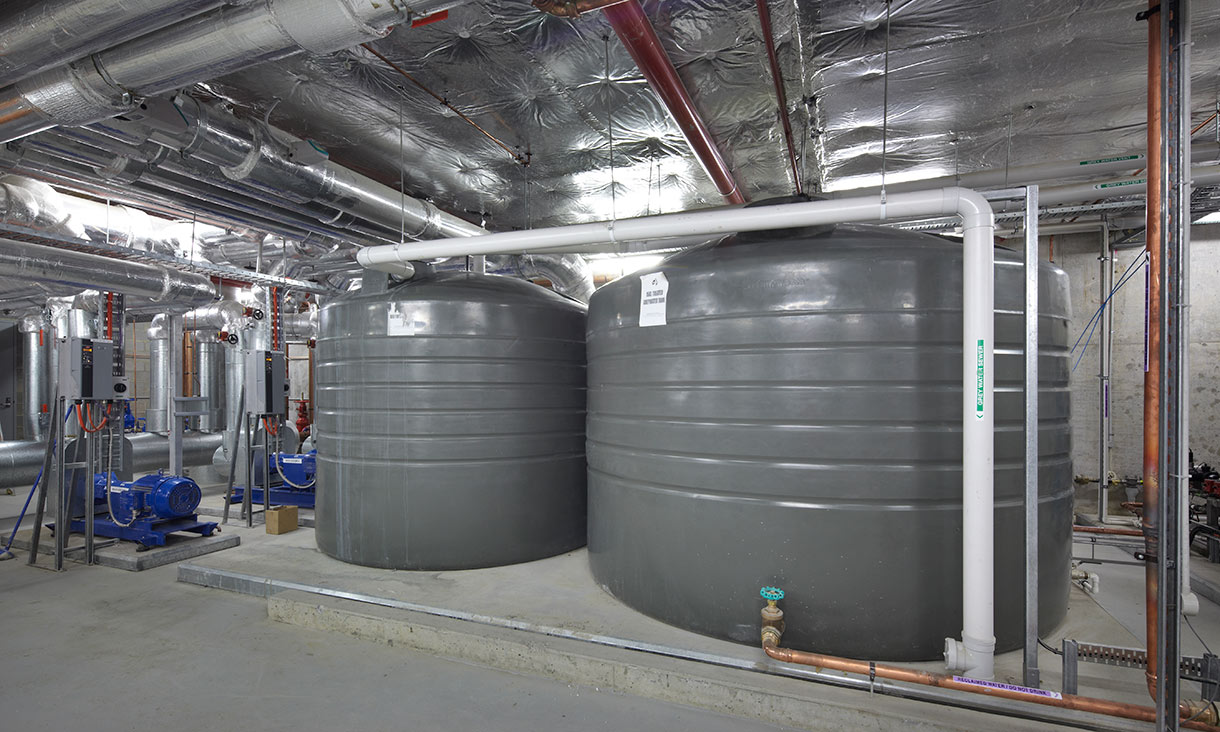
RMIT uses various on-campus storage and extraction technologies and infrastructure to sustainably capture and reuse water. We do not have off-campus facilities for this purpose.
We have 1.3 million litres of on-site water storage capacity including integrated and freestanding collection tanks, reducing potable water demand by capturing rainwater and stormwater for toilet flushing and irrigation.
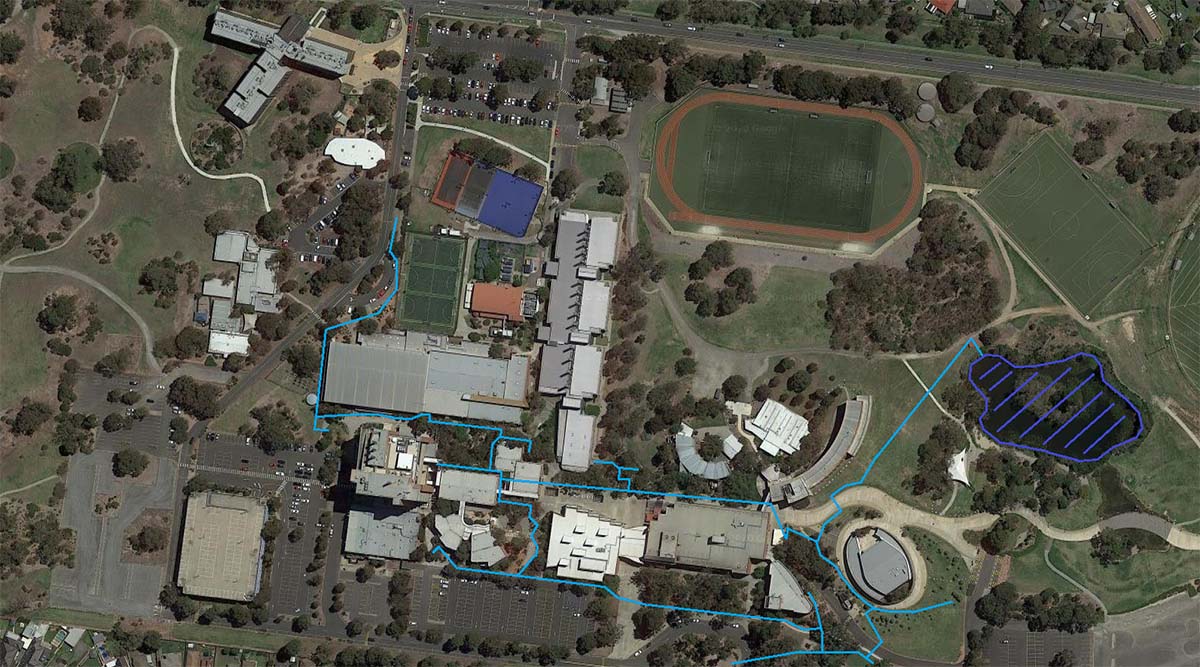
At the Bundoora campus, stormwater is collected in natural basins and when water levels are sufficient, the excess is used in cooling tower applications.
Reuse and extraction opportunities and associated technologies are guided by Design Standards, including through sections on Stormwater Drainage (11.1.11) and Rainwater Harvesting (16.3.9).
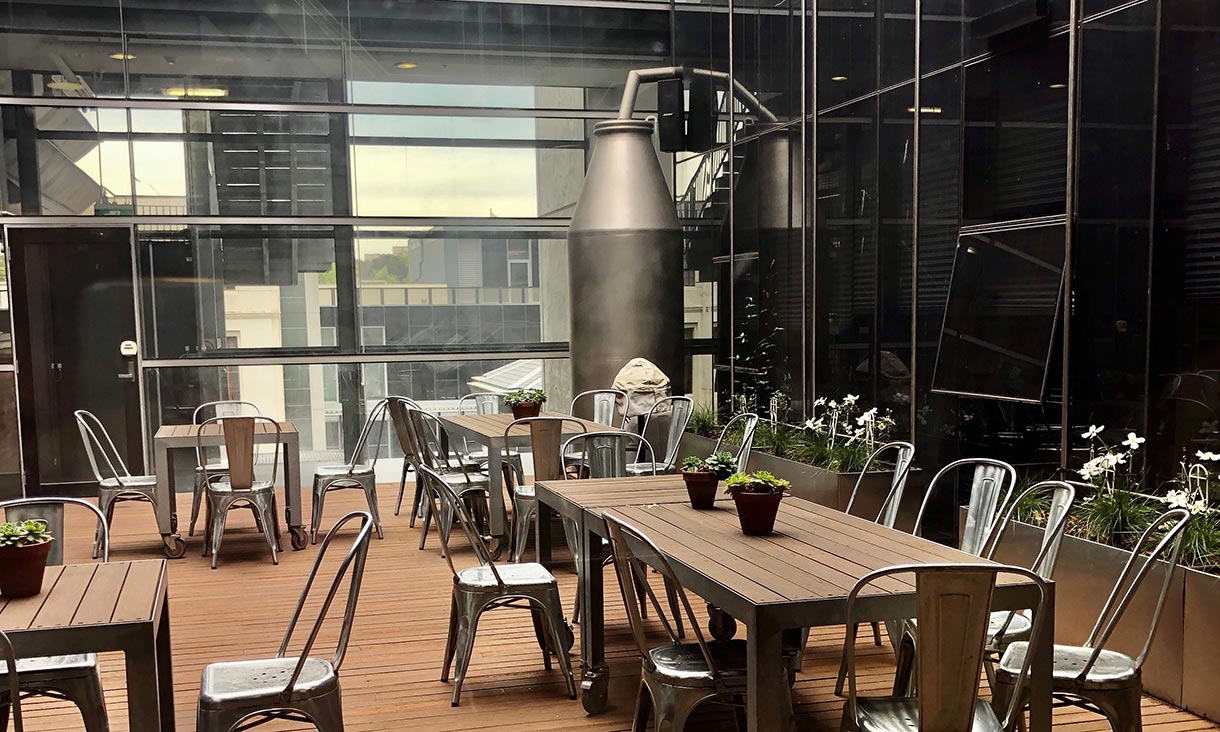
Please click on the individual image above to view it in full.
RMIT has a total of 1.3 ML of rainwater tank and stormwater extraction capacity providing non-potable water for toilet flushing and irrigation purposes installed across 14 buildings and various campus locations. These initiatives provide RMIT an estimated 12 ML of water reuse every year.
While we utilise alternative water sources like stormwater and rainwater and estimate their outputs based on capacity, we do not directly measure these volumes. Instead, their use offsets our potable water requirements, reflected in reduced consumption levels.
Adherence to the RMIT Design Standards ensures the consideration of further reuse potential as building projects occur across the University.
Example reuse capacity include:
RMIT provides educational opportunities for local communities to learn more about good water management through local partnerships, linked school programs and our own formal training offerings.
Free opportunities are available through ‘citizen science’ type activities that are included in some of our partnership work, such as Litter Trackers.
The Aquatic Environmental Stress (AQUEST) Research Group at RMIT University excels in studying stressors and pollution in waterways, providing science that informs management and policy for healthy ecosystems.
Various programs and projects are delivered in partnership with others and include 'citizen science' elements that engage and educate local communities.
AQUEST has participated in the longstanding Litter Trackers program in partnership with the Victorian Government, Melbourne Water and other partners. This program also created formal school education tools and engaged volunteers in citizen-science based activities.
Litter Trackers: 'Burbs to the Bay' project, in collaboration with Corangamite Catchment Management Authority and Bellarine Catchment Network, used GPS-tracked bottles to show litter movement in Geelong's waterways. This initiative educated communities about litter's environmental impact, empowering informed choices to reduce pollution.
Funded by Coastcare Victoria Community Grants and supported by the Victorian Government, the program has seen success and amplified educational outreach through partnerships and social media engagement. The original Litter Trackers project demonstrated litter travel in Port Phillip Bay, engaging schools and community groups.
In 2024, the program was a finalist for the Inspiring Community Engagement and Education category at the Victorian Marine and Coastal Awards, highlighting its significant contribution to Victoria's marine and coastal environment.
RMIT is engaged with local communities in addressing and supporting water management and conservation in conjunction with water authorities, government and NGOs and reaches communities off-campus locally and overseas.
We do a significant amount of work in water conservation through key research and partnership activities such as:
RMIT University is a key research partner in the Flow-MER program, contributing its expertise to enhance the management and evaluation of Commonwealth environmental water across the Murray-Darling Basin.
RMIT’s researchers collaborate with the Commonwealth Environmental Water Holder (CEWH), governments at all levels, and other stakeholders to design and implement scientific monitoring in select Basin sites. This includes collecting and analysing data on river, wetland, and floodplain health, and developing tools for adaptive water management.
RMIT also helps integrate First Nations values and knowledge by co-designing research and monitoring approaches that reflect First Nations priorities. Through interdisciplinary research and active engagement, RMIT supports evidence-based decision-making and strengthens connections between environmental and community outcomes.
RMIT cooperates on water security with various levels of government, water authorities, NGOs, research institutes and other partners to further progress on this critical issue.
The WETT Research Centre at RMIT plays a pivotal role in driving innovation to ensure long-term water security. One of its three core research themes, Resilient Water Infrastructure, brings together experts to develop solutions that protect communities and ecosystems in the face of growing water challenges.
This theme focuses on integrated water resource management, sustainable sewer infrastructure, climate change adaptation, and advanced simulation and modelling.
By emphasising smart technologies, asset management, integrated design, and nature-based solutions, WETT researchers work to improve the quality, distribution, and resilience of water systems. Their work supports sustainable development, mitigates environmental impacts, and safeguards the health and wellbeing of current and future generations.
RMIT provides free drinking water through a network of external and internal hydration stations and drinking water taps to make it easy for students and staff to refill their own reusable bottles. The key locations are included in a campus map and are also included on the RMIT navigator app for students.
Campuses are open to the public so visitors also have access to many of these. There are also free drinking water taps (over 180 in total) provided through facilities such as kitchens, kitchenettes and student break out spaces across the University campuses.
As part of our Life on Campus webpage, our Sustainable Events Guide aims to promote conscious water usage on campus. This guide is a practical tool for in-house teams to create sustainable events and improve sustainability performance, including conscious use of water. For example, Pg. 18 provides details of the water management and conscious water use.
Further, our Sustainable Retail Framework supports and encourages RMIT retailers towards becoming more sustainable in their day-to-day operations including around water-conscious usage in their own operations.
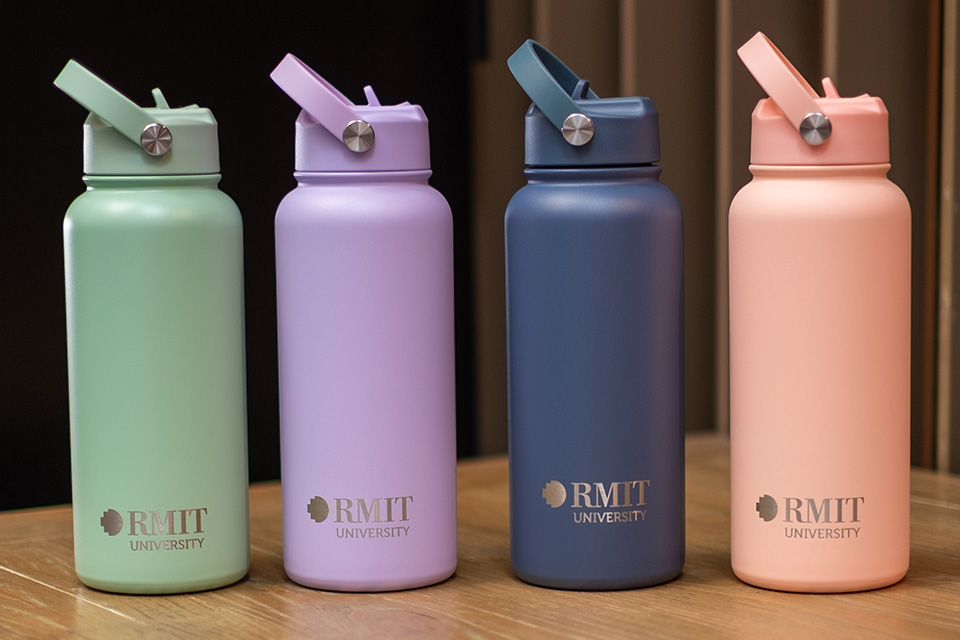
The RMIT Store sells a range of reusable water bottles at different price points to support students, staff and visitors to avail of free water on campuses.


RMIT University acknowledges the people of the Woi wurrung and Boon wurrung language groups of the eastern Kulin Nation on whose unceded lands we conduct the business of the University. RMIT University respectfully acknowledges their Ancestors and Elders, past and present. RMIT also acknowledges the Traditional Custodians and their Ancestors of the lands and waters across Australia where we conduct our business - Artwork 'Sentient' by Hollie Johnson, Gunaikurnai and Monero Ngarigo.
Learn more about our commitment to Aboriginal and Torres Strait Islander peoples