

‘Inside-Out’: Driving Social Change through Prison-Based Education

‘Inside-Out’: Driving Social Change through Prison-Based Education

The Inside-Out Prison Exchange program is a unique prison-based education model which brings together incarcerated ('inside') students and RMIT ('outside') students. It is the only program of its kind in Australia, promoting social change by breaking down barriers between the community and incarcerated people.

Changing Lives through Education

Led by Associate Professor Marietta Martinovic from RMIT’s School of Global, Urban and Social Studies, the Inside-Out program delivers meaningful social and educational impact. Dr Martinovic has been running the program for eleven years and currently spends a few days a week teaching in prisons. She describes the work as a major passion. 

Originally developed at Temple University in Philadelphia in 1997, the program was adapted for Australia and introduced to Victorian prisons in 2015 through a partnership between RMIT and Corrections Victoria. Since then, the RMIT-funded program has operated in eight Victorian prisons and has educated more than a thousand 'inside' and 'outside' students. 

Two people seated at a yellow outdoor table, one working on a laptop while the other listens, with trees and campus buildings in the background. Dr Martinovic with 'Inside' student Michael. Credit: RMIT Media 2020.

Research investigation and findings have confirmed the positive outcomes from the program. Students participate in a twelve week Comparative Criminal Justice Systems course, studying together for two hours each week. Outside students gain firsthand insight into the realities of incarceration, fostering empathy and a restorative justice mindset. Inside students build confidence, motivation, critical thinking, and aspirations for further study – skills linked to improved post release outcomes, including employment and reduced reoffending.

Think Tanks Creating Impact

The Inside-Out program also introduces students to policy-making processes and the importance of self and collective advocacy. After completing the teaching program, students can join prison based Think Tanks, which bring together alumni and external stakeholders to co design solutions for the justice system. These Think Tanks have contributed to more than 150 policy consultations and produced over 50 reports for Corrections Victoria, ensuring policy development is informed by lived experience.

Key achievements include:

  • Between the Blue and Green Program: Think Tanks developed a training program for new prison officers to strengthen relationships between staff and people in custody. In 2025, trained lived‑experience facilitators delivered more than twenty sessions to over two hundred officers – an Australian first that supports safer, more rehabilitative prison environments.
  • Employment Hubs in Prison: Think Tanks identified barriers to post release employment and created a Lived Experience Presenter Panel to motivate people in custody to engage with employment services. In 2025, more than twenty sessions reached over four hundred participants, encouraging stronger engagement with reintegration pathways.

Recognition of the program’s impact

The impact of the Inside-Out program and Think-Tanks has been internationally recognised with the 2024 Asia Pacific Triple E Award for ‘Impactful Collaboration of the Year’ for driving social change and building community through collaboration. In 2025, the programs were selected as a finalist in the Shaping Australia Awards in the Future Builder category. According to Innika La Fontaine (Associate Director, Offender Service and Reintegration, Corrections Victoria), ‘these initiatives underscore Dr Martinovic's commitment to future building which ultimately builds community and enhances community safety.’

Shaping future social impact

In 2020, Dr Martinovic formed the Beyond the Stone Walls Advisory Collective (BSWAC), bringing together lived experience members, students, researchers, and justice practitioners to embed lived experience into justice reform.

The Inside-Out model is now expanding internationally, with a new program launched at the University of Otago in New Zealand. Conversations are also underway with universities in Tasmania, NSW, South Australia, and Queensland. 

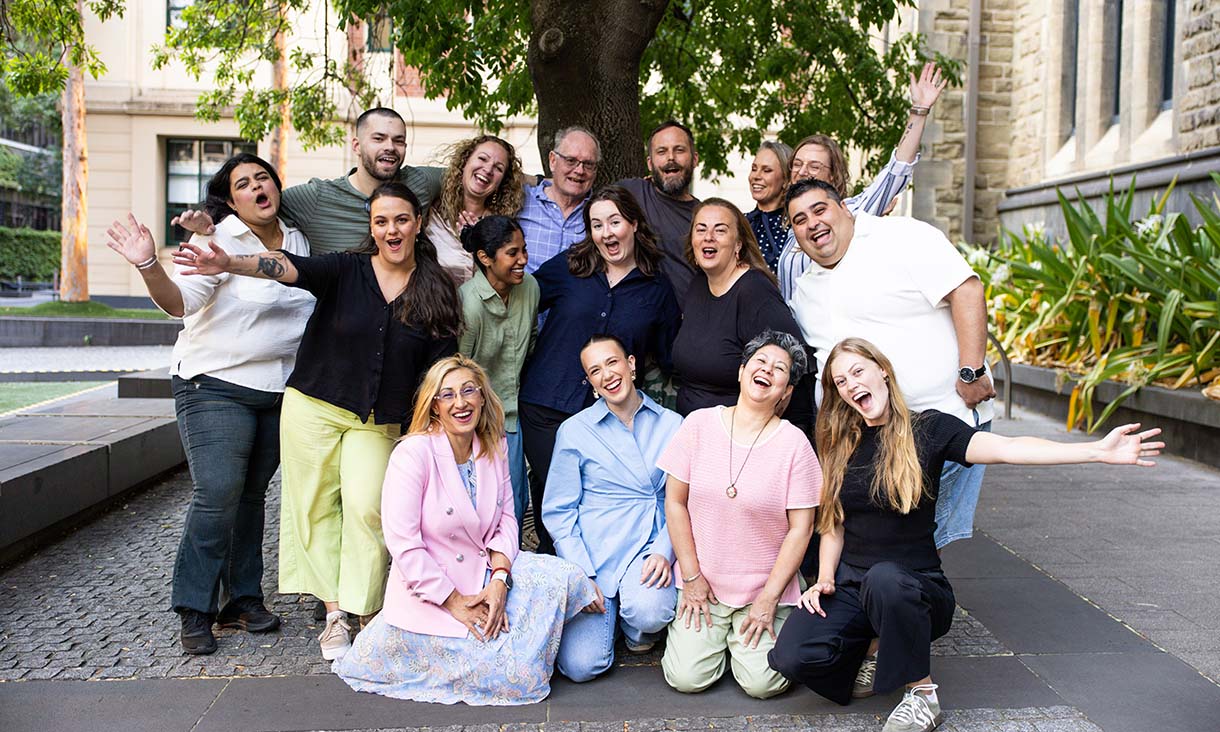
Group of people posing together outdoors under a tree, some standing and others kneeling, with arms raised and smiling, in front of campus buildings. Members of the Beyond the Stone Walls Advisory Collective. Credit: Natalia Edge Photography 2026.

Dr Martinovic emphasises the power of education in custody:

The level of engagement I witness from people in custody is unlike anything I have experienced elsewhere. Their curiosity is genuine. Their questions are thoughtful. They are hungry for knowledge. Education in prison is not simply about content delivery; it is about dignity, agency, and being seen as capable of intellectual growth. The learning is reciprocal.

With additional support, the program has the potential to expand further, but this requires sustained university commitment and more academics willing to teach inside prisons.

Support the future of the program

Dr Martinovic is actively seeking government and philanthropic support to meet the strong demand from incarcerated learners. Public understanding and support remain a challenge. Recognising the need for community education, Dr Martinovic and her team at BSWAC regularly hold talks at the Law Week and Social Sciences Week at RMIT. Participants often express surprise at what they learn about the reality of the incarceration experience and re-entry into community. 

The Inside Out team acknowledges the generosity of supporters who make this work possible. If you would like to contribute, please email the RMIT Philanthropy team.

For more information, refer to the Corrections Victoria webpage and the Shaping Australia Awards page for testimonials and participant feedback.

Key contact

Dr Marietta Martinovic

Associate Professor in Criminology and Justice studies in the School of Global, Urban and Social Studies at RMIT University

SDGs

SDG 4
SDG 10
sdg 16
SDG 8
SDG 17

Read related RMIT impact stories


Connect with RMIT Research

If you're not sure how you can best work with us, our team can explain what's possible and put you in touch with the right person. 

aboriginal flag float-start torres strait flag float-start

Acknowledgement of Country

RMIT University acknowledges the people of the Woi wurrung and Boon wurrung language groups of the eastern Kulin Nation on whose unceded lands we conduct the business of the University. RMIT University respectfully acknowledges their Ancestors and Elders, past and present. RMIT also acknowledges the Traditional Custodians and their Ancestors of the lands and waters across Australia where we conduct our business - Artwork 'Sentient' by Hollie Johnson, Gunaikurnai and Monero Ngarigo.

Learn more about our commitment to Indigenous cultures