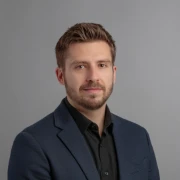
Dr. Maciej Mazur
Details
 College: School of Engineering
 Department: School of Engineering
 Campus: City Campus Australia
 maciej.mazur@rmit.edu.au
 ORCID: 0000-0003-3482-9135
Open to
- Masters Research or PhD student supervision
About
Maciej Mazur is a Senior Lecturer at RMIT University’s Centre for Additive Manufacturing whose research advances design and optimisation for additive manufacturing. His research focuses on the additive manufacture of light-weight cellular materials, industrial tooling, fluid flow devices, and aerospace propulsion components, for applications in the chemical science, aerospace and manufacturing industries.
His research contributions span the design-to-performance continuum, from computational enablement of complex, support-free geometries to experimentally validated components with tailored mechanical and thermal behaviour. A defining focus of Maciej's research focuses on metal cellular materials fabricated by laser powder bed fusion. He and his colleagues have identified geometry–property relationships and deformation and failure mechanisms across a range of lattice structure designs. These contributions laid the foundation for further collaborative contributions in the functional surface engineering of additively manufactured cellular materials, for applications in catalysis such as endothermic catalytic cracking of jet fuels for thermal management in hypersonic aircraft.
Maciej’s work has a strong focus on design for additive manufacturing (DfAM) to leverage its unique capabilities, including the development of patented uniform fractal flow distributors and mixer designs. He has also advanced the design for additive manufacture of industrial tooling, developing design methods for conformally cooled plastic injection moulds and aluminium extrusion dies—work that couples numerical modelling with experimental validation to improve tool performance and reliability.
Beyond structural design, Maciej contributes to process development and manufacturability across metals and polymers. His studies link alloy composition and process parameters to defect formation and mechanical properties in Inconel 625, address the machining of additively manufactured Ti‑6Al‑4V, and establish review-backed strategies for void reduction in material extrusion FDM processes, including new interlaced toolpaths to suppress porosity. Maciej is also an active educator in advanced manufacturing and design topics. He is a co-author of chapters in several books focused on AM of cellular materials, AM for Chemical Sciences and Engineering, as well as AM for Critical Minerals. Earlier in his career, he contributed to computer-aided tolerancing and stochastic variation in assemblies, automotive seat design and optimization, wheelchair biomechanics, and shape-memory actuators—foundations that inform his current emphasis on robust, end-to-end design and validation.
His publications have attracted more than 4000 citations, reflecting high‑impact contributions that have helped move additive manufacturing from geometric possibility to engineered performance across structural, thermal, and chemical sciences applications.

Supervisor projects
- Additive Manufacture of Mechanical Springs
- 23 Sep 2026
- The catalytic decomposition of ammonia in a compact additively manufactured reactor
- 11 Sep 2026
- Study on Kinematic Enhancements in 3D Bioprinting for Improved Biological Structure Fabrication
- 28 May 2026
- Manufacturing Alloys with Refined Microstructure through Severe Plastic Deformation (SPD) for High strength and Radiation Resistance
- 26 May 2026
- Additive Manufacturing of Advanced Water Filtration Membranes
- 31 Mar 2026
- Digital twin incorporating AI Features for the prediction of sub-surface damage and fatigue life of the machined components
- 30 Mar 2026
- Laser powder bed fusion of thin-wall copper geometries for heat exchanger applications
- 30 Jan 2026
- Continuum modelling of aluminium based galvanising
- 14 Aug 2025
- Damage Tolerant 3D Printed Composite Materials for Engineering Applications
- 26 Jun 2025
- CSIRO - Detection of Defects in Additive Manufacturing
- 19 May 2025
- Multi-objective optimisation of additively manufactured components subject to multiphysics loading
- 24 Feb 2025
- Modelling the performance of metals and coated metals in the service and accelerated tests for rapid design and qualification
- 24 Feb 2025
- Surface Properties of components formed by Additive/Subtractive manufacturing
- 24 Feb 2025
- Development of Stainless Steel-Aluminium Bimetallic Transitionally Graded Structures using Directed Energy Deposition (DED) Processes
- 6 Dec 2022
- Techno-economic Analysis of Conformal Tooling via Hybrid Manufacturing
- 22 Sep 2021
- Manufacturing of a Hybrid Die for Aluminium Extrusion Using Additive Manufacturing From H13 Tool Steel
- 16 Feb 2021
- An Interlaced Toolpath Method for Void Reduction in Material Extrusion Additive Manufacturing
- 15 May 2020

Teaching interests
Teaching activities:
MANU2488 Advanced Manufacturing and Mechatronics
MANU2455 Advanced Manufacturing and Design

Research interests
Research interests and areas of expertise:
Design and optimisation for Additive Manufacture in the following application areas:
- Cellular materials
- Aerospace propulsion
- Tooling (injection moulding, die casting, extrusion)
- Fluid flow and heat exchange devices
- Chemical sciences
Current and past industrial collaborative research partners include: Autodesk, Bioelektra, DefendTex, Romar Engineering, Sutton Tools, Capral Aluminium, Agilent Technologies, CSRIO, Defence Science and Technology Group (DSTG), Defence Materials Technology Centre (DMTC), Australian Nuclear Science and Technology Organisation (ANSTO), Univeristy of Sheffield, KTH Royal Institute of Technology, Sabanci Univeristy, Indian Council of Scientific & Industrial Research, and others.



