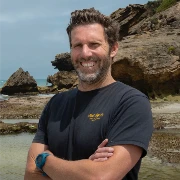
Associate Professor Adam Miller
Details
 College: School of Science
 Department: School of Science
 Campus: City Campus Australia
 adam.miller@rmit.edu.au
About
Adam Miller is an Associate Professor in Marine Science and Genomics at RMIT University. His research addresses both fundamental and applied questions relating to the ecology and evolution of native and invasive species.
Spanning marine, freshwater and terrestrial ecosystems, his research encompasses commercially important fisheries, threatened wildlife, culturally significant species, pest species and other organisms of high ecological importance. He has particular expertise in integrating genomic technologies and computational methods with field and laboratory experiments, geospatial tools and modelling approaches to investigate species' demographic histories, spatial and trophic ecology, patterns of adaptation, drivers of selection and long-term evolutionary potential.
His research involves close partnerships with industry, government agencies and Traditional Owner groups, with projects focused on improving biodiversity outcomes, ecosystem function, food security and pest management in a rapidly changing world.
Adam is also passionate about research-led education, developing engaging learning experiences that connect fundamental biological concepts with contemporary research, practical skills, field-based learning and real-world environmental challenges.

Teaching interests
Adam has extensive experience in the development and delivery of undergraduate and postgraduate teaching across genetics and genomics, molecular biology, bioinformatics, evolutionary biology, ecological and conservation genetics, wildlife conservation, marine science and environmental sustainability.
His teaching philosophy centres on creating engaging, research-led learning experiences that connect fundamental scientific concepts with their practical application. He is a strong advocate for blended teaching approaches that integrate theoretical learning, laboratory and computational practicals, immersive field experiences and direct engagement with industry and research professionals.
A particular focus of Adam's teaching is developing practical and vocational skills that prepare graduates for employment and further research. He aims to provide students with opportunities to engage with authentic scientific challenges, contemporary genomic technologies, real-world datasets and applied research projects. He also strongly values the teaching–research nexus, using field-based learning and student participation in research activities to contribute to longer-term environmental monitoring and management programs.
Adam is committed to incorporating Indigenous knowledge systems, cultural values and connections to Country into environmental and biological science education. He has experience developing learning activities in partnership with Traditional Owners, providing opportunities for students to engage with Indigenous perspectives on biodiversity, conservation and natural resource management.
Ultimately, Adam aims to develop scientifically literate, technically capable and critically thinking graduates who can apply their knowledge across research, biotechnology, conservation, fisheries and environmental management.

Research interests
Adam's research focuses on ecological and evolutionary genomics, integrating cutting-edge genomic technologies and computational approaches with ecological, experimental and geospatial methods to understand the processes shaping biodiversity, population dynamics, adaptation and species persistence.
His research interests span several interconnected areas:
Population and conservation genomics: Investigating genome-wide and functional genetic diversity, population connectivity, inbreeding, genetic erosion and evolutionary potential in threatened, exploited, invasive and functionally important species.
Whole-genome demographic reconstruction: Developing and applying genomic approaches to reconstruct historical population dynamics and effective population size trajectories, with applications in fisheries assessment, wildlife conservation and evaluating population sustainability.
Evolutionary and landscape genomics: Investigating patterns and drivers of local adaptation, environmental associations, gene flow and population differentiation, and understanding how species respond evolutionarily to changing environmental conditions across landscapes and seascapes.
Fisheries and aquaculture genomics: Applying genomic technologies to investigate demographic histories, biological stock structure, recruitment dynamics, adaptive capacity, genetic sustainability, trophic connections supporting fisheres, and to understand the impacts of exploitation and environmental change on commercial fisheries.
Climate adaptation and environmental resilience: Integrating genomic, experimental and geospatial approaches to investigate environmental tolerances, adaptive capacity and evolutionary responses to environmental change, and inform conservation, restoration and management strategies.
First Nations research and Indigenous-led conservation: Working in partnership with Traditional Owner groups to integrate Indigenous knowledge systems, cultural values and contemporary genomic and ecological science to address knowledge gaps and inform the conservation and management of culturally significant species, biodiversity and Country.
Environmental DNA and biodiversity monitoring: Developing and applying molecular approaches to assess biodiversity, monitor ecological communities, investigate species distributions and detect invasive species and emerging biosecurity threats.
Bioinformatics and computational biology: Developing and applying analytical workflows, statistical methods and simulation approaches to extract ecological and evolutionary insights from large-scale genomic datasets.
A central focus of Adam's research is translating advances in genomic technology into practical tools and evidence-based approaches for biodiversity conservation, fisheries assessment, environmental management and sustainable resource use. His research is highly collaborative, involving partnerships with government agencies, industry, philanthropic organisations, research institutions and First Nations groups across Australia and internationally.
This link provides access to Adam's publication histiry: Google Scholar