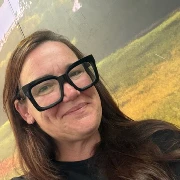
Dr. Tonya Meyrick
Details
 College: School of Design
 Department: School of Design
 Campus: City Campus Australia
 tonya.meyrick@rmit.edu.au
 ORCID: 0000-0002-8765-073X
 LinkedIn
Open to
- Masters Research or PhD student supervision
- Collaborative projects
- Industry Projects
About
Dr Tonya Meyrick is a designer, researcher and academic working at the intersection of regenerative design, colour, HCI and ethical practice. She holds a Vice-Chancellor's Senior Research Fellowship at RMIT University in the School of Design and Social Context, where she is establishing the Chroma Waste Lab and founding a new design research field of ethical colour.
This work leads from Perpetual Pigments, a practice-led project developing bio-derived, non-extractive pigments from textile waste as a sustainable alternative to synthetic colour systems. Having attracted over $1 million in competitive research funding, the project was co-developed with First Nations collaborators, received an international award citation at the International Anthem Awards in Sustainability (2024) and was showcased at the 13th International Design Biennial in Saint-Etienne. It demonstrates how design can activate circular economies and fundamentally rethink colour production.
Tonya's broader research portfolio spans 18 traditional research outputs across peer-reviewed journals, alongside over 85 non-traditional research outputs encompassing exhibition curation, speculative artefacts and interdisciplinary collaborations. Her internationally exhibited practice-led research responds to urgent global challenges, particularly environmental sustainability and material circularity, by advancing design as a socially embedded, culturally grounded and systems-oriented discipline.
She is a Research Leader at the Centre for Digital Ecology (CODE) at RMIT and a Chief Investigator on ARC Linkage project LP25010035 (2027-2030) in collaboration with Deakin University's Institute for Frontier Materials. Her collaborators include UNESCO, the United Nations, Textile Recyclers Australia, Rip Curl and Creative Victoria.
Tonya's design leadership is evidenced through awards from Good Design Australia, the International Anthem Awards and the Victorian Premier's Design Awards, alongside her curatorial role for Geelong Design Week and exhibitions at the Venice and Saint-Etienne Design Biennales. She is a jury member with the Design Institue to Victoria - GOTYA - graduate of the year awards. Her work is internationally recognised and spans research, curation and industry partnership across national and global sustainability contexts.
At the core of her practice is a belief in design as a transformative force, one that not only addresses problems but generates new ways of thinking, living and relating. Tonya continues to redefine design's capacity to shape a more just, connected and regenerative world.

Research fields
- 3303 Design
- 330306 Design practice and methods
- 330316 Visual communication design (incl. graphic design)
- 3606 Visual arts

UN sustainable development goals
- 12 Responsible Consumption and Production
- 13 Climate Action
- 11 Sustainable Cities and Communities

Academic positions
- Vice Chancellor's Senior Research Fellow
- RMIT University
- School of Design
- Melbourne, Australia
- 1 Jun 2026 – Present
- Senior Lecturer - Design
- Deakin University
- Faculty of Arts &Education
- Geelong, Australia
- 1 Jun 2010 – 29 May 2026

Non-academic positions
- Audit Committee - Member
- International Council of Design
- Lithuania
- 29 Nov 2024 – 1 Dec 2028

Degrees
- Masters Degree by Coursework, Creative Arts
- University of Melbourne
- Australia
- 2004 – Present
- Graduate Certificate, Education
- Deakin University
- Australia
- 2013 – Present
- Ph.D, Graphic and Design Studies
- Swinburne University
- null
- 2014 – Present
- Bachelor Degree Level, Graphic and Design Studies
- University of Tasmania
- Australia
- 1999 – Present
- Masters Degree by Research, Graphic and Design Studies
- University of Melbourne
- Australia
- 2006 – Present

Teaching interests
An award-winning educator, Tonya's teaching interests span design education and practice, regenerative design, circular design practices, design methodologies, typography, and the cultural, social and political dimensions of design practice. She supervises Higher Degrees by Research, bringing her practice-led research expertise into postgraduate mentorship, and actively engages students through work integrated learning and global exchange programmes. Her approach is student-centred, prioritising active learning, critical making and the development of design thinking that is both technically rigorous and socially aware.

Research interests
Tonya's research sits at the intersection of regenerative design, ethical colour and material circularity. She investigates how bio-derived pigments, waste textiles and circular systems can reframe colour production as a socially and ecologically responsible practice. Her work spans practice-led research, HCI, design systems thinking and AI systems, with a particular focus on how design can respond to urgent environmental challenges while remaining culturally grounded and community connected. A complementary strand of her research examines neurodiversity in the creative industries, exploring how design practice and education can better recognise and support neurodivergent ways of thinking and making.



