
New internet-reliant technologies like self-driving cars, remote controlled mining and medical equipment will require even faster speeds and increased bandwidth in the future. To keep up with this demand, we need continued growth in data-carrying capacity in the backbone fibre optic technology that carries all this data.
The research team led by Monash University’s Dr Bill Corcoran, RMIT’s Distinguished Professor Arnan Mitchell and Swinburne’s Professor David Moss combined their expertise in photonic chip technologies, high-capacity optical communications and microcomb technology.
The team joined forces with the aim of increasing the data-carrying capacity of our internet.
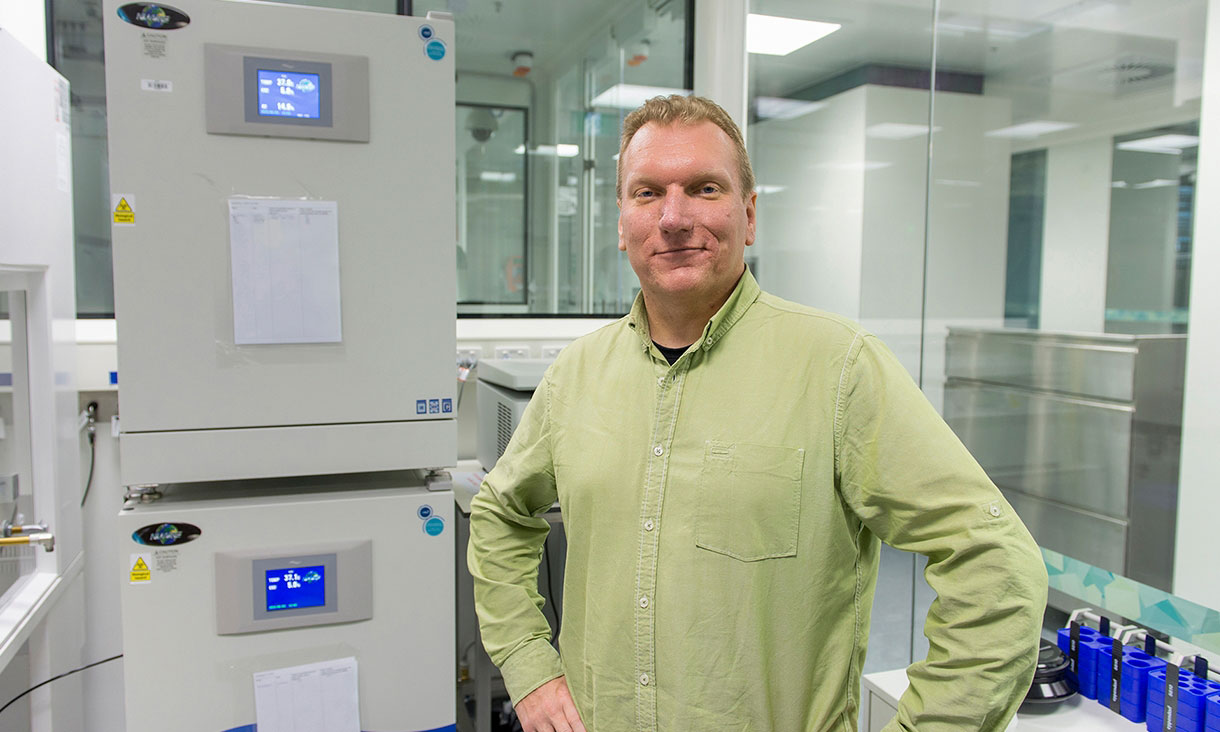 Arnan Mitchell creates innovative microchip technologies advancing photonics, fluidics and biomedical research.
Optical fibres like those used in the NBN transmit data on pulses of light.
The team's device, known as an optical micro-comb, creates a rainbow of infrared light allowing data to be transmitted on many frequencies of light at the same time, vastly increasing bandwidth.
Micro-combs had not been used in field trials before this study, when researchers placed the fingernail-sized chip – contributed by Swinburne University – onto optical fibres and sent maximum data down each channel to simulate peak internet usage.
The system achieved a data speed of 44.2 Tbps – around three times the record data rate for the entire NBN network and about 100 times the speed of any single device currently used in Australian fibre networks.
 Optical fibres transmit information as pulses of light.
Demonstrations of this magnitude are usually confined to a laboratory.
Significantly, this was tested on 76.6km of ‘dark’ optical fibres between RMIT’s Melbourne City Campus and Monash University’s Clayton Campus.
The fibre loop is part of the Australian Lightwave Infrastructure Research Testbed (ALIRT) established with investment from the Australian Research Council by a consortium led by Mitchell.
Mitchell said the testbed allows researchers to investigate innovative new approaches to increasing the data capacity of existing optical fibre networks.
Having RMIT University as the central node of this world-leading communications testbed gives us insight into the challenges and opportunities for next generation fibre optic communications in a real-world setting. It also gives us the ability to rapidly test new ideas.
Achieving the world’s fastest internet on a single optical chip at 44.2 Terabits per second
The breakthrough results and internet data speeds demonstrated the potential of microcomb technology to dramatically increase bandwidth while using existing optical fibre infrastructure.
The home-grown technology has the potential to fast-track the next 25 years of Australia’s – and the world’s – telecommunications capacity.
Using ALIRT, researchers can quickly validate that new data technologies are compatible with real-world systems, bringing the research teams closer to translating their work out of academia and into industry.
The use of microcombs to achieve this record-breaking internet speed on a single optical chip is astounding – it is a very exciting step forward to keep up with our world’s need for even faster internet speeds.
– Andrea Blanco-Redondo Head of Silicon Photonics Department at Bell Labs, USA
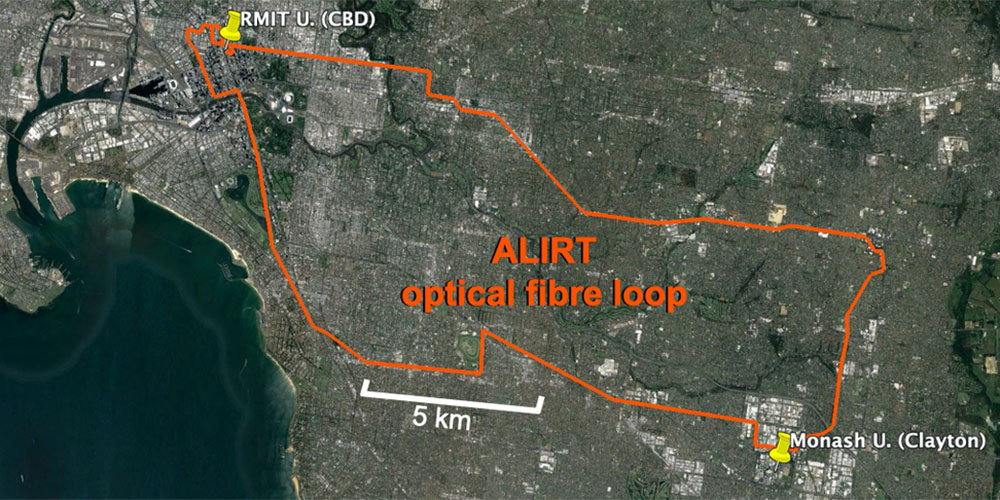 The test was carried out on a 75km optical fibre loop between RMIT and Monash University in Melbourne.
Mitchell said the future ambition of the project was to scale up the current transmitters from hundreds of gigabytes per second towards tens of terabytes per second without increasing size, weight or cost.
“Long-term, we hope to create integrated photonic chips that could enable this sort of data rate to be achieved across existing optical fibre links with minimal cost,” Mitchell said.
“Initially, these would be attractive for ultra-high speed communications between data centres. However, we could imagine this technology becoming sufficiently low cost and compact that it could be deployed for commercial use by the general public in cities across the world.”
*ALIRT is part of the InPAC laboratories linking RMIT and Monash University. The testbed was established under ARC Linkage Infrastructure and Equipment Funds LE170100160 as a collaboration between RMIT, Monash, Swinburne and AARNET. This project was supported by ARC Discovery Project 'Rainbows on Demand: coherent comb sources on a photonic chip' DP190102773.

Director, ARC Center of Excellence COMBS


RMIT University acknowledges the people of the Woi wurrung and Boon wurrung language groups of the eastern Kulin Nation on whose unceded lands we conduct the business of the University. RMIT University respectfully acknowledges their Ancestors and Elders, past and present. RMIT also acknowledges the Traditional Custodians and their Ancestors of the lands and waters across Australia where we conduct our business - Artwork 'Sentient' by Hollie Johnson, Gunaikurnai and Monero Ngarigo.
Learn more about our commitment to Aboriginal and Torres Strait Islander peoples


