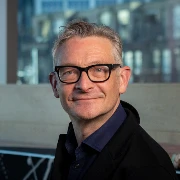
Chris Speed
Details
 College: School of Media & Communication
 Department: Education Portfolio
 Campus: City Campus Australia
 chris.speed@rmit.edu.au


Open to
- Masters Research or PhD student supervision
- Collaborative projects
- Industry Projects
- Join a web conference as a panellist or speaker
- Media enquiries
- Membership of an advisory committee
- Mentoring (short-term)
About
About Section:
Chris Speed FRSE is Director of the Regenerative Futures Institute and Professor of Design for Regenerative Futures at RMIT University, Melbourne, Australia. At RMIT, Chris leads Australia's first dedicated regenerative futures institute, bringing together 37 Regenerative Futures Fellows across all schools and colleges to transform how we educate for and research regenerative systems. The Institute launches publicly in March 2026 with pioneering interdisciplinary courses, research collaborations, and community partnerships that move beyond sustainability toward restoration and renewal. Chris has an established track record in directing large complex grants and educational programmes with academic, industry and third sector partners, applying design and data methods to social, environmental and economic challenges.
Previous Leadership Roles:
2022-2023: Director, Edinburgh Futures Institute Chris led the transformation of the 23,000m² Old Royal Infirmary of Edinburgh (a Florence Nightingale hospital in the centre of Edinburgh) into a world-leading centre for interdisciplinary teaching, research and innovation. EFI's distinctiveness stems from an approach combining multidisciplinarity with co-production, working with industry, government and communities at home and abroad to build a 'challenge-led' and 'data-rich' portfolio of activity with demonstrable ethical, social, economic and environmental impact.
2018-2024: Director, Creative Informatics R&D Partnership Led the £7.4m Creative Informatics programme, one of nine AHRC funded Creative Industries Clusters in the UK. This 4.5-year major programme for the UK's Creative Sector focused on data science and artificial intelligence, supporting creatives in Edinburgh and South East Scotland to innovate with data-driven technologies. The programme developed a network of over 5,000 creatives, trained 650+ in data-driven technologies, funded 130+ projects, developed 145+ new products and services, and secured over £6.78m in further funding. Partners included CodeBase, Creative Edinburgh, BBC, and National Galleries of Scotland.
2012-2022: Co-Director, Institute for Design Informatics, University of Edinburgh Co-led the Institute from its inception to become the largest, most successful research centre in the College of Arts, Humanities and Social Science, and one of the highest growth departments in intensive media in the UK. Uniquely positioned across the Schools of Design at Edinburgh College of Art and the world-class School of Informatics, the Institute grew to 80 staff across research, technical and professional services, masters and PhD programmes, with over £21m in grant income, establishing itself at the international forefront of design for human-data interaction.
2020-2025: Co-Investigator, DECaDE Centre Co-Investigator for the £5m Digital Economy Centre DECaDE led by University of Surrey with Digital Catapult and University of Edinburgh, exploring decentralised platforms enabled by AI, distributed ledgers and blockchain. Partners included BBC, Tesco Bank, NatWest, and the Bank of England.
2016-2020: Principal Investigator, OxChain Project Led the £1.1m collaborative research project between Universities of Edinburgh, Northumbria and Lancaster, developing smart contracting donation products with Oxfam, Zero Waste Scotland, Volunteer Scotland and WHALE Arts, resulting in the 'If/Then/Give' app launched with Oxfam Australia.
Consultancy & Community Work:
Chris' consultancy work supports organisations understanding value creation in data-driven economies. Clients include Oxfam, NatWest, UKRI, Asian Banking School, Franklin Templeton, and Tesco Bank. He remains committed to working respectfully with communities, with his co-developed projects with the Wester Hailes community in Edinburgh representing a personal career highlight.

Research fields
- 3303 Design
- 460806 Human-computer interaction
- 330314 Sustainable design
- 350201 Environment and climate finance
- 451906 Indigenous data and data technologies
- 330301 Data visualisation and computational (incl. parametric and generative) design
- 360503 Digital and electronic media art
- 470204 Cultural and creative industries

UN sustainable development goals
- 10 Reduced Inequalities
- 11 Sustainable Cities and Communities
- 12 Responsible Consumption and Production
- 13 Climate Action
- 16 Peace, Justice and Strong Institutions
- 7 Affordable and Clean Energy
- 9 Industry, Innovation and Infrastructure
- 5 Gender Equality
- 4 Quality Education

Academic positions
- Director
- RMIT University
- The Regenerative Futures Institute
- Melbourne, Australia
- 1 Jun 2025 – Present
- Professor of Design for Regenerative Futures
- RMIT University
- School of Design
- Melbourne, Australia
- 8 Jan 2024 – Present
- Professor
- University of Edinburgh
- Edinburgh Futures Institute
- Edinburgh, United Kingdom
- 1 Jan 2022 – 31 Dec 2024
- Professor
- University of Edinburgh
- Institute for Design Informatics
- Edinburgh, United Kingdom
- 1 Apr 2012 – 31 Dec 2021
- Reader
- University of Edinburgh
- Edinburgh College of Art
- Edinburgh, United Kingdom
- 1 Apr 2008 – 31 Mar 2012
- Senior Lecturer
- Plymouth University
- Institute for Digital Art & Technology
- Plymouth, United Kingdom
- 1 Aug 2006 – 31 Mar 2008
- Lecturer
- Plymouth University
- School of Computing
- Plymouth, United Kingdom
- 1 Aug 1996 – 31 Jul 2024

Supervisor projects
- Rituals of Colonisation: Designing, Re-staging, and Re-imagining Freemasonry as Colonial Infrastructure in the Frontier
- 11 Sep 2026
- Convening-With Fungi: Mapping and myceliating design methodology alongside vernacular knowledge groups in Australian Mycology.
- 29 Jun 2026
- Urban Quality-of-life Indicator System: Translating Local Priorities into Context-Sensitive Spatial Metrics.
- 13 Mar 2026
- Tracing Carbon Infrastructures and their Impacts in the Planetary Commons: A Critical Counter-Mapping and Testimonial approach to more Regenerative Futures
- 18 Feb 2026
- Designing more-than-human economies: Pollinators and regenerative organizing
- 5 Jan 2026
- Regulating artificial consciousness: mapping the priorities for an Australian regulatory response to AIs that demonstrate conscious thought
- 25 Aug 2025
- Broadening the epistemic infrastructure of ‘development’: Reconstituting autonomous cultures of design and sense-making
- 27 Mar 2025
- Storying the value of lifelong learning in digital society
- 3 Oct 2024

Teaching interests
- Design:
- Design Informatics: Designing from / with / by data.
- Critical and speculative design approaches to collaborating with more than humans.
- Regenerative design
- Design and innovation policy
- Social practice
- Human-Computer Interaction:
- FinTech by Design
- Blockchain / Distributed technologies
- Participatory methods
- Design Interactions
- Human-Data Interaction
I have led 22 PhD students and one MPhil student to successful completion:
Dr. Elisa Giaccardi: Principles Of Metadesign, 2003
Dr. Olubusayo Tolulope Onabolu: Architecture and the Creation of Worlds, 2010
Dr. Uli Speirling: Implicit Creation: Non-Programmer Conceptual Models for Authoring in Interactive Digital Storytelling 2012, University of Plymouth.
Dr. Elif Ayiter: Creativity Enablement in a Metaverse 2012, University of Plymouth.
MPhil Klas Hyllen: THE UNCONSCIOUS LIFE OF OLD TOWN A Psychoanalytic Study Of Edinburgh’s Historic City 2012
Dr. Karlyn Sutherland: Attachment to Place: Towards a Design Methodology 2013
Dr. Larissa Pschetz: Temporal Design: design for a multi-temporal world 2015
Dr. Rocio von Jungenfeld: Creative Mediated Places: a practice-based investigation into the creative possibilities of media in public space. 2015
Dr. Ingi Helgason: Complex Pleasures: Interactions in new-media art as a resource for the design of the user-experience (Registered at Napier University). 2015
Dr. Dave Wood: Visual Communication and the Aesthetics of Use: A Visual Phenomenological Methodology. 2015
Dr. Gianni Corino: Extending Social Networks through Objects, Things and Props (Registered at the University of Plymouth. 2016
Dr. Montasir Masoud Abdullah Alabdulla: Towards more pedestrian-friendly urban streets - Changing human travel behaviour in hot-humid car-dependent society, with reference to Dammam City, Saudi Arabia; A socio-cultural approach. 2017
Dr. Karl Monsen: Better medical apps for healthcare practitioners through interdisciplinary collaboration: lesson from transfusion medicine. 2017
Dr. Duncan Shingleton: Data Led Design: A practice research approach to understand the role of objects in the Internet of Things. 2018
Dr. Fabrizio Gesuelli: Learning from Protest Un-mediating Architecture. 2018
Dr. Diego Zamora: Crafting In The Digital Age; 3d Printing And Contemporary Approaches To Craft. 2018
Dr. Matteo Ronzani: Designing for Complexity: Data Visualizations in Megaproject Management. 2018
Dr. Lore Said: Humanizing Domestic Environment Using Collapsibility Concept as a Design Strategy. 2018
Dr. Ian Lambert: Narratives of Making: Modes of Articulating Tacit Knowledge. 2019
Dr Hadi Mehrpouya: Disrupting surveillance: critical software design-led practice to obfuscate and reveal surveillance economies and knowledge monopolies. 2019
Dr Lucas Godfrey: Automated Map Content Selection for Multi-Modal Travel (funded by the EPSRC / Ordnance Survey). 2020
Dr Vikki Jones: Cultural Value in Edinburgh: how the city’s cultural sector communicates its value and values. 2023

Research interests
The Institute for Design Informatics, remains a unique centre to explore how we design systems for better human data interaction, in diverse settings such as climate, health, culture, mobility and finance. Teams explore design from, with, and by data: the central concern being the design of how data flows in such a way as to sustain and enhance human (and more than human) values. Relevant technologies range from the internet of things, through blockchains, to robotics, natural language processing, data visualisation, interaction design, and social computing. Design informatics as a contemporary discipline across design research continues to combine data science with design methods in a context of critical enquiry and speculation.
A parallel institutional project that Chris co-designed and ultimately Directed, was the transformation of the 23,000m2 Old Royal Infirmary of Edinburgh, a Florence Nightingale hospital in the centre of Edinburgh, into a world leading centre for interdisciplinary teaching, research and innovation. The Edinburgh Futures (EFI) Institute (https://efi.ed.ac.uk/) seeks to pursue knowledge and understanding that supports the navigation of complex futures. EFI’s distinctiveness stems from our approach to research and innovation, education and engagement – an approach that combines multi-disciplinarity with co-production. Working with industry, government and communities at home and abroad, EFI aims to build a challenge-led and data-rich portfolio of activity that has demonstrable ethical, social, cultural, economic and environmental impacts.
Chris was involved in 49 research projects during his time at the University of Edinburgh, leading on 19 projects worth a total of £13.5.mil and Co-Investigating 30 projects worth in excess of £76mil. Chris was PI for the TOTeM project investigating social memory within the ‘Internet of Things’ funded by the Digital Economy (£1.4m) and the related Research in the Wild grant: Internet of Second Hand Things (£250k); PI for three AHRC Connected Community grants under the moniker Community Hacking that explores parallels between virtual society and actual society (£120k); Co-I to the Sixth Sense Transport RCUK funded Energy project (£900k) which explored the implications for the next generation of mobile computing for dynamic personalised travel planning. He was PI to the EPSRC funded Connected High Street project (£350k) with University of Dundee and NCR, and Co-I to the AHRC funded Design in Action Knowledge Exchange Hub (£6m). He is currently PI to the EPSRC TIPS grant OxChain (£1mil), PI to the ESRC After Money project (£250k), Co-I to the £5mil PETRAS IoT Hub and Co-I to the EPSRC TIPS PACTMAN grant (£1mil). Chris is Director of the £6mil (£5.5Mil AHRC & £0.5Mil SFC) Creative Informatics R&D Partnership, one of the nine AHRC funded Creative Industries Clusters in the UK, and is Co-I to the Next Stage Digital Economy Centre DECaDE led by Surrey with the Digital Catapult. Chris was made a Fellow of the Royal Society of Edinburgh in 2020.
Chris is a regular contributor to design conferences including the DRS,(https://www.drs2024.org/) EAD,(https://eadresearch.org/) DIS, (https://dis.acm.org/2024/)CHI (https://chi2024.acm.org/) and the Research Through Design (https://www.researchthroughdesign.org/) network for which he co-chaired the 2017 conference (http://www.researchthroughdesign.org/2017/) in Edinburgh.
In 2020 Chris was awarded the Chancellors Award for Research at the University of Edinburgh, the most prestigious recognition for commitment, expertise and experience in the development of research cultures and economies.




