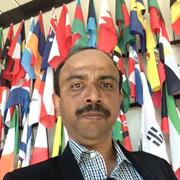
Professor Sivananthan Siva Sarasanandarajah
Details
 College: School of Health and Biomedical Sciences
 Department: Health and Biomedical Sciences
 Campus: Bundoora West Australia
 siva.sarasanandarajah@rmit.edu.au
 ORCID: 0000-0003-0854-2077
About
Professor Sarasanandarajah Sivananthan, B.Sc (Hons, Physics), PGDipSc (Distinction, Medical Physics), MSc (Medical Physics), PGCert (Physics Education), Ph.D (Medical Physics), FACPSEM, is an internationally recognised Medical Physicist, Scholar, and Inventor. He currently serves as a Senior Scientist (Senior Medical Physicist) at the Peter MacCallum Cancer Centre in Australia - one of the world’s leading academic cancer centres solely dedicated to cancer research, education and treatment.
In addition to his primary role, he holds academic appointments as an A/Professor at RMIT University (Australia) and as a Mentor Professor at Bharathiar University (India).
With over 30 years of clinical and academic experience in Medical Physics, Professor Sivananthan has trained and worked across prestigious institutions in:
-
IAEA: International Atomic Energy Agency, United Nations in Vienna, Austria
-
Australia: Royal Adelaide Hospital, University of Adelaide, Monash University
-
New Zealand: Auckland City Hospital, University of Canterbury
-
Japan: National Institute of Radiological Sciences & Chiba Cancer Centre
-
Sweden: Lund University, Malmo Hospital
-
Canada: Ottawa Hospital Cancer Institute, National Research Council, Carleton University
-
Sri Lanka: University of Jaffna, University of Peradeniya, National Cancer Institute
He has successfully defended his Ph.D. in Medical Physics at the University of Canterbury in New Zealand as a recipient of the prestigious Canterbury Doctoral Scholarship. His doctoral research resulted in a novel invention, and he is listed as the inventor on two internationally patented technologies, both of which have been commercialised.
Professor Sivananthan is a Fellow of the Australasian College of Physical Scientists and Engineers in Medicine (FACPSEM) and is registered as a Clinician Scientist in Medical Physics in the United Kingdom.
Notably, he recently held the position of International Expert in Medical Physics (with diplomatic status) at the International Atomic Energy Agency (IAEA) under the United Nations in Vienna, Austria. In this role, he led and implemented multiple medical physics and radiotherapy education and clinical projects across Asia, the Pacific, Europe, and the Middle East. His expert missions included countries such as:
-
Asia-Pacific: Vietnam, Nepal, Mongolia, Myanmar, Thailand, Malaysia, Indonesia, Bangladesh
-
Middle East & Central Asia: Saudi Arabia, UAE, Afghanistan, Tajikistan, Uzbekistan
-
Europe: Malta, Romania
He coordinated medical physics training programs involving 21 countries, contributed to international codes of practice and guidelines, and led coordinated research projects for both developed and developing nations. He also oversaw the IAEA-WHO global radiotherapy dosimetry audit of cancer treatment centres.
An accomplished academic, he has authored or co-authored over 70 peer-reviewed research articles and conference papers, and has delivered invited talks at major international conferences, including the World Congress in Medical Physics and the Asia-Oceania Conference on Medical Physics.
Professor Sivananthan is a recipient of numerous international awards, scholarships, and fellowships, notably including the prestigious Australia Endeavour Executive Award for high achievement, granted by the Australian Government.
He continues to supervise and collaborate with research students and institutions across Sri Lanka and India, and serves as an Editorial Board member for the SCI/SCIE Journal of Physical and Engineeing Sciences in Medicine & Expert Reviewer for several international indexed journals in the field of medical physics.

Media

Research fields
- 3202 Clinical sciences
- 5105 Medical and biological physics
- 3211 Oncology and carcinogenesis
- 4003 Biomedical engineering
- 3208 Medical physiology

UN sustainable development goals
- 4 Quality Education

Academic positions
- Associate Professor
- RMIT University
- Health & Biomedical Sciences
- Melbourne, Australia
- 1 Aug 2024 – Present
- Mentor Professor
- Bharathiar University
- Department of Medical Physics
- Coimbatore, India
- 1 Jul 2024 – Present
- Radiotherapy Medical Physics Expert
- International Atomic Energy Agency
- Vienna, Austria
- 1 May 2017 – 1 May 2019
- Adjunct Senior Lecturer
- Monash University
- Medical Imaging & Radiation Sciences
- Melbourne, Australia
- 1 Sep 2016 – 1 Jul 2024
- Adjunct Lecturer
- University of Adelaide
- Adelaide, Australia
- 1 Aug 2009 – 1 Sep 2015
- Research Fellow
- Lund University
- Lund, Sweden
- 2 Sep 2002 – 3 Mar 2003
- Lecturer
- University of Jaffna
- Jaffna, Sri Lanka
- 1 Aug 1995 – 1 Sep 2006

Non-academic positions
- Radiotherapy Medical Physics Expert
- International Atomic Energy Agency
- Vienna, Austria
- 1 May 2017 – 31 May 2019
- Australia Award Fellow
- Ottawa Hospital
- Ottawa, Canada
- 2 Sep 2013 – 23 Dec 2013
- Senior Scientist ( Senior Medical Physicist)
- Peter MacCallum Cancer Centre
- Melbourne, Australia
- 25 Feb 2013 – Present
- Scientist ( Medical Physicist)
- Royal Adelaide Hospital
- Adelaide, Australia
- 1 Nov 2008 – 15 Feb 2013
- Medical Physicist
- Auckland City Hospital
- Auckland, New Zealand
- 1 Mar 2006 – 30 Oct 2008
- IAEA Fellow
- National Institute of Radiological Sciences, Japan
- Chiba, Japan
- 1 Mar 2001 – 28 Feb 2002

Teaching interests
Professor Siva is a research supervisor and collaborator of the Medical Radiations Physics Research Group, which includes research students at Honours, Masters and PhD level. He also involved in teaching Medical Radiation physics to undergraduate students

Research interests
• Prostate Cancer, conformal treatment options with IGRT, 3DCRT, brachytherapy (LDR & HDR)
• Clinical implementation of functional imaging and radiobiological models in treatment planning and post implant evaluation in brachytherapy
• Radiation dosimetry, EPID dosimetry and In Vivo dosimetry
• Diagnostic Reference Levels & Dose optimisation in Medical Imaging
• Radiation Protection Dosimetry in Interventional Cardiology Practice
• Machine learning techniques in Medical imaging, including optical imaging




