
Melbourne is consistently ranked the world's best student city, and Australian universities are known for strong industry connections and research opportunities built into your degree. At RMIT, that includes courses designed around industry connections and a range of support built specifically for students from India.
Here's everything you need to know, from entry requirements to life in Melbourne.
Melbourne is Australia's top-ranked student city, and #5 in the world according to the QS Best Student Cities Rankings 2026, so you'll study in a place built around student life, not just somewhere with a university in it.
RMIT itself is ranked #1 in Australia for Art and Design (26th globally) and #1 in Australia for Architecture and Built Environment (21st globally), according to the QS World University Rankings by Subject 2025. Across all of our courses, you'll find strong industry connections, work placements and research opportunities already built into your degree, not bolted on afterwards.
RMIT also has a long-standing relationship with India. For example, our BITS-RMIT Higher Education Academy, a dual-degree partnership with Birla Institute of Technology and Science Pilani (BITS-Pilani), gives engineering students the chance to study across both institutions, one of the only programs of its kind shared between the two countries.
Business, health, computing and engineering are among the most in-demand study areas for international students across Australia. Here’s how that looks at RMIT, where many Indian students come to study in these areas.
From accounting to commerce, RMIT's business courses are shaped by real industry partnerships, encouraged by Melbourne's position as a major Asia-Pacific business hub.

RMIT's Master of Business Administration degree is ranked in the top #200 universities globally and #7 in Australia for the Global MBA in the QS World University Rankings by Subject 2026.
RMIT's engineering programs combine strong theoretical foundations with hands-on industry experience, including through the BITS-RMIT Higher Education Academy for students following the dual-degree pathway.

Two of RMIT's engineering specialisations are ranked among the best in the world. Civil Engineering sits at #26 globally and Aerospace Engineering at #34, with both ranked #1 in Australia, according to the ShanghaiRanking for 2026.
With demand driven by data science, cybersecurity and software development, RMIT's IT and data science courses are built around the skills employers worldwide are actively looking for.
Australia’s health system is globally respected, supported by strong public health infrastructure, biomedical research and allied health services.
Healthcare and social assistance is one of Australia’s largest and fastest-growing employment sectors, according to Jobs and Skills Australia. There is strong demand across nursing, allied health, medical research and laboratory sciences.

Entry requirements for Australian universities vary by institution and course, so it's worth understanding how they generally work before diving into specifics.
Each course page will have its own list of entry requirements, from academic prerequisites to additional selection tasks.
If you're completing Class 12 (CBSE, ISC or a state board) or hold a bachelor's degree from India, here's how entry requirements typically apply to most of the courses at RMIT.
To study in Australia, all international students must meet a minimum standard of English. English language requirements at Australian universities can differ based on university and course.
When applying to RMIT, you can demonstrate your English language proficiency in 3 ways:
If you are demonstrating your proficiency through an English test, RMIT accepts results from several English language proficiency tests, including:
For further information on this, see English language requirements.
If you don't meet the entry requirements for your course, there are alternate pathways to enter university in Australia, such as through vocational education, foundation programs and associate degrees. For more information, head to International Pathways.

Minimum class 12 requirements vary by university. At RMIT, these typically sit at around a 65% minimum* but vary by course and stream. You can find out more about Class 12 conversions, and how they apply to different levels of qualifications, on the dedicated page for Indian equivalents to RMIT’s academic requirements.
As a general guide on some of the most popular courses amongst students from India:
| Course | Minimum Class 12 percentage (All India Senior School Certificate (AISSC) or Indian School Certificate (ISC)) | State Boards of Education (Higher Secondary Certificate, HSC) equivalency |
|---|---|---|
|
65% |
70% |
|
|
65% |
70% |
|
|
65% |
70% |
|
|
65% |
70% |
|
|
65% |
70% |
* Equivalency in 2026. Every course sets its own entry requirements, so make sure to check directly on the course page for the most up to date and accurate information or speak with an international adviser.
Offers also depend on subject prerequisites, English language requirements, further studies undertaken after high school, any selection tasks or portfolios your course requires, and overall application strength and your ability to meet the Genuine Student requirement for the Student Visa program, as outlined by the Australian Department of Home Affairs.
Many Australian universities accept 3-year Indian bachelor’s degrees for coursework masters, but there can be some exceptions. Whether your degree is accepted for postgraduate entry depends on the course you’re considering. Here's how it plays out for a few popular master's degrees among Indian students at RMIT:
| Course | 3-year Indian bachelor's accepted? |
|---|---|
|
Yes, provided it meets the discipline requirements and is equivalent to an Australian bachelor's degree with a minimum GPA of 2.0 out of 4.0. |
|
|
Yes, provided it is equivalent to an Australian bachelor's degree. |
|
|
Yes, provided it is equivalent to an Australian bachelor's degree completed within the last 10 years with a minimum GPA of 2.0 (out of 4.0). Applicants with a GPA of at least 1.5 will be considered if they have at least 2 years of relevant industry experience. Please see the course page for further details on academic discipline requirements. |
|
|
Yes, provided it is equivalent to an Australian bachelor's degree with a minimum GPA of 2.0 (out of 4.0). |
|
|
Yes, provided it is equivalent to an Australian bachelor's degree or higher-level qualification in any discipline from a recognised tertiary institution. |

For up-to-date and accurate information, please head to the Entry Requirements section on our course pages.
In addition to meeting the minimum entry requirements and satisfying any course-specific prerequisites, students from India must also achieve a positive English proficiency test score, as described earlier on this page, in order to study at RMIT.
As an international student, you'll need to show evidence of sufficient funds as part of your student visa. This can include savings, education loans, or a combination of both, along with any scholarship you've been awarded. Many Indian students use an education loan to help cover tuition and living costs; check with your bank or the Department of Home Affairs for current proof-of-funds requirements before you apply.
Tuition and living costs across Australia vary depending on the university, course and city you choose, so here's a general guide to help you plan, using RMIT's current fees as a reference point.
Your fees will be based on the number of credit points you are enroled in for your degree, and the fee-per-credit-point for that course in the current year.
Most, but not all, degrees at RMIT have a standard annual full-time load of 96 credit points, so you can estimate your expected tuition fee for the year by multiplying the fee-per-credit-point by 96.
Fee per credit point x credits per year = annual fee
Living costs vary depending on the city you study in, for example, Melbourne is generally more affordable than Sydney, while still offering a major-city student experience. Here, you could budget around AU$30,000–45,000 per year for rent, food, transport and everyday expenses. Melbourne's compact city centre and student-friendly public transport can help keep day-to-day costs manageable, and on-campus or purpose-built student accommodation are often the most budget-predictable options.
For a full breakdown of fees, living costs and working rights, see our Cost of Studying in Australia for International Students guide.
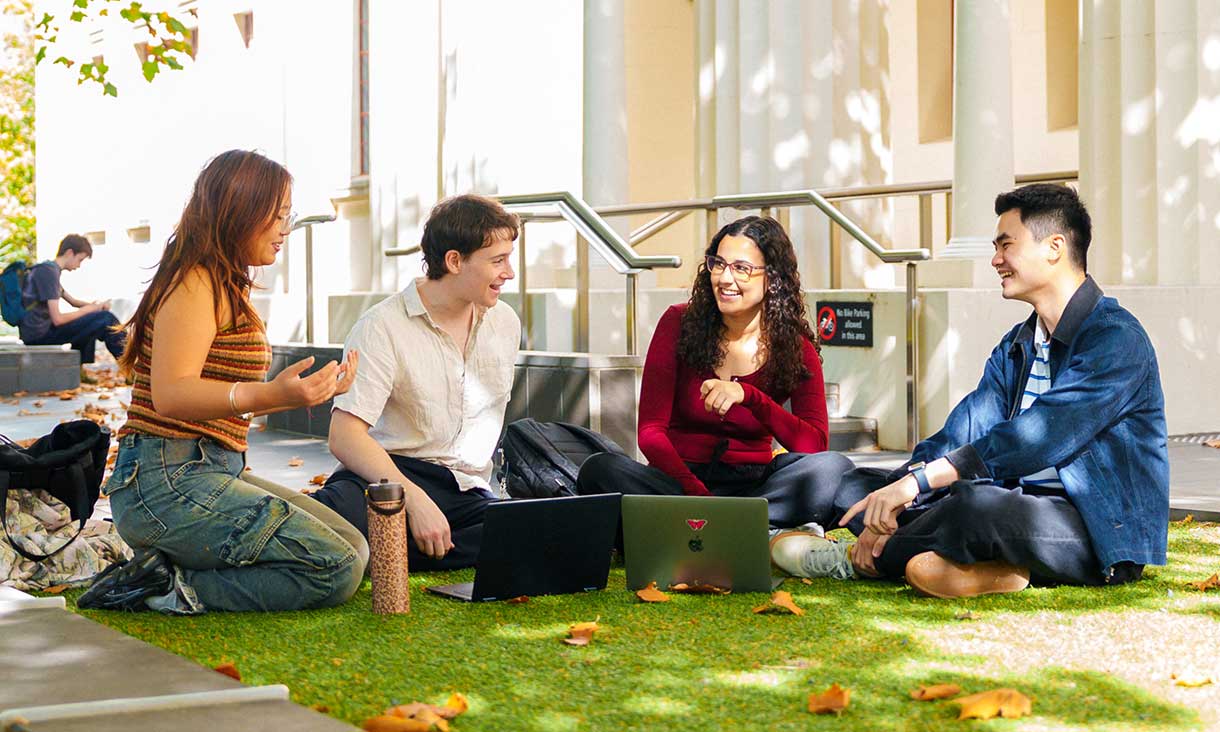
Studying in Australia is an investment in your future. Use our guide to tuition fees, everyday expenses and understanding working rights to help you plan ahead.
RMIT's Future Leaders Scholarship gives students from India and the wider subcontinent a 20% tuition fee reduction for the full duration of an eligible Bachelor's or Master's by coursework program. There's no separate application required; if you're a citizen of India, Sri Lanka, Bangladesh, Bhutan, Nepal or Pakistan and receive an offer for an eligible program, you'll automatically be considered.
This is one of the most direct ways to reduce the cost of studying at RMIT, and it's built specifically for students from India and the subcontinent, not a general international scholarship you're competing for against applicants from every other country.
Once obtained, your academic progress is reviewed each year to confirm your scholarship continues.
RMIT awards more than 2,000 scholarships to international students every year, across a range of criteria including academic merit, field of study and financial need. While the Future Leaders Scholarship is the most direct fit for Indian students, it's worth checking RMIT's full range of international scholarships to see if you're eligible for anything else, including scholarships tied to specific courses or faculties.

RMIT offers a range of scholarships to commencing international students across all fields of study. Browse our scholarships and see what you could be eligible for.
Melbourne has one of the largest Indian communities in Australia, and that's reflected on campus too. RMIT has thousands of international students from more than 100 countries, including a well-established Indian student community with its own clubs, societies and support networks. You'll find Indian grocery stores, restaurants and places of worship across the city, particularly in areas popular with students.
Diwali is one of the major celebrations on Melbourne's cultural calendar, alongside other festivals like Lunar New Year and Eid, celebrated both on campus through RMIT's cultural societies and citywide through public events. You won't be far from a sense of home, even when you're on the other side of the world.
Whether you're after the convenience of on-campus housing, the independence of a private rental, or the extra support of a homestay, students who come to Australia to study can find a living situation that suits their needs.
In addition to the accommodation types above, RMIT also offers student accommodation at all three of our Melbourne campuses.
Melbourne is known for being clean, safe and easy to navigate, with reliable public transport and student discounts on trams, trains and buses. RMIT's City campus sits right in the CBD, so classes, accommodation and everyday essentials are typically within walking distance or a short tram ride away.
Pack layers. Australia’s climate varies widely by region, and Melbourne in particular is famous for its ‘four seasons in one day’. You’ll need both sunscreen and a hoodie (sometimes in the same hour).
The application process to study in Australia is a guideline and the process may differ for some international students.
Before you apply, it helps to have the following ready:
Requirements vary by course, so check the documents required for your application before you start.
Many Indian students apply to RMIT through an RMIT-authorised education agent in India, who can help guide you through course selection, your application and visa preparation. Find an RMIT-authorised agent or book a 1-on-1 appointment with RMIT's international team directly.
Once you've accepted your offer, you'll need to apply for a student visa (subclass 500). You'll need your Confirmation of Enrolment, proof of funds, Overseas Student Health Cover (OSHC), and any additional supporting documents.
Most Indian students target the February intake at Australian universities because it offers the widest range of courses and the most scholarship opportunities, and lines up well if your Class 12 or bachelor's results are finalised by mid-year. The July intake suits students whose final results come through later in the year, or who need more time to prepare their application, English test or visa documentation.
RMIT is also one of the few Australian universities to offer a Semester 3 (October) intake for select programs. If your results or visa timeline don't line up with February or July, check whether your preferred course runs a Semester 3 intake.
Start your journey as an international student at RMIT and find the right course for you – with the support, networks and career opportunities to match.



RMIT University acknowledges the people of the Woi wurrung and Boon wurrung language groups of the eastern Kulin Nation on whose unceded lands we conduct the business of the University. RMIT University respectfully acknowledges their Ancestors and Elders, past and present. RMIT also acknowledges the Traditional Custodians and their Ancestors of the lands and waters across Australia where we conduct our business - Artwork 'Sentient' by Hollie Johnson, Gunaikurnai and Monero Ngarigo.
Learn more about our commitment to Aboriginal and Torres Strait Islander peoples