Take your first steps toward a career in the classroom. Focus on the education environment, inclusivity, and informed approaches to learning and teaching.
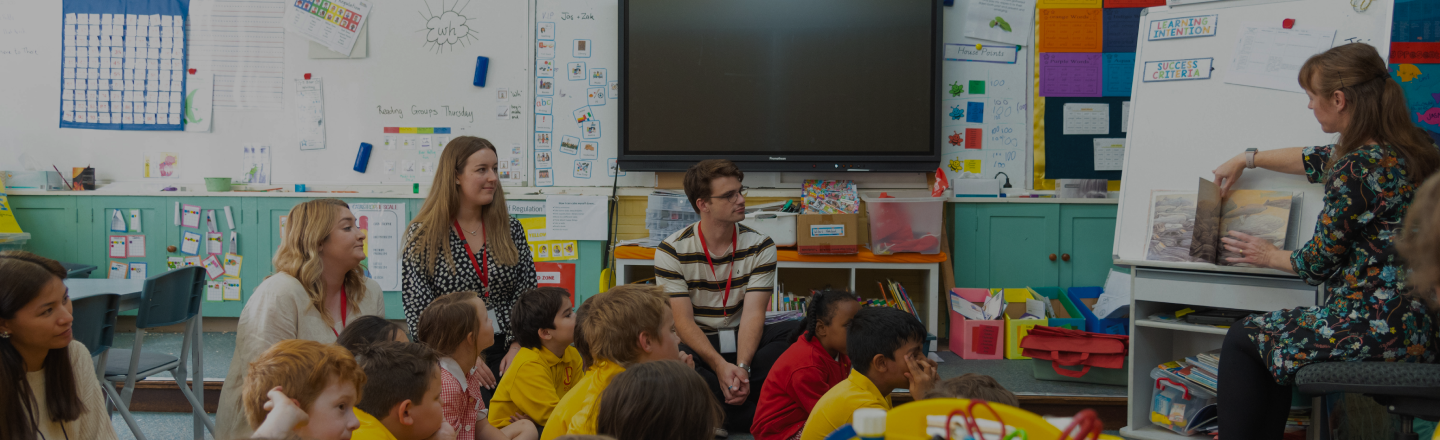
You will put learning into practice with supervised vocational placement working collaboratively with teachers and students in school and community settings.
At RMIT, you’ll be studying at an institution with expert teachers, passionate researchers and strong connection to industry.
This qualification may provide career opportunities in the education support sector, including education support worker, teacher assistant or integration/teacher aide.
RMIT offers a variety of learning and teaching approaches including lectures, seminars, studios, workshops, presentations and group work.
This diploma offers blended delivery with some online and some face-to-face classes.
The work and tasks you complete during this diploma will focus on the teaching and learning of children and young people.
Assessment may include observations, written tasks, oral tasks, group work, projects, work-based assessment, online tasks and evidence gathered from the workplace environment.
The types of classes you have will depend on the course you’re studying. Classes are offered in various formats designed to provide meaningful engagement with staff, industry and peers and provide for access and use of spaces where learning can be applied and active, including an array of specialised equipment.
Most RMIT courses do not include passive large-scale classes such as lectures, instead the content traditionally provided in lectures is made available online. This may be in the form of readings, videos or other on-demand learning materials. This content will also support the basis of interactive learning that takes place in on-campus classes.
The world is constantly changing, and there are universal skills that can help you adapt to the evolving nature of work and global engagement.
As part of your study experience at RMIT, we provide 6 future-focused RMIT Capabilities:
RMIT Capabilities are built into your course as well as some of our extracurricular experiences. They inform the design and delivery of your learning activities and assessments, so by the time you graduate, you’ll be ready to apply these capabilities in your life and work.
Throughout this diploma, students will engage in placements that are designed to develop the skills required to work under direct supervision in a real workplace.
Vocational placements are organised in negotiation with individual students. You will need to have a Working with Children Check (WWCC) before you commence work placement.
RMIT University is committed to providing an educational experience that strongly links formal learning with professional or vocational practice.
This course is competency-based and has been designed to help you develop the practical skills and knowledge necessary to work effectively in your chosen field. You will learn and be assessed by practising and demonstrating your capabilities, all of which can be readily applied in the workplace.
In addition to the specific vocational skills you build throughout this course, you will also develop a set of essential employability skills, including communication, planning, organising, and problem solving, self-management, initiative and teamwork. These foundational skills will enable you to navigate the world of work, collaborate effectively with others, and successfully get the job done.
As you begin your study in the Diploma of Teacher Education Preparation, you will explore the education system and contemporary issues in teaching.
You will study fundamentals of learning and supporting learning in both literacy and numeracy., as well as the use of digital tools in education.
As part of your study in this course, you will also complete an industry placement within a school setting designed to help hone your skills in a practical classroom environment.
This diploma further prepares you for studying at an undergraduate level with academic skills, literacy and numeracy.
Choose a plan below to find out more about the subjects you will study and the course structure.
If you are holding a temporary visa (other than a student visa) and your visa has a full study entitlement, you may be eligible to apply. For more information, see the international students with other temporary (non-student) visas.
As a graduate of the Diploma of Teacher Education Preparation, you will qualify to work in a diverse range of education and training roles, providing assistance and support to supervisors and teachers in educational and learning environments and situations.
Possible roles for graduates include:
You may also wish to pursue further study. Upon completion of this diploma, you have options to progress into the Bachelor of Education and other undergraduate education degrees.
You need to satisfy all of the following academic (entry) requirements to be considered for entry into this course.
There are no minimum academic entry requirements for this course. Applicants must meet the minimum university entry requirements.
There are no prerequisite subjects required for entry into this qualification.
A selection task is not required for entry into this qualification.
The following information outlines the tasks you will be required to undertake during professional experience placement and on-campus learning activities.
The non-academic abilities listed are provided for your information only and are not entry requirements.
By understanding the types of activities you'll participate in, you can:
If there are any activities outlined which may be difficult for you to undertake, there is a range of adjustments to your study conditions available to enable and support you to demonstrate these abilities.
Please contact the Equitable Learning Services (ELS) team to discuss any adjustments you may require. To receive learning adjustments, you need to register with ELS.
If you are living with disability, long-term illness and/or a mental health condition, we can support you by making adjustments to activities in your course so that you can participate fully in your studies.
The University considers the wellbeing and safety of all students, staff and the community to be a priority in academic and professional experience placement settings.
This course includes practical placement. If you are successful in obtaining a place in the course, you must meet a number of immunisation and compliance requirements upon commencement of your studies.
Throughout the course you will engage in placement that will develop the skills required to work under direct supervision in a real workplace.
Vocational placements are organised in negotiation with individual students.
If placement is undertaken in specialist schools, students will be required to meet the immunisation requirements as is required by DET for workers in specialist schools.
You must hold a Victorian Working with Children Check valid for 5 years, prior to undertaking clinical components as part of this course.
Note: For clinical components undertaken interstate, a valid Working With Children Check for that state is required.
A pathway is an alternative way to get into a course. RMIT's pathways can help you move through different levels of study to reach the qualification you're aiming for, even if you don't meet the requirements for your destination course.
This course has pathways available.
The Diploma of Teacher Education Preparation provides credit and guaranteed entry into further study.
Credit, recognition of prior learning, professional experience and accreditation from a professional body can reduce the duration of your study by acknowledging your earlier, relevant experience.
Credit and exemptions will be assessed consistent with the principles of the RMIT Credit Policy.
Credit may reduce the duration of your study by acknowledging your earlier, relevant study experience.
When you are submitting an application, please indicate that you want to be considered for credit and provide detailed course syllabus (also known as course outline), outlining volume of learning, course content and weekly topics, learning objectives/outcomes, assessment types and their weightings, and reference to the learning resources such as prescribed textbooks and recommended readings.
The tuition fees you will pay depends on your eligibility for government subsidies.
Not sure which fee type applies to you? Learn more and check your eligibility.
Fees are adjusted on an annual basis and these fees should only be used as a guide.
You may be eligible for a fee concession if you hold a valid Commonwealth Health Care Card, Pensioner Card, or Veteran's Gold Card, or are enrolled in the Asylum Seeker VET program. Find out more about fee concessions.
| Item | Description | Cost (AUD) |
|---|---|---|
| Tuition fee student pays
The total tuition fee you will be charged for a full-fee place
|
The total tuition fee you will be charged for a full-fee place
|
$13,000.00 |
| Student services and amenities fee (SSAF)
Based on 2026 cap of $373 per calendar year
|
Based on 2026 cap of $373 per calendar year
|
$373.00 |
| Material fees
Total cost of material fees associated with this course |
Total cost of material fees associated with this course
|
N/A
|
| Estimated total cost to you
Includes all fees listed above |
$13,373.00 |
The tuition fees shown include the Victorian Government contribution. This amount is reflected in your fees and is paid directly to RMIT by the Government: $ per nominal hour ($ total).
| Item | Description | Cost (AUD) |
|---|---|---|
| Tuition fee student pays
Tuition fees after government subsidy
|
Tuition fees after government subsidy
|
$6,250.00 |
| Student services and amenities fee (SSAF)
Based on 2026 cap of $373 per calendar year
|
Based on 2026 cap of $373 per calendar year
|
$373.00 |
| Material fees
Total cost of material fees associated with this course |
Total cost of material fees associated with this course
|
N/A
|
| Estimated total cost to you
Includes all fees listed above |
$6,623.00 |
The tuition fees shown include the Victorian Government contribution. This amount is reflected in your fees and is paid directly to RMIT by the Government: $7.15 per nominal hour ($5,219.50 total).
| Item | Description | Cost (AUD) |
|---|---|---|
| Tuition fee student pays
Tuition fees exempt for eligible students in a government subsidised place
|
Tuition fees exempt for eligible students in a government subsidised place
|
$0.00 |
| Student services and amenities fee (SSAF)
Based on 2026 cap of $373 per calendar year
|
Based on 2026 cap of $373 per calendar year
|
$0.00 |
| Material fees
Total cost of material fees associated with this course |
Total cost of material fees associated with this course
|
N/A
|
| Estimated total cost to you
Includes all fees listed above |
$0.00 |
The tuition fees shown include the Victorian Government contribution. This amount is reflected in your fees and is paid directly to RMIT by the Government: $7.15 per nominal hour ($5,219.50 total).
Generated on 25 June 2026 | RMIT University's Registered Training Organisation (RTO) Code is 3046 | Payment and refund information
VET Student Loan cap for Diploma of Teacher Education Preparation (C5422): $19290
Any tuition fees above the cap must be paid upfront to RMIT by their due date. Caps are indexed annually by the Commonwealth Government. Eligibility applies.
Learn about eligibility for VSL|
$0
|
|||||
|
|||||
$ per nominal hour ($ total).
Choose the specific course plan to see relevant fee information:
VET Student Loan cap for (): $
Any tuition fees above the cap must be paid upfront to RMIT by their due date. Caps are indexed annually by the Commonwealth Government. Eligibility applies.
Learn about eligibility for VSLRMIT awards more than 2000 scholarships every year to recognise academic achievement and assist students from a variety of backgrounds.
RMIT awards more than 2000 scholarships every year to recognise academic achievement and assist students from a variety of backgrounds.
Use our Frequently Asked Questions to learn about the application process and its equity access schemes, find out how to accept or defer your offer or request a leave of absence, discover information about your fees, refunds and scholarships, and explore the various student support and advocacy services, as well as how to find out more about your preferred program, and more.

RMIT University acknowledges the people of the Woi wurrung and Boon wurrung language groups of the eastern Kulin Nation on whose unceded lands we conduct the business of the University. RMIT University respectfully acknowledges their Ancestors and Elders, past and present. RMIT also acknowledges the Traditional Custodians and their Ancestors of the lands and waters across Australia where we conduct our business - Artwork 'Sentient' by Hollie Johnson, Gunaikurnai and Monero Ngarigo.
Learn more about our commitment to Indigenous cultures