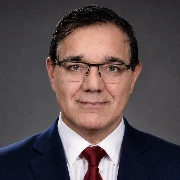
Professor Reza Hoseinnezhad
Details
 College: School of Engineering
 Department: School of Engineering
 Campus: City Campus Australia
 reza.hoseinnezhad@rmit.edu.au


Open to
- Masters Research or PhD student supervision
About
Professor Reza Hoseinnezhad is a leading researcher, academic leader and educator in autonomous systems, statistical signal processing, information fusion, machine vision, multi-object tracking and intelligent transportation systems. He has been based at RMIT University since 2010 and is Professor of Autonomous Systems in the School of Engineering.
Before joining RMIT, Professor Hoseinnezhad held academic and research positions at the University of Tehran, Swinburne University of Technology and the University of Melbourne. He holds a PhD in Robotics from the University of Tehran, where his thesis on intelligent path planning of mobile robots using sensor data fusion received the Distinguished Thesis Award.
The domains in which Professor Hoseinnezhad has managed and contributed research include statistical machine vision, information fusion, multi-object systems, multi-target tracking, computer vision, autonomous vehicles, robotics, sensor fusion, robust estimation, control systems, intelligent transportation systems, autonomous navigation, machine learning, safety-critical systems and advanced manufacturing. As a result, he has contributed to a substantial portfolio of nationally competitive, government-funded, industry-facing and internationally collaborative research, creating impact through research translation, industry partnerships, patents, academic publications, invited keynote addresses, HDR supervision and academic leadership.
Professor Hoseinnezhad’s research is centred on the development of mathematical, statistical and computational methods that enable intelligent systems to perceive, estimate, track, decide and act in uncertain, cluttered and dynamic environments. His work has made significant contributions to random finite set theory, labelled multi-Bernoulli filtering, multi-target tracking, track-before-detect methods, distributed multi-sensor fusion, sensor management, robust visual estimation, stochastic geometry and statistical computer vision. These methods underpin applications in autonomous vehicles, connected driving, robotic swarms, radar systems, defence platforms, surveillance, smart manufacturing, infrastructure inspection, medical imaging, microscopy, underwater vehicles and industrial automation.
Professor Hoseinnezhad’s projects have required the deployment of advanced signal processing, machine vision, sensor fusion, artificial intelligence, control theory and autonomous systems methods for a wide range of government and industry partners. His funded research has involved organisations including the Australian Research Council, iMOVE CRC, CSIRO Data61, Food Agility CRC, Defence Science and Technology Group, Defence Science Institute, Rheinmetall Defence Australia, Rail Manufacturing CRC, Australian Meat Processor Corporation, Automotive Engineering Graduate Program partners, APV Engineering & Testing Services, APV Safety Products and Thrust Maritime.
Relevant government and industry projects have also ensued with the Department of Infrastructure, Transport, Regional Development, Communications, Sport and the Arts; the Australian Mathematical Sciences Institute; the Victorian Government; the Commonwealth Government; and international funding agencies including the Natural Science Foundation of China. These projects span road condition monitoring, undersea navigation, intelligent automation, mixed reality for aircraft maintenance, connected vehicle networks, advanced photonic navigation, fleet-based sensing, robotic inspection, meat processing analytics, road safety, vehicle safety, autonomous vehicle deployment and automated manufacturing inspection.
Professor Hoseinnezhad works with collaborators across Australia, Asia, Europe, the United Kingdom, North America and South America, thereby fostering a global outlook and reach through his research. He has delivered keynote, plenary and invited talks in Australia, Vietnam, the Czech Republic, Iran, Chile, China, the United Kingdom and the United States. He has also contributed expert commentary on autonomous driving and participated in strategic university discussion on emerging issues such as lethal autonomous weapons.
Professor Hoseinnezhad has published extensively across signal processing, computer vision, robotics, autonomous vehicles, intelligent transportation systems, control, vehicular technology, industrial electronics, aerospace systems and artificial intelligence. His publications include the 2024 research book The Labeled Multi-Bernoulli Filter: A Comprehensive Guide for Practitioners, book chapters, journal articles and conference papers in leading venues such as IEEE Transactions on Signal Processing, IEEE Transactions on Intelligent Transportation Systems, IEEE Transactions on Pattern Analysis and Machine Intelligence, IEEE Transactions on Image Processing, IEEE Transactions on Vehicular Technology, IEEE Transactions on Industrial Electronics, Pattern Recognition, Computer Vision and Image Understanding, Information Fusion, Aerospace Science and Technology, ISA Transactions and Engineering Applications of Artificial Intelligence.
On research leadership, Professor Hoseinnezhad has held major academic leadership roles within RMIT’s School of Engineering. From 2019 to 2023 he served as Associate Dean, Mechanical and Automotive Engineering, leading a portfolio with a headcount of 72 and monitoring a budget of $65 million. During this period, the portfolio’s research income KPI increased five-fold and its industry engagement KPI increased seven-fold. He has also served as Discipline Leader for Manufacturing and Mechatronics and as Research Development Lead for the School of Engineering, facilitating industry engagement across a portfolio of more than 200 staff.
Professor Hoseinnezhad’s research has also resulted in intellectual property outcomes. His patents include signal processing methods and apparatus for missing data handling by multi-step-ahead predictive filtering; signal processing and position-determining apparatus and methods; and pulse and gap control for electrical discharge machining equipment. This work reflects the applied engineering orientation of his research, connecting theoretical advances in estimation, sensing and control with practical technologies in automotive systems, manufacturing and safety-critical engineering.
Professor Hoseinnezhad has made significant contributions to engineering education. His teaching areas include mechatronics, autonomous systems, signals and systems, image processing, probability and statistics, control systems, sensor fusion and machine vision. At RMIT he developed and coordinated project-based learning courses including Automated System Design, Autonomous Systems and Mechatronics Principles. He has also taught Automatic Control Systems and Design for Assembly and Automation, and has held teaching roles at the University of Melbourne, Swinburne University of Technology and the University of Tehran.
Professor Hoseinnezhad mentors researchers from early-stage students through to PhD candidates and postdoctoral collaborators. His PhD supervision record includes 16 completions and 6 current candidates. His supervision spans autonomous systems, multi-object tracking, computer vision, sensor fusion, robotics, connected vehicles, machine learning, smart manufacturing, undersea systems, intelligent transportation and safety-critical engineering systems.
Professor Hoseinnezhad has contributed to scholarly and professional service through national research assessment, editorial leadership and university governance. He has served as an assessor for Australian Research Council Discovery, Linkage and Centre of Excellence programs, as Associate Editor of IEEE Transactions on Vehicular Technology, and as Associate Editor of IEEE Transactions on Intelligent Transportation Systems. He has also served as an elected member of the RMIT Academic Board and RMIT College Board, and as an invited member of an Engineers Australia accreditation panel.
Professor Hoseinnezhad has received numerous awards and recognitions for research, teaching, leadership and scholarly contribution. In 2026, he was recognised as a National Field Leader in Signal Processing in The Australian Research Magazine’s Top 250 Australian Researchers. He has also received best paper awards at international conferences, the RMIT School of Engineering Research Excellence Award, the RMIT Learning and Teaching Innovation Award, the RMIT Outstanding Contribution Award, Swinburne University of Technology’s Vice Chancellor Research Award, the University of Tehran Distinguished Thesis Award and a Japanese Government Monbusho Scholarship.
Through his research, leadership, teaching and professional service, Professor Hoseinnezhad advances autonomous systems that are mathematically rigorous, computationally robust and relevant to real-world societal and industrial challenges. His work connects statistical signal processing, machine vision, sensor fusion, robotics, artificial intelligence and engineering practice to support safer transport systems, more capable autonomous platforms, smarter manufacturing processes, more reliable sensing networks and more intelligent decision-making systems.
Awards- 2026 – National Field Leader in Signal Processing, The Australian Research Magazine: Top 250 Australian Researchers 2026
- 2025 – Best Paper Award, International Conference on Intelligent Systems and Networks, Hanoi, Vietnam
- 2023 – Best Paper Award, International Conference on Control, Automation and Information Sciences, Hanoi, Vietnam
- 2018 – Research Excellence Award, School of Engineering, RMIT University, awarded for outstanding research performance in 2017
- 2013 – Learning and Teaching Innovation Award, School of Aerospace, Mechanical and Manufacturing Engineering, RMIT University, awarded for development of project-based learning courses and laboratories
- 2013 – Best Paper Award, International Conference on Control, Automation and Information Sciences, Saigon, Vietnam
- 2013 – Outstanding Contribution Award, School of Aerospace, Mechanical and Manufacturing Engineering, RMIT University, awarded for overall outstanding performance in teaching and research
- 2006 – Vice Chancellor Research Award, Swinburne University of Technology, awarded for outstanding research performance in the early career category
- 2003 – Distinguished Thesis Award, University of Tehran, awarded for outstanding PhD research
- 2000 – Monbusho Scholarship, awarded by the Japanese Government
Current and Recent Research Projects
- 2025–2029 – Physics-Informed, Passive Undersea Navigation via Situational Awareness
Funding – CSIRO Data61 NGET Graduate Program, Emerging Technologies for the Integration of Autonomous Vehicles into Networked Naval Operations, $117,505 - 2025–2028 – Crash Dynamics Simulation: Enhancing Vehicle Safety and Occupant Survival Strategies
Funding – National Industry PhD Grant, APV Engineering & Testing Services, $155,000 - 2025–2028 – Electronic High-Speed Pre-Tension System for a Seatbelt Retractor
Funding – National Industry PhD Grant, APV Safety Products, $155,000 - 2025–2027 – Enhancing Road Safety Through Fleet-Based Vehicle Sensor Technology: A Strategy for Monitoring Road Conditions in Australia
Funding – Department of Infrastructure, Transport, Regional Development, Communications, Sport and the Arts, $1.25 million - 2025–2026 – High-Speed In-Situ Characterisation of Aeroperm Ribbon
Funding – iMOVE CRC, Project 1-091, $600,000 - 2024–2026 – Empowering Data-Driven Decision Making in Meat Processing Plants
Funding – Food Agility CRC, Project FA141, $795,000 - 2022–2025 – All System Analysis, Analytics and Intelligent Automation
Funding – CSIRO Data61 Next Generation Graduates Program, $1,073,880 - 2022–2023 – Control and Optimise a Marine Barge on a Lake Using Mathematical Modelling and Control Theory
Funding – APR.Intern and Thrust Maritime Pty Ltd, $16,000 - 2022 – Mixed Reality for Aircraft Maintenance
Funding – Defence Science and Technology Group, $100,000 - 2021–2025 – Detection of Structure and Defects of Additively Manufactured Parts
Funding – CSIRO PhD Scholarship, $81,000 - 2021–2022 – Capability Development for 3D Virtual Representation of Stress Visualisation Data
Funding – Defence Science Institute, $120,000 - 2020–2023 – Automated Integrity Assessment of Self-Piercing Rivet Joints: i4.0 Approach
Funding – Australian Research Council Linkage Project LP190100165, $281,205 - 2020–2022 – ACW Phase 1: Deep Intelligence Machine Simulator
Funding – Rheinmetall Defence Australia, $1,343,378 - 2020 – Effective Tracking in Multi-Agent Systems
Funding – Australian Mathematical Sciences Institute, $20,500 - 2020 – Drone Video/Image Feature Extraction and Labelling
Funding – Australian Mathematical Sciences Institute, $14,500
- 2019–2022 – Miniature Crawling Robots for Rolling Stock Manufacture and Maintenance
Funding – Rail Manufacturing CRC, RM-CRC Grant R2.7.10, $150,000 - 2019–2021 – Advanced Integrated Photonics Circuits for Future Navigation Systems in Autonomous Driving Cars
Funding – Automotive Engineering Graduate Program, AEGP000007, $264,858 - 2019–2021 – Wireless Systems for Vehicular Access, Security and Safety
Funding – Automotive Engineering Graduate Program, AEGP000053, $505,716 - 2019–2021 – Development of a Simulation Tool for Adoption and Deployment of Autonomous Vehicles
Funding – Automotive Engineering Graduate Program, AEGP000050, $262,858 - 2019–2021 – Multi-Target Tracking for Autonomous Vehicle Cooperative Perception
Funding – Natural Science Foundation of China, NSFC Grant 51805055, ¥250,000 - 2018–2021 – Dynamic Programming Based Track-Before-Detect Method for Netted Radar Systems
Funding – Natural Science Foundation of China, NSFC Grant 61771110, ¥670,000 - 2018–2020 – Vision Systems for Process Control in Metal Additive Manufacturing
Funding – CSIRO PhD Scholarship, $81,000 - 2017–2018 – Intelligent Solutions for Boxed Beef Trim Export Enhancement
Funding – Australian Meat Processor Corporation, $280,000 - 2016–2018 – Crowd Tracking and Visual Analytics for Rapidly Deployable Imaging Devices
Funding – Australian Research Council Linkage Project LP160101081, $301,597 - 2016–2018 – Visual Intelligence for Safe Vehicle Operation in Industrial Environment
Funding – Australian Research Council Linkage Project LP160100662, $356,250 - 2016–2018 – Multi-Object Estimation for Live Cell Microscopy
Funding – Australian Research Council Discovery Project DP160104662, $419,552 - 2016–2018 – Educational Pathways: Creating a Highly Skilled Meat Industry
Funding – Australian Meat Processor Corporation, $950,348 - 2015–2016 – Development of Machine Vision Technologies for Automated Activity Detection
Funding – Commonwealth Government Research Connection Grant RC48071, $98,676 - 2015 – Development of Advanced Computer Vision Technology for Smart Time-Lapse Photography
Funding – Victorian Government Technology Development Voucher TDev396, $62,500 - 2014–2017 – Automated Visual Inspection and Preparation of Live Animals for Meat Processing
Funding – Australian Meat Processor Corporation, $445,600 - 2014–2017 – Development and Demonstration of a Low-Signature, Rechargeable and Portable Energy Supply Using Reversible Hydrogen Fuel Cells
Funding – Defence Science and Technology Organisation Capability and Technology Demonstrator Project, $1,600,000 - 2013–2016 – Intelligent Collision Avoidance System for Mobile Industrial Platforms
Funding – Australian Research Council Linkage Project LP130100521, $385,000 - 2013–2016 – A Stochastic Geometric Framework for Bayesian Sensor Array Processing
Funding – Australian Research Council Discovery Project DP130104404, $295,000 - 2005–2008 – Data Fusion Techniques for Electro-Mechanical Braking Systems
Funding – Australian Research Council Linkage Project LP0561923, $186,664
Professor Hoseinnezhad’s publication record includes:
- 2024 – The Labeled Multi-Bernoulli Filter: A Comprehensive Guide for Practitioners, Cambridge Scholars Publishing
- Book chapters on audio-visual fusion, intelligent situational awareness, reinforcement learning for quadruped robots, stochastic sensor management, visual data segmentation and nonlinear electromechanical braking systems
- Journal articles in signal processing, intelligent transportation systems, pattern analysis, machine vision, computer vision, autonomous vehicles, robust estimation, multi-object tracking, sensor fusion, robotics, medical imaging, industrial electronics and artificial intelligence
- Conference papers in leading international venues including IEEE/RSJ International Conference on Intelligent Robots and Systems, IEEE/CVF Conference on Computer Vision and Pattern Recognition, IEEE Intelligent Transportation Systems Conference, International Conference on Information Fusion, International Conference on Control, Automation and Information Sciences, and related venues
- 2014 – Pulse and Gap Control for Electrical Discharge Machining Equipment
Patent Number PCT/AU2014/000076 - 2006 – Signal Processing Methods and Apparatus: Missing Data Handling by a Multi-Step-Ahead Predictive Filter
Published as International Patent WO/2006/092026, with associated Chinese, European and Canadian patents - 2005 – Signal Processing and Position-Determining Apparatus and Methods
Published as International Patent WO2005124487, with associated United States, Japanese, European, Chinese and Canadian patents
- 2024 – Media Interview, 2PM Radio 531, Australia
Expert commentary on Tesla’s proposal to see fully autonomous self-driving cars on United States roads by 2026 - 2019 – Strategic Conversation, RMIT Academic Board, Melbourne, Australia
Contribution to institutional discussion on joining the pledge against lethal autonomous weapons - 2010 – BusinessWeek, published online
Commentary in “Toyota’s woes raise questions about auto electronics”
- 2025 – Keynote Talk
International Conference on Intelligent Systems and Networks, Hanoi, Vietnam - 2022 – Keynote Talk
International Conference on Control, Automation and Information Sciences, Hanoi, Vietnam - 2021 – Invited Plenary
IEEE/RSJ International Conference on Intelligent Robots and Systems, Prague, Czech Republic - 2018 – Keynote Speaker
Emerging Sensing Technologies Summit, RMIT University, Melbourne, Australia - 2017 – Keynote Speaker
Iranian Electrical Engineering Conference, K. N. Toosi University of Technology, Tehran, Iran - 2016 – Keynote Speaker
IEEE RAS International Workshop on Vision, Robotics and Tracking Applications, University of Chile, Santiago, Chile - 2015 – Invited Talk
Recent Developments in Multi-Bernoulli Solutions for Multi-Target Tracking, Fudan University, Shanghai, China - 2015 – Invited Talk
Recent Developments in Multi-Bernoulli Solutions for Multi-Target Tracking, University of Electronic Science and Technology of China, Chengdu, China - 2014 – Invited Talk
Recent Advances in Random Set Solutions for Computer Vision, University of Adelaide, Adelaide, Australia - 2014 – Invited Talk
Recent Advances in Bayesian Multi-Object Filtering Using Random Set Theory, University College London, London, United Kingdom - 2011 – Invited Talk
Recent Applications of Random Set Theory in Multi-Object Estimation and Tracking, Changshu Institute of Technology, Jiangsu, China - 2010 – Invited Talk
Stochastic Geometry for Visual Tracking, University of Adelaide, Adelaide, Australia - 2010 – Invited Talk
High-Breakdown Robust Estimation, University of Adelaide, Adelaide, Australia - 2010 – Invited Talk
Multi-Object Estimation in a Stochastic Geometric Framework, IEEE Signal Processing Chapter, Curtin University, Perth, Australia - 2010 – Invited Talk
Visual Multi-Target Tracking Using Random Finite Sets, CISR, Deakin University, Victoria, Australia - 2010 – Invited Talk
Joint Detection and Tracking of Multiple Targets from Video, Center for Multimedia Communication, Rice University, Houston, United States
- 2019–2023 – Associate Dean, Mechanical and Automotive Engineering, School of Engineering, RMIT University
Led a portfolio with a headcount of 72 and monitored a budget of $65 million. During this period, the portfolio’s research income KPI increased five-fold and its industry engagement KPI increased seven-fold. - 2019 – Discipline Leader, Manufacturing and Mechatronics, School of Engineering, RMIT University
Led a portfolio with a headcount of 24, including staff workplan management. - 2018 – Research Development Lead, School of Engineering, RMIT University
Facilitated industry engagement across a portfolio of more than 200 staff, contributing to $2 million in new research income.
Professor Hoseinnezhad’s teaching areas include mechatronics, autonomous systems, signals and systems, image processing, probability and statistics, control systems, sensor fusion and machine vision.
His teaching experience includes:
- 2025–present – Automatic Control Systems
Lecturer and Course Coordinator, RMIT University - 2024–present – Design for Assembly and Automation
Lecturer and Course Coordinator, RMIT University - 2010–2019 – Automated System Design
Lecturer and Course Coordinator, RMIT University; project-based learning course developed from scratch - 2010–2019 – Autonomous Systems
Lecturer and Course Coordinator, RMIT University; project-based learning course developed from scratch - 2010–2015 – Mechatronics Principles
Lecturer and Course Coordinator, RMIT University; project-based learning course developed from scratch - 2009 – Control 1
Lecturer, University of Melbourne - 2004–2008 – Robotics and Mechatronics Project 2
Lecturer and Laboratory Instructor, Swinburne University of Technology - 2004–2008 – Robotics and Mechatronics Project 1
Lecturer and Laboratory Instructor, Swinburne University of Technology - 2001–2002 – Engineering Statistics and Probability
Lecturer and Course Coordinator, University of Tehran - 2001–2002 – Signals and Systems
Lecturer and Course Coordinator, University of Tehran - 1996–1999 – Linear Control Systems
Lecturer, University of Tehran - 1996–1999 – Electronics 1
Lecturer, University of Tehran - 1996–1999 – Electric Circuits 1
Lecturer, University of Tehran
- Current PhD candidates: 6
- PhD completions: 16
- 2023 – Invited Member of Engineers Australia Accreditation Panel
Engineers Australia - 2017–2018 – Elected Member of RMIT Academic Board
RMIT University - 2015–2016 – Elected Member of RMIT College Board
RMIT University - 2011–2019 – Associate Editor
IEEE Transactions on Intelligent Transportation Systems - 2010–present – Assessor
Australian Research Council Centre of Excellence Program - 2008–present – Assessor
Australian Research Council Discovery and Linkage Project Programs - 2005–2012 – Associate Editor
IEEE Transactions on Vehicular Technology

Supervisor projects
- Certification of Metal Additive Manufactured (3D Printed) Components by Development of a Novel Thermal Fuse
- 17 Feb 2026
- Development of crash dynamics simulation models for school buses
- 7 Aug 2025
- Robust Labelled Random Finite Set Filters for Multi-Object Tracking in Dynamic Environments
- 16 Jul 2025
- Inventive design and development of an electronic high‑speed pre‑tension system for a seatbelt retractor
- 26 May 2025
- Study and analysis of heterogenous multi-inertial sensor architecture for motion estimation
- 12 Mar 2025
- Audio-Visual Multi-Target Tracking for Intelligent Vehicles
- 23 Sep 2024
- Anomaly Detection for in Large Dynamic Networks
- 15 Jul 2024
- Enhanced Collaborative Situational Awareness in Robotic Teaming through Multi-Object Tracking with Intermittent Communication
- 4 Jun 2024
- Multi-Modal Information Fusion for Situational Awareness in Dynamic Environments
- 24 Nov 2023
- Swarm Tracking in the Random Finite Set Framework
- 20 Oct 2022
- Fault Tolerant Control of Autonomous Underwater Vehicles
- 14 Sep 2020
- Statistical Information Fusion for Multi-Camera Visual Tracking
- 18 Jun 2020
- Stochastic Geometric Information Fusion for Cooperative Driving
- 10 Dec 2019
- Design and Control of a Miniature Structure-Climbing Robot
- 1 Nov 2019
- Tracking of Multiple Interacting Targets in the Random Finite Set Framework
- 27 Mar 2019
- Passive Visual Depth Estimation in the Deep Learning Era
- 13 Dec 2018
- In-Situ Monitoring of Laser Metal Deposition for Additive Manufacturing
- 29 Oct 2018
- Anomaly Detection in Machine Vision Applications
- 1 Jun 2018
- Identification of Moving Objects in Complex Dynamic Scenes Using Semantics
- 1 Mar 2018
- Intelligent Energy Management Control Systems for Autonomous Vehicles
- 3 Jul 2017
- Selective Sensor Control for Multi-Object Tracking
- 18 Jul 2016
- Multi - Object Tracking in Video using Labeled Random Finite Sets
- 21 Jul 2014
- Improved Image Analysis by Maximised Statistical Use of Geometry-Shape Constraints
- 3 Mar 2014
- Minimum Roll Control of an Autonomous Vehicles
- 16 Jul 2012

Teaching interests
Automatic Control Systems
Mechatronics PRinciples
Automated System Design
Autonomous Systems

Research interests
signal processing; multi-object tracking; random finite sets; labelled RFS methods; sensor fusion; distributed estimation; robust filtering; sensor control and management; autonomous systems; surveillance; drone-swarm detection; robotics; autonomous vehicles; defence sensing; intelligent infrastructure.




