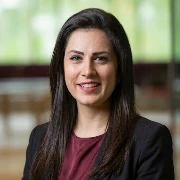
Dr. Rosita Shishegar
Details
 College: School of Computing Technologies
 Department: School of Computing Technologies
 Campus: City Campus Australia
 rosita.shishegar@rmit.edu.au
Open to
- Masters Research or PhD student supervision
- Collaborative projects
- Media enquiries
- Join a web conference as a panellist or speaker
- Industry Projects
About
Dr Rosita Shishegar is a Lecturer in Artificial Intelligence and Digital Health in the School of Computing Technologies at RMIT University. She also holds appointments as an Adjunct Research Fellow in the Department of Electrical and Computer Systems Engineering at Monash University and an Honorary Scientist at Austin Health. Before joining RMIT, she was a Senior Research Scientist at CSIRO’s Australian e-Health Research Centre.
Her research brings together artificial intelligence, machine learning, biostatistics and neuroimaging to advance digital health and personalised medicine. She develops computational methods for analysing complex biological and clinical data, with a particular focus on understanding the onset and progression of neurodegenerative diseases, including Alzheimer’s disease, Huntington’s disease and Friedreich’s ataxia.
A central contribution of her work is the development of methods to harmonise cognitive assessments across international studies, enabling researchers to combine data collected using different testing protocols. Her current research also explores generative AI, synthetic biomedical data and digital twins to model individual disease trajectories and support more personalised approaches to prediction and monitoring.
Dr Shishegar completed her PhD in Electrical Engineering at the University of Melbourne, where she developed MRI analysis methods to investigate brain development.
Research and funding
Dr Shishegar is a Chief Investigator on projects funded through the Medical Research Future Fund’s Dementia, Ageing and Aged Care Mission and the NHMRC–AMED Dementia Collaborative Research scheme, serving as methodological lead for biostatistics and AI. These include the Cognition, Optimised, Digitised, and Harmonised (C-ODH) platform for assessing and monitoring dementia and cognitive impairment, and research investigating biomarkers, therapeutic targets and modifiable risk factors for non-Alzheimer’s dementias.
She has developed research software platforms to support data harmonisation and disease prediction for clinicians and health researchers. Her work has also attracted competitive CSIRO support for industry-linked doctoral research, undergraduate research placements and data harmonisation tools.

Research fields
- 4605 Data management and data science
- 420302 Digital health
- 4602 Artificial intelligence
- 400304 Biomedical imaging
- 460307 Multimodal analysis and synthesis

Academic positions
- Lecturer
- RMIT University
- Melbourne, Australia
- Oct 2026 – Present
- Adjunct Research Fellow
- Monash University
- Department of Electrical and Computer Systems Engineering
- Melbourne, Australia
- Jan 2025 – Present
- Research Affiliate
- Monash University
- Shool of Psychological Sciences
- Melbourne, Australia
- Mar 2019 – Dec 2024
- Postdoctoral Researche Fellow
- Monash University
- Monash Biomedical Imaging
- Melbourne, Australia
- Feb 2017 – Feb 2019

Non-academic positions
- Senior Research Scientist
- Commonwealth Scientific and Industrial Research Organisation
- Health and Biosecurity
- Melbourne, Australia
- Jul 2025 – Oct 2026
- Research Scientist
- Commonwealth Scientific and Industrial Research Organisation
- Health and Biosecurity
- Melbourne, Australia
- Jul 2022 – Jun 2025
- Honorary Scientist
- Austin Health
- Australia
- Nov 2022 – Present
- Postdoctoral Research Fellow
- Commonwealth Scientific and Industrial Research Organisation
- Health and Biosecurity
- Melbourne, Australia
- Mar 2019 – Jul 2022

Supervisor projects
- AI based Biological System Modelling
- 26 Oct 2026

Research interests
-
Artificial intelligence and machine learning for digital health
-
Personalised medicine and predictive modelling
-
Generative AI, digital twins and synthetic biomedical data
-
Multimodal integration of clinical, cognitive and neuroimaging data
-
Data harmonisation across studies and clinical settings
-
Computational modelling of disease onset and progression
-
Neuroimaging, cognitive assessment and biomarkers of brain health