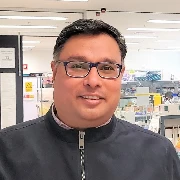
Dr. Sarvesh Soni
Details
 College: School of Science
 Department: School of Science
 Campus: City Campus Australia
 sarvesh.soni@rmit.edu.au

Open to
- Masters Research or PhD student supervision
About
Dr Soni is responsible for developing/implementing policy and managing various grant programs under several Medical Research Future Fund's (MRFF) initiatives. He is primarily engaged in policy development, program and grant design, implementation and management, as well as related research and analysis activities. He brings strong analytical, problem-solving, and research skills, which he applies to complex policy issues and development for ministerial consideration.
He was selected as an Australian Science Policy Fellow (2021–2022) by the Office of the Chief Scientist. He brings a unique perspective to government policy, acting as a bridge between scientific research and public policy.
In 2025, Dr. Soni was honoured as the Citizen of the Year by the City of Whittlesea for his outstanding contributions to community engagement and advocacy for inclusivity. As an executive member of the Whittlesea Interfaith Network, he has promoted interfaith dialogue and community cohesion.
With a background in microbiology, Dr. Soni has built a multidisciplinary research portfolio in nanobiotechnology, microbial diagnostics, and nanotherapeutics. His overarching goal is the sustainable mitigation of public health risks, achieved through collaboration with communities, organisations, and policymakers.
He is the Founder-Director of the RMIT Technology and Entrepreneurship Network & Club, supporting innovation, research translation, and commercialisation. His academic journey includes roles at RMIT, Monash University, CSIRO, and New York University, with expertise in R&D, science policy, disruptive innovation, and technology entrepreneurship.
The potential and impact of his research include:
-Transforming biosolids management in Australia, promoting environmentally sustainable practices globally.
-Developing novel methods for nanobiomaterials synthesis and applications.
-Creating point-of-care microbial detection technologies for risk mitigation.
-Influencing policy changes regarding the storage and release of recycled water.
-Optimising the use of sunscreens and reducing toxic pollutants in marine and aquatic environments.
-Advancing inhaled nanotherapeutics for the treatment of deadly tuberculosis.

Media

Academic positions
- Adjunct Industry Professor
- RMIT University
- School of Science
- Melbourne, Australia
- 1 Jul 2026 – Present
- Principal Research Fellow (Adjunct)
- RMIT University
- School of Science
- Melbourne, Australia
- 1 Jul 2021 – 30 Jun 2026
- Senior Research Fellow
- RMIT University
- School of Science
- Melbourne, Australia
- 1 Jan 2021 – 30 Jun 2021
- Research Fellow
- RMIT University
- School of Science
- Melbourne, Australia
- 1 Aug 2014 – 31 Dec 2020

Non-academic positions
- Vice President (Executive Board member - Volunteer)
- Australian NPC Disease Foundation Inc.
- Melbourne, Australia
- 3 Nov 2025 – Present
- Executive
- Australian Department of Health, Disability and Ageing
- Medical Research Future Fund (Health and Medical Research Office)
- Canberra (working remotely @ Melbourne), Australia
- 1 Feb 2022 – Present
- Australian Science Policy Fellow
- Therapeutic Goods Administration (TGA)
- Australia
- 1 Jul 2021 – 1 Feb 2022

Teaching interests
Biomacromolecular and Bio-catalytic self-assembly, Bionanotechnology, Enzymology, Microbial biotechnology, Biochemistry

Research interests
Nanobiotechnology, Science Policy, Public Health and Medical Policy, BioPhysical Chemistry (incl. Structural), Microbiology, Biochemistry, Environmental Science and Management




