Bachelor of Legal and Dispute Studies
Student type:
Quick facts
-
Entry score
-
Duration
Full-time 3 years, Part-time 6 years -
Location
Melbourne City -
Fees
Next intake
February, JulyEntry score
ATAR 70.35
Duration
Full-time 3 years
Location
Melbourne City
Fees
AU$26,880 (2019 annual)
Program brochure (PDF) Create a personalised brochure
Next intake
February, July
Overview
Are you looking to work within the legal industry? This degree offers insight into moral and legal aspects of society within Australia and other countries, along with the skills to critically analyse them. You'll be prepared for employment in private law firms, government, corporations, tribunals, community organisations and legal services.
You will gain knowledge and skills in alternative dispute resolution and mediation, international human rights, restorative justice and policy analysis. You’ll develop a deeper understanding of the legal system to help create a just, socially aware and responsible community.
Details
RMIT offers a variety of learning and teaching approaches including lectures, seminars, studios, workshops, presentations and group discussions.
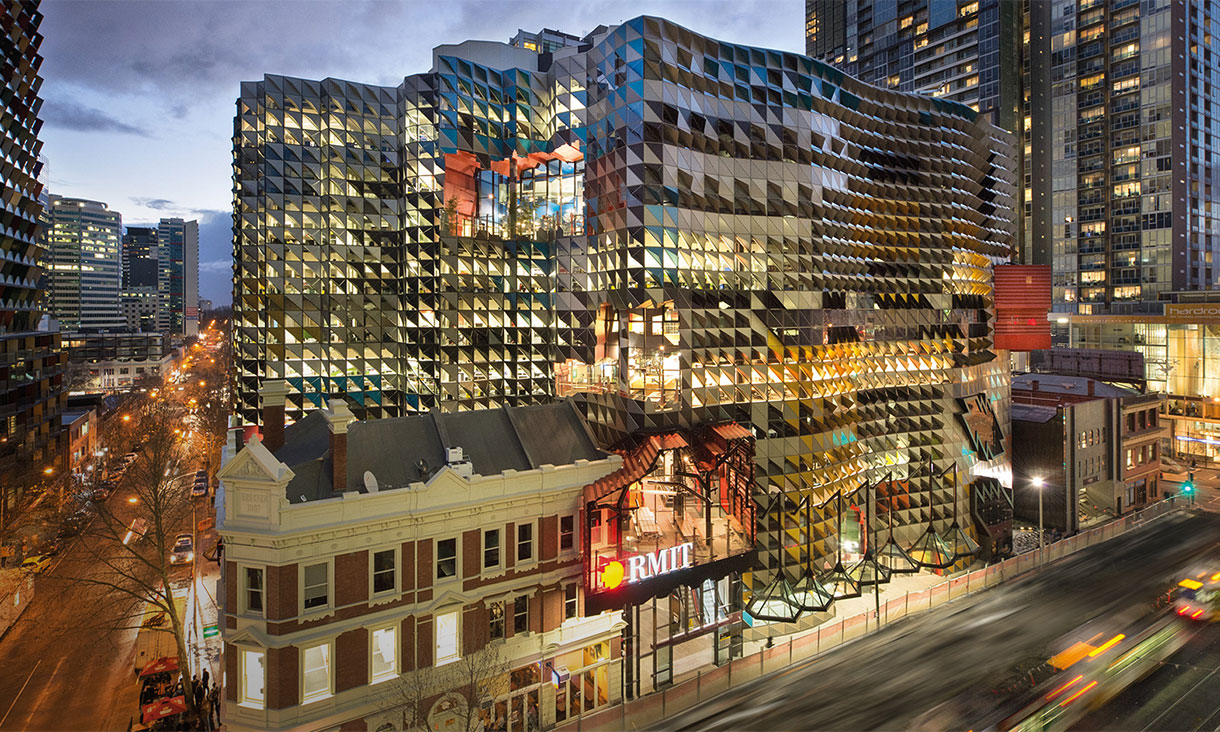
Your lectures and tutorials will take place in a number of different spaces, including traditional lecture theatres and the interactive theatres in RMIT's Swanston Academic Building.
You will complete a wide range of assessments, including essays, online tests and group presentations, and you may also submit some of your assessment online.
Academics are actively involved in teaching, research and professional practice in agencies such as the Dispute Settlement Centre (Victoria), Amnesty International Australia and the Australian Human Rights Teachers’ Network.
All programs are delivered in English. You will have access online and digital resources through the myRMIT student portal.
This degree includes a variety of learning experiences such as:
- fieldwork
- work placements
- rich online study environments
- real-world projects.
In your final year, you will have the opportunity to undertake a 50-day supervised field placement or internship. These internships have assisted past students in gaining employment within the industry.
Previous field placements have taken place in:
- Department of Justice
- Victorian Legal Aid
- community legal centres
- private law firms
- Dispute Settlement Centre, Victoria
Integral to the success of RMIT justice programs are their close links with the Dispute Resolution Centre, the court system, community legal centres and criminal justice agencies. These links influence and complement program design, development and delivery.
This degree is developed in consultation with an advisory committee made up of representatives from the Department of Justice, courts and tribunals, Corrections Victoria, Victoria Police, Australian Federal Police and the wider justice community. Their involvement ensures that the degree is vocationally relevant, meets the needs of graduate employers and incorporates the latest issues emerging in the sector.
RMIT University is committed to providing you with an education that strongly links formal learning with professional or vocational practice.
You have the opportunity to undertake international study tours where you can apply your knowledge to real-world projects in international contexts. Past study tours have included students participating in an international forum on migration and human trafficking in the Philippines. Students returning from study tours are able to reflect on the new perspectives they have gained and the experiences they have enjoyed.
You are encouraged to take one semester of the program at a partner university. RMIT University has exchange partners all over the world including the US, Mexico, China, Chile and more.
By combining international exchange, professional internship and international research projects, you may be away for an entire year. Financial support is available through scholarships, RMIT travel grants and government loans.
RMIT’s Global Experience Office (GEO) supports students to undertake exchange or short-term mobility activities with over 165 partner universities worldwide.
This program consists of 3 complementary areas of study, as follows:
- social science in relation to legal studies
- legal and justice studies
- field education (internship).
Year 1
You will acquire a comprehensive understanding of the sociology of law and an introduction to important areas such as family law, criminal law, torts and alternative dispute resolution.
Year 2
You will develop a solid legal grounding in welfare law, information law, mediation and international human rights. You will study critical debates relating to how society responds to social issues including substance abuse, criminality and imprisonment.
Year 3
You will develop a solid legal grounding in civil procedure, legal and justice issues of relevance to young people and engage in the practice of mediation. You will acquire the knowledge and skills to perform paralegal duties and understand policy processes in the legal and justice system.
You will also gain organisational skills and undertake work experience.
Choose a program structure
Program code: BP204
Career
Graduates work in administration and research within a legal context or as human rights and community workers in government and non-government agencies, or progress to further studies in law, mediation and negotiation.
Employment opportunities are primarily in the paralegal field for roles as dispute resolution professionals, and in policy positions in:
- private firms
- government departments
- corporations
- legal aid
- council legal offices
- tribunals
- activist organisations
- community legal services
Careers
- paralegal
- indigenous services liaison
- youth justice officer
- legal aid
- law clerk
- victim support officer
- legal policy officer
- counsellor
- judge’s associate
- case manager.
Admissions
*ATAR refers to the lowest selection rank to which an offer was made (including consideration of any adjustments) for current and recent year 12 applicants.
RMIT is committed to providing transparency to the admissions process. In line with this commitment, we provide you with information that will help in making informed choices about your undergraduate study options.
RMIT admits students from a range of educational pathways, including Year 12 results, previous higher education or vocational education study, work experience, and for some programs - interviews, auditions or portfolios.
Gain a better understanding of the Admission criteria for this program by viewing RMIT’s Admission information.
The highest level of education you have previously completed will determine which category applies to you.
Entry to this program is competitive. Applicants are ranked and selected in order of merit based on their academic achievement, e.g., ATAR or GPA (including any adjustments).
Applicants with recent secondary education (current or within the past two years)
Successful completion of an Australian Year 12 senior secondary certificate of education or equivalent in 2016, 2017 or 2018. If applicable, this includes equity access schemes and any other adjustment factors.
School Network Access Program (SNAP)
The SNAP access scheme is designed to increase tertiary access and participation of eligible students from SNAP partner schools.
Applicants with Vocational Education and Training study
Satisfactory completion of an Australian Certificate IV or above (or equivalent).
Applicants with Higher Education study
Satisfactory completion of at least two courses (subjects) at an Australian undergraduate level (or overseas equivalent).
Applicants with Work and Life Experience
Successful completion of an Australian senior secondary certificate of education (Year 12) or overseas equivalent.
Prerequisites: VCE Units 3 and 4: a study score of at least 30 in English (EAL) or at least 25 in English other than EAL (or equivalent) or achieve an overall score of at least 155 in the STAT multiple choice.
If you were not studying year 12 in 2018 you should submit a personal statement outlining:
- your reasons for wanting to study this program
- the personal strengths and attributes you will bring to the program
- your understanding of current issues relevant to the program
- details of any related work or voluntary experience
If you do not submit a personal statement you will be considered on the basis of academic achievement only, e.g. ATAR.
Aboriginal and Torres Strait Islander peoples
The Indigenous Access Program will support your application into RMIT programs through an informal interview process with support from the Ngarara Willim Centre. Your relevant life, work, educational and training experience as preparation for study, in addition to any formal qualifications, are all considered.
Elite Athlete Program
The RMIT Elite Athlete Program (REAP) supports elite athlete and emerging athletes to achieve sporting and academic excellence.
You must have successfully completed an Australian Year 12 or equivalent senior secondary school qualification with a minimum 70% average (check calculator below).
Equivalent qualifications may also include completion of the RMIT Foundation Studies program or a recognised post-secondary diploma in the relevant discipline with the required grades.
Meeting the minimum academic requirements does not guarantee entry. Your application will still need to be assessed and accepted.
To study this program you will need to complete one of the following English proficiency tests:
- IELTS (Academic): minimum overall band of 6.5 (with no individual band below 6.0)
- TOEFL (Paper Based Test): minimum score of 580 (TWE 4.5)
- TOEFL (Internet Based Test - IBT): minimum overall score of 79 (with minimum of 13 in Reading, 12 in Listening, 18 in Speaking and 21 in Writing)
- Pearson Test of English (Academic) (PTE (A)): minimum score of 58 (with no communication band less than 50)
- Cambridge English: Advanced (CAE): minimum of 176 with no less than 169 in any component.
For detailed information on English language requirements and other proficiency tests recognised by RMIT, visit English language requirements and equivalency information.
Don't meet the English language test scores? Complete an Advanced Plus Certificate at RMIT English Worldwide.
The following information outlines the tasks you will be required to undertake during professional experience placement and on-campus learning activities.
The non-academic abilities listed are provided for your information only and are not entry requirements.
If there are any activities outlined which may be difficult for you to undertake, there are a range of adjustments to your study conditions available to enable and support you to demonstrate these abilities. Please contact the Equitable Learning Service to discuss any adjustments you may require.
The following information outlines the tasks you will be required to undertake during professional experience placement and on-campus learning activities.
The non-academic abilities listed are provided for your information only and are not entry requirements.
If there are any activities outlined which may be difficult for you to undertake, there are a range of adjustments to your study conditions available to enable and support you to demonstrate these abilities. Please contact the Equitable Learning Service to discuss any adjustments you may require.
By understanding the types of activities you’ll participate in, you can:
- understand more about the program
- determine if you may need support during your studies
- make an informed decision about whether the program is suitable for you
If you are living with disability, long-term illness and/or a mental health condition, we can support you by making adjustments to activities in your program so that you can participate fully in your studies.
To receive learning adjustments, you need to register with Equitable Learning Service
The University considers the wellbeing and safety of all students, staff and the community to be a priority in academic and professional experience placement settings.
Pathways
Fees
In 2019, the annual student contribution amount (tuition fee) you will pay for a standard year of full-time study is between AU$6,566 to AU$10,958*.
* Amounts quoted are indicative fees per annum, and are based on a standard year of full-time study (96 credit points). A proportionate fee applies for more or less than the full-time study load.
Additional expenses
Student services and amenities fee (SSAF): AU$303 maximum fee for 2019.
Other items related to your program, including field trips, textbooks and equipment.
Fees are adjusted on an annual basis and these fees should only be used as a guide.
Learn more about fees for undergraduate study.
Defer your payment
You may be eligible to apply for a HECS-HELP loan, which can be used to defer payment of up to the full amount of your student contribution fees. You may also be eligible to apply to defer payment of your SSAF through the SA-HELP loan scheme.
All undergraduate and honours degrees have Commonwealth supported places (CSP) available. In 2019, the annual student contribution amount (tuition fee) you will pay for a standard year of full-time study is between AU$6,566 to AU$10,958.
In a CSP, your tuition fees are subsidised by the Australian Government. Your share of the fee (student contribution) is set each year by the Australian Government and is determined by the discipline areas (bands) of the courses in which you enrol, not the overall program.
How much can I expect to pay for my Commonwealth supported place?
Courses (subjects) fall into one of three bands. The band determines the student contribution amount for the course.
Amounts listed in the table below are based on a standard, full-time study load (96 credit points per year) with all courses in the same band. A proportionate fee applies for more or less than the full-time study load or for enrolment in courses (subjects) from a combination of bands.
You can learn how to calculate your exact tuition fees for units from different bands at fees for Commonwealth supported students.
Maximum student contribution amount for Commonwealth supported places in 2019
Student contribution band by course (subject) |
Maximum annual student contribution amount in 2019 |
Band 1: humanities, behavioural science, social studies, clinical psychology, foreign languages, visual and performing arts, education, nursing |
$6,566 per standard year |
Band 2: mathematics, statistics, computing, built environment, other health, allied health, science, engineering, surveying, agriculture |
$9,359 per standard year |
|
$10,958 per standard year |
HECS-HELP Loans
The Australian Government provides financial assistance via the HECS-HELP loan scheme, which allows eligible students (such as Australian citizens or holders of an Australian permanent humanitarian visa) to defer payment of up to the full amount of their student contribution.
SA-HELP Loans
You may be eligible to apply to defer payment of the Student services and amenities fee (SSAF) through the SA-HELP loan scheme. If you use SA-HELP, the amount will be added to your accumulated HELP debt.
How does a HELP loan work?
If your HECS-HELP and/or SA-HELP loan application is successful, the Australian Government will pay RMIT, on your behalf, up to the full amount of your fees. This amount will become part of your accumulated HELP debt.
You will only start repaying your accumulated HELP debt to the Australian Government once you earn above the minimum income threshold for repayment, which is set each year by the Australian Government (this also applies if you are still studying).
The Australian Taxation Office (ATO) will calculate your compulsory repayment for the year and include this on your income tax notice.
For more information about loan repayment options see Commonwealth assistance (HELP loans) or Study Assist.
In addition to tuition fees, you will be charged an annual student services and amenities fee (SSAF), which is used to maintain and enhance services and amenities that improve your experience as an RMIT student.
The SSAF is calculated based on your enrolment load and the maximum fee for 2019 is $303.
For more information about calculating your actual SSAF see Paying SSAF.
You may also be required to purchase other items related to your program, including field trips, textbooks and equipment. These additional fees and expenses vary from program to program.
The annual tuition fee for 2019 is AU$26,880.
The total indicative tuition fee for 2019 commencement is AU$83,520.
In addition to tuition fees you also need to pay for:
- Student services and amenities fee (SSAF) in each calendar year.
- Overseas Student Health Cover (OSHC) - Student visa holders must have cover for the total duration of their visa.
- Some programs incur additional expenses.
You also need to account for your living expenses. Estimate the cost of living ;in Melbourne.