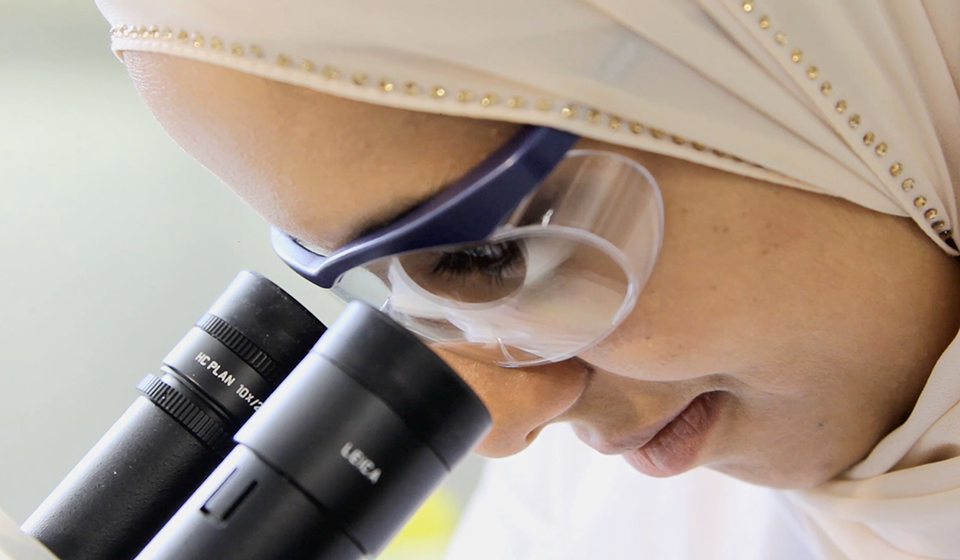
You will explore gene and protein technologies, bioinformatics, and various microbiology and food science disciplines, both in the classroom and via a strong component of hands-on laboratory practicals.
This course includes an option to complete one semester of either work experience in the form of an industry placement, or a research project where you’ll complete minor thesis.
All students have the opportunity to analyse real-world data when undertaking a research project.
RMIT Master of Biotechnology graduate, Angela Peng talks about her journey to become a research assistant in the Cancer Development and Treatment Laboratory at Peter MacCallum Cancer Centre.
This course is delivered full-time in face-to-face mode supported by blended learning activities (including online).
Learning environments include lectures, tutorials, online delivery and individual and group work.
You will spend a high proportion of your studies undertaking project and field work, providing a real-world context and the opportunity to develop teamwork and time-management skills.
High-achieving students may undertake work-integrated learning (WIL) through an industry-based research project or optional work experience.
Previous projects and work experience have been undertaken at organisations such as The Peter Doherty Institute for Infection and Immunity, Murdoch Children's Research Institute, Peter MacCallum Cancer Centre, Olivia Newton-John Cancer Centre, CSIRO, Seqirus, Burnet Institute, and AgriBio, to name a few.
The types of classes you have will depend on the course you’re studying. Classes are offered in various formats designed to provide meaningful engagement with staff, industry and peers and provide for access and use of spaces where learning can be applied and active, including an array of specialised equipment.
Most RMIT courses do not include passive large-scale classes such as lectures, instead the content traditionally provided in lectures is made available online. This may be in the form of readings, videos or other on-demand learning materials. This content will also support the basis of interactive learning that takes place in on-campus classes.
The world is constantly changing, and there are universal skills that can help you adapt to the evolving nature of work and global engagement.
As part of your study experience at RMIT, we provide 6 future-focused RMIT Capabilities:
RMIT Capabilities are built into your course as well as some of our extracurricular experiences. They inform the design and delivery of your learning activities and assessments, so by the time you graduate, you’ll be ready to apply these capabilities in your life and work.
The specialisations within this course are validated by an industry panel comprising practising professionals who meet regularly to review the contents of each discipline.
Students have an option to explore work experience or research project opportunities at leading global institutes recognised by RMIT University.
Upon successful completion of this course, you will be able to demonstrate an advanced understanding of biological sciences by articulating the methods of science, explaining its relevance in society, and why current knowledge is both contestable and testable.
Calling on your cognitive skills and mastery of advanced theoretical knowledge and recent developments in biotechnology, you will be able to generate new and abstract ideas, as well as research, analyse, address and solve solve complex problems in existing and new areas.
You will also utilise your research skills to plan and execute a substantial research or work-based project and/or pieces of scholarship, demonstrating creativity, initiative and a high level of autonomy.
Importantly, you will be able to effectively communicate concepts of biotechnology to specialist and non-specialist audiences using a variety of presentation modes. Your studies will also shape you into an independent and self-directed learner who works effectively, responsibly, ethically and safely whether autonomously or within a team, able able to take accountability for your learning, work, and professional practice. You will further demonstrate knowledge of and adherence to all regulatory frameworks and ethical principles relevant to biotechnology.

This course emphasises the practical application of new knowledge and technologies, and includes an optional semester of work experience or a research project.
Year 1 focuses on the development of core skills and knowledge, allowing you to specialise by selecting subjects relevant to the biotechnology stream that may include systems biology, functional genomics and proteomics, gene technologies, protein technology, bioinformatics, biotechnology and business, to name a few.
Year 2 further develops your specialisation. Here you will choose subjects from a selected minor option (science, food technology, or clinical microbiology) and apply your skills through an opportunity to complete an optional work placement or research project with an institute or industry partner.
Choose a plan below to find out more about the subjects you will study and the course structure.
International student visa holders can only study full-time.
Graduates of this program find roles in medical or pharmaceutical research, food science and more.
Apply your knowledge of living systems to address challenges in the environment, health (infectious disease) or food science.
As a graduate of this course, you’ll be eligible to apply for roles in advanced areas of the biotechnology industry. You’ll be equipped with skills in gene and protein technologies, bioinformatics, and in various microbiology and food science disciplines. These skills are in high demand within the diverse biotechnology sector.
Depending on which subjects you've studied, you can apply for membership of one or more of the following professional societies:
You need to satisfy all of the following entry requirements to be considered for entry into this degree.
An Australian bachelor degree with a GPA of at least 2.0 out of 4.0 in biological sciences, food science/technology, biotechnology, medicine, veterinary science, dentistry, agricultural science or chemical engineering, or equivalent.
International qualifications are assessed for comparability to Australian qualifications, according to the Australian Qualifications Framework (AQF).
Successful completion of a Chemistry or Biochemistry course in a bachelor degree.
A selection task is not required for entry into this qualification.
You must meet the University's minimum English language requirements to be eligible for a place in this program.
You need to satisfy all of the following requirements to be considered for entry into this course.
You must have successfully completed an Australian bachelor degree (or equivalent overseas qualification) in biological sciences, food science/technology, biotechnology, medicine, veterinary science, dentistry, agricultural science or chemical engineering with a minimum GPA of 2.0 (out of 4.0).
Successful completion of a chemistry or biochemistry course in a bachelor degree.
A selection task is not required for entry into this qualification.
To study this course you will need to complete one of the following English proficiency tests:
Note: RMIT does not accept scores from 'at-home' or 'online' testing.
For detailed information on English language requirements and other proficiency tests recognised by RMIT, visit English language requirements and equivalency information.
Don't meet the English language test scores? Complete an English for Academic Purposes (EAP) Advanced Plus at RMIT University Pathways (RMIT UP).
You can gain entry to this master's degree from a range of RMIT undergraduate courses, if you meet the entry requirements.
You may be eligible for credit for previous study in a qualification at AQF level 8 or above, from other institutions or overseas. These include a graduate certificate, graduate diploma, or bachelor honours degree.
Students who have undertaken a bachelor degree in biotechnology may be given up to 48 credit point exemptions. Please contact the Program Manager for advice.
Credit, recognition of prior learning, professional experience and accreditation from a professional body can reduce the duration of your study by acknowledging your earlier, relevant experience.
Credit and exemptions will be assessed consistent with the principles of the RMIT Credit Policy.
The Australian Qualifications Framework (AQF) is the national policy for Australian qualifications in vocational and higher education.
Upon successful completion of this degree, you may be eligible for entry into an RMIT Master by Research or Doctoral (PhD) program.
You can gain entry into this degree from a range of RMIT undergraduate programs.
RMIT has pathway arrangements with many partner institutions around the world.
If your institution has a pathway arrangement with RMIT you may be able to receive credit and reduce the time it will take to complete your preferred RMIT program.
Find out if your institution has a pathway arrangement with RMIT
If you have qualifications from an institution that is not an RMIT partner, credit into your RMIT program will be assessed on a case-by-case basis.
You may be eligible for credit for previous study in a qualification at AQF level 8 or above, from other institutions or overseas. These include a graduate certificate, graduate diploma, or bachelor honours degree.
Students who have undertaken a bachelor degree in biotechnology may be given up to 48 credit point exemptions. Please contact the Program Manager for advice.
The Australian Qualifications Framework (AQF) is the national policy for Australian qualifications in vocational and higher education.
When you are submitting an application, please indicate that you want to be considered for credit.
Applicants with a bachelor honours degree, graduate certificate, graduate diploma or master's degree qualification majoring in a different discipline may also be eligible for credit transfer of up to 48 credit points (equivalent to one semester full-time study).
When you are submitting an application, please indicate that you want to be considered for credit and provide detailed course syllabus (also known as course outline), outlining volume of learning, course content and weekly topics, learning objectives/outcomes, assessment types and weightings, and reference to the learning resources.
Credit and exemptions will be assessed consistent with the principles of the RMIT Credit Policy.
Upon successful completion of this degree, you may be eligible for entry into an RMIT Master by Research or Doctoral (PhD) program.
Entry for this program is primarily through Commonwealth Supported Places (CSPs).
Government financial assistance is available to eligible students regardless of the type of place you enrol in.
Amounts quoted are indicative fees per annum, and are based on a standard year of full-time study (96 credit points). A proportionate fee applies for more or less than the full-time study load.
*Fees are adjusted on an annual basis and these fees should only be used as a guide.
For information on how to pay your fees or how to apply for a refund, please see Paying your fees and applying for refunds.
If you are offered a Commonwealth supported place, your tuition fees are subsidised by the Australian Government.
Your share of the fee (student contribution) is set on an annual basis by the government and is determined by the discipline areas (bands) of your individual enrolled courses, not the overall program.
The Australian Government has introduced changes to university funding and student contribution fees under its Job-ready Graduates Package.
The fees in the table below apply to students who commence their program in 2026. Fees for continuing students are available at fees for Commonwealth supported students.
Each course (subject) falls into a band. The band determines the student contribution amount for the course.
Amounts listed in the table below are based on a standard, full-time study load (96 credit points per year) with all courses in the same band. A proportionate fee applies for more or less than the full-time study load or for enrolment in courses (subjects) from a combination of bands.
You can learn how to calculate your exact tuition fees for units from different bands at Fees for Commonwealth supported students.
Student contribution band by course (subject) |
Maximum annual student contribution amount (per EFTSL) in 2026 |
|---|---|
| Education, Postgraduate Clinical Psychology, English, Mathematics, Statistics, Nursing, Indigenous and Foreign Languages, Agriculture | $4,738 per standard year $592 per standard (12 credit point) course |
| Allied Health, Other Health, Built Environment, Computing, Visual and Performing Arts, Professional Pathway Psychology, Professional Pathway Social Work, Engineering, Surveying, Environmental Studies, Science, Pathology | $9,537 per standard year $1,192 per standard (12 credit point) course |
| Dentistry, Medicine, Veterinary Science | $13,558 per standard year $1,694 per standard (12 credit point) course |
| Law, Accounting, Administration, Economics, Commerce, Communications, Society and Culture | $17,399 per standard year $2,174 per standard (12 credit point) course |
On 1 January 2022, the Government implemented the Student Learning Entitlement (SLE).
If you are offered a full-fee place, you will need to pay the full tuition costs of your program. However, eligible students (such as Australian citizens or holders of an Australian permanent humanitarian visa) may apply to defer payment of some or all of their tuition fees via the Commonwealth Government’s FEE-HELP loan scheme.
In addition to tuition fees, you will be charged an annual student services and amenities fee (SSAF), which is used to maintain and enhance services and amenities that improve your experience as an RMIT student.
The SSAF is calculated based on your enrolment load and the maximum fee for 2026 is $373.
You may also be required to purchase other items related to your course, including field trips, textbooks and equipment. These additional fees and expenses vary from course to course.
The Australian Government provides financial assistance via the HECS-HELP loan scheme, which allows eligible students (such as Australian citizens or holders of an Australian permanent humanitarian visa) to defer payment of up to the full amount of their student contribution.
Eligible students (such as Australian citizens or holders of an Australian permanent humanitarian visa) may apply to defer payment of some or all of their tuition fees via the Commonwealth Government’s FEE-HELP loan scheme.
You may be eligible to apply to defer payment of the Student services and amenities fee (SSAF) through the SA-HELP loan scheme. If you use SA-HELP, the amount will be added to your accumulated HELP debt.
If your HECS-HELP, FEE-HELP and/or SA-HELP loan application is successful, the Australian Government will pay RMIT, on your behalf, up to 100% of your fees. This amount will become part of your accumulated HELP debt.
You only start repaying your accumulated HELP debt to the Australian Government once you earn above the minimum income threshold for repayment, which is set each year by the Australian Government (this also applies if you are still studying). The Australian Taxation Office (ATO) will calculate your compulsory repayment for the year and include this on your income tax notice.
For more information about loan repayment options see Commonwealth assistance (HELP loans) or Study Assist.
You may be eligible for student income support payments from the Commonwealth Government if you are undertaking a graduate certificate, graduate diploma or an approved professionally oriented masters by coursework program. For more information see Income support for Masters students.
If you are enrolled in an eligible program you will also need to satisfy all other student payment eligibility requirements. You can contact Centrelink or Services Australia for further information about student income support entitlements, your eligibility and how to apply.
You may be eligible to apply for income tax deductions for education expenses linked to your employment.
See the Australian Taxation Office (ATO) for more information.
RMIT awards more than 2000 scholarships every year to recognise academic achievement and assist students from a variety of backgrounds.
In addition to tuition fees you also need to pay for:
You also need to account for your living expenses. Estimate the cost of living in Melbourne.
In addition to tuition fees, you will be charged an annual student services and amenities fee (SSAF), which is used to maintain and enhance services and amenities that improve your experience as an RMIT student.
The SSAF is calculated based on your enrolment load and the maximum fee for 2026 is $373.
Find out more details about how fees are calculated and the expected annual increase.
Find information on how to apply for a refund as a continuing international student.
RMIT awards more than 2000 scholarships every year to recognise academic achievement and assist students from a variety of backgrounds.
Use our Frequently Asked Questions to learn about the application process and its equity access schemes, find out how to accept or defer your offer or request a leave of absence, discover information about your fees, refunds and scholarships, and explore the various student support and advocacy services, as well as how to find out more about your preferred program, and more.
RMIT University acknowledges the people of the Woi wurrung and Boon wurrung language groups of the eastern Kulin Nation on whose unceded lands we conduct the business of the University. RMIT University respectfully acknowledges their Ancestors and Elders, past and present. RMIT also acknowledges the Traditional Custodians and their Ancestors of the lands and waters across Australia where we conduct our business - Artwork 'Sentient' by Hollie Johnson, Gunaikurnai and Monero Ngarigo.
More information