Bachelor of Design (Communication Design)
Student type:
Quick facts
-
Entry score
-
Duration
Full-time 3 years -
Location
Melbourne City -
Fees
Next intake
FebruaryEntry score
Range of criteria
Duration
Full-time 3 years
Location
Melbourne City
Fees
AU$33,600 (2019 annual)
Program brochure (PDF) Create a personalised brochure
Next intake
February, July
Overview
Communication Design applies to the shaping of communication across all aspects of contemporary society, from commercial, entertainment, and education, to environmental, cultural and civic sectors.
This degree prepares you to be a locally- and internationally-aware communication designer capable of working across a range of domains and industries, including graphic design, advertising, branding and illustration consultancies, as well as design and communication units within corporate, government and non-government organisations.
You’ll learn skills alongside a strong selection peers in studio-based facilities. Throughout the degree, you will develop skills in negotiating a consensus among participants with a range of interests in the design outcome. You will also learn how a visual strategy can contribute to all phases of the problem-solving process.
Details
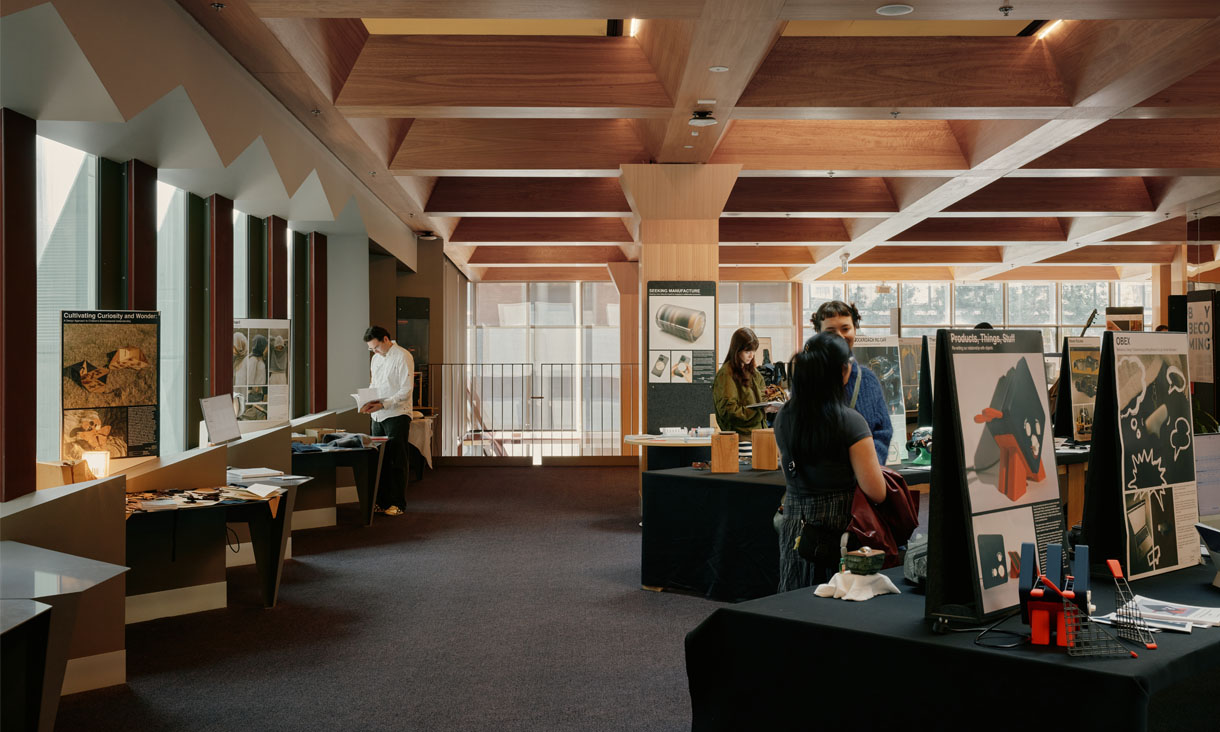
This course has a strong focus on studio learning, enabling you to learn by doing. All lecturers have worked in the design industry throughout their careers, and will offer you key insights into the contemporary design world.
Most of the work is individually assessed through submission of printed artefacts (books, logo, objects), digital submissions, class presentations and client and peer review of work.
RMIT runs an internal mentor scheme, as well as a number of industry events where students and design professionals work together on projects or professional practice.
This course maintains strong industry links, and many opportunities exist for students to work with industry professionals.
You will work on projects with industry partners, including:
Australian Graphic Design Association
Penguin Books
Deloitte
Kit Cosmetics
Hardie Grant
Jacky Winter Group
ABC
CFA
Roger Seller
de Bono Institute
MECCA.
In the first two semesters, you are taught in a series of assigned sequential, interrelated projects, which cover a broad spectrum of communication design activities.
The following four semesters see you participate in a range of design and communication studios that support the sequential study pattern of this program.
Software delivery is taught in association with the design process, rather than in isolation. On completion of the degree, your software knowledge will be of industry standard for print and digital media.
Major areas of study are:
communication strategies
conceptual thinking
design process
media
publication
strategic branding
typography
You can also undertake study in courses within other media, design and communication programs as electives or interdisciplinary projects.
Choose a program structure
| Title | Location | Duration | Plan code | CRICOS | ||
|---|---|---|---|---|---|---|
| Bachelor of Design (Communication Design) | City Campus |
3 years full-time-6 semesters
|
3 years full-time
|
BP115P04 | 012348F |
Choose a program structure
Program code: BP115
Career
Careers
Graduates can expect to work within graphic design consultancies, multi-disciplined consultancies, publishing houses, new media/multimedia studios and advertising agencies as:
art directors
graphic designers
communication designers
web designers/ UX designers
freelancers
interaction designers
service designers
experience designers
Admissions
RMIT is committed to providing transparency to the admissions process. In line with this commitment, we provide you with information that will help in making informed choices about your undergraduate study options.
RMIT admits students from a range of educational pathways, including Year 12 results, previous higher education or vocational education study, work experience, and for some programs - interviews, auditions or portfolios.
Gain a better understanding of the Admission criteria for this program by viewing RMIT’s Admission information.
The highest level of education you have previously completed will determine which category applies to you.
Entry to this program is competitive. Applicants are ranked and selected in order of merit based on their academic achievement, e.g., ATAR or GPA (including any adjustments).
Applicants with recent secondary education (current or within the past two years)
Successful completion of an Australian Year 12 senior secondary certificate of education or equivalent in 2016, 2017 or 2018. If applicable, this includes equity access schemes and any other adjustment factors.
School Network Access Program (SNAP)
The SNAP access scheme is designed to increase tertiary access and participation of eligible students from SNAP partner schools.
Applicants with Vocational Education and Training study
Satisfactory completion of an Australian Certificate IV or above (or equivalent).
Applicants with Higher Education study
Satisfactory completion of at least two courses (subjects) at an Australian undergraduate level (or overseas equivalent).
Applicants with Work and Life Experience
Successful completion of an Australian senior secondary certificate of education (Year 12) or overseas equivalent.
Prerequisites: VCE Units 3 and 4: a study score of at least 30 in English (EAL) or at least 25 in English other than EAL (or equivalent) or achieve an overall score of at least 155 in the STAT multiple choice.
You must:
- complete and submit the Communication Design pre-selection kit.
- VTAC applicants must register and submit the selection kit here.
- All kits must be submitted by the dates noted below for each VTAC round:
- Early round (Non year 12 only): 27 September 2018
- Main round (All applicants): 2 November 2018
- All subsequent rounds (if places are available): 15 February 2019
- RMIT current or recent students please click the apply button to submit your direct application. The link to submit your pre-selection kit will appear on the applicant dashboard after you have submitted your application.
- All kits must be submitted by 6 March 2019*
- *Kits will be assessed in the order they are received until this date unless places are filled prior.
Advisory letters will be sent in late October (Early round) and late December (Main round).
Pre-selection kit
The pre-selection kit has two components: a design statement and a selection task.
The pre-selection kit requires:
1. Design statement 1: You must submit a design statement that:
- Describes your experience such as employment, voluntary work, etc., and how these will make a contribution to the RMIT communication design community.
- Describes what you hope to achieve through your studies.
- (Maximum 200 words)
2. Design statement 2: Please explain how you think design can have an impact on the world and describe one example of a design (not your own) that has had an impact.
- (Maximum 200 words)
3. Selection task: You must:
- Provide examples of one or two projects (up to 4 images in total) that best demonstrate your creative passion, and:
- Provide a written statement (max 200 words) about one of the projects that covers the following points:
1. A brief explanation of the project,
2. The motivation and aims behind the project,
3. How this project reflects your values and passions.
Each file must be one image only. Files must be formatted as JPEG or PDF (maximum size 4MB). If you would like to upload film or sound based work, please ensure that file types are common (maximum file size 4MB, maximum duration 4 minutes).
All file names must be in the format: VTAC ID/Application number_Surname_Project number (e.g. 12365478L_Smith_Project 2.jpg).
Alternatively, you can provide a URL to your work. Please provide a username and/or password if applicable.
Art and Design application tips
View the following videos for some practical application advice:
Aboriginal and Torres Strait Islander peoples
The Indigenous Access Program will support your application into RMIT programs through an informal interview process with support from the Ngarara Willim Centre. Your relevant life, work, educational and training experience as preparation for study, in addition to any formal qualifications, are all considered.
Elite Athlete Program
The RMIT Elite Athlete Program (REAP) supports elite athlete and emerging athletes to achieve sporting and academic excellence.
You must have successfully completed an Australian Year 12 (or equivalent senior secondary school qualification) with a minimum 65% average (check calculator below).
For information on international qualifications and corresponding entry requirements that are equivalent to an Australian Year 12, see the Entry requirements by country web page.
Equivalent qualifications may also include completion of the RMIT Foundation Studies program or a recognised post secondary diploma in the relevant discipline with the required grades.
Meeting the minimum academic requirements does not guarantee entry. Your application will still need to be assessed and accepted.
Folio: You must supply evidence of your creativity in the form of a folio that contains a variety of your personal work in art, design or media relevant to the program/s you are applying for. The folio should demonstrate your interests and creative thinking as well as your conceptual, design, problem solving and technical skills. You should include evidence of how ideas were developed as well as finished works.
Examples of work to include in your folio are drawings, paintings, graphic designs, photographs, digital images, models, sculpture, video, scripting, short stories, and/or 2D and 3D Flash animation.
We recommend you explain each work to help the Selection Officer understand the purpose and background of that work.
Your folio should be submitted electronically as an A4 PDF containing between 10 and 20 pages. Time based works such as animations or videos should be uploaded to YouTube or Vimeo and submitted as a link with your folio.
Your PDF must be no larger than 10MB and you must only submit one folio with your application.
To study this program you will need to complete one of the following English proficiency tests:
- IELTS (Academic): minimum overall band of 6.5 (with no individual band below 6.0)
- TOEFL (Paper Based Test): minimum score of 580 (TWE 4.5)
- TOEFL (Internet Based Test - IBT): minimum overall score of 79 (with minimum of 13 in Reading, 12 in Listening, 18 in Speaking and 21 in Writing)
- Pearson Test of English (Academic) (PTE (A)): minimum score of 58 (with no communication band less than 50)
- Cambridge English: Advanced (CAE): minimum of 176 with no less than 169 in any component.
For detailed information on English language requirements and other proficiency tests recognised by RMIT, visit English language requirements and equivalency information.
Don't meet the English language test scores? Complete an Advanced Plus Certificate at RMIT English Worldwide.
Pathways
Fees
In 2019, the annual student contribution amount (tuition fee) you will pay for a standard year of full-time study is between AU$6,566 to AU$10,958*.
* Amounts quoted are indicative fees per annum, and are based on a standard year of full-time study (96 credit points). A proportionate fee applies for more or less than the full-time study load.
Additional expenses
Student services and amenities fee (SSAF): AU$303 maximum fee for 2019.
Other items related to your program, including field trips, textbooks and equipment.
Fees are adjusted on an annual basis and these fees should only be used as a guide.
Learn more about fees for undergraduate study.
Defer your payment
You may be eligible to apply for a HECS-HELP loan, which can be used to defer payment of up to the full amount of your student contribution fees. You may also be eligible to apply to defer payment of your SSAF through the SA-HELP loan scheme.
All undergraduate and honours degrees have Commonwealth supported places (CSP) available. In 2019, the annual student contribution amount (tuition fee) you will pay for a standard year of full-time study is between AU$6,566 to AU$10,958.
In a CSP, your tuition fees are subsidised by the Australian Government. Your share of the fee (student contribution) is set each year by the Australian Government and is determined by the discipline areas (bands) of the courses in which you enrol, not the overall program.
How much can I expect to pay for my Commonwealth supported place?
Courses (subjects) fall into one of three bands. The band determines the student contribution amount for the course.
Amounts listed in the table below are based on a standard, full-time study load (96 credit points per year) with all courses in the same band. A proportionate fee applies for more or less than the full-time study load or for enrolment in courses (subjects) from a combination of bands.
You can learn how to calculate your exact tuition fees for units from different bands at fees for Commonwealth supported students.
Maximum student contribution amount for Commonwealth supported places in 2019
Student contribution band by course (subject) |
Maximum annual student contribution amount in 2019 |
Band 1: humanities, behavioural science, social studies, clinical psychology, foreign languages, visual and performing arts, education, nursing |
$6,566 per standard year |
Band 2: mathematics, statistics, computing, built environment, other health, allied health, science, engineering, surveying, agriculture |
$9,359 per standard year |
|
$10,958 per standard year |
HECS-HELP Loans
The Australian Government provides financial assistance via the HECS-HELP loan scheme, which allows eligible students (such as Australian citizens or holders of an Australian permanent humanitarian visa) to defer payment of up to the full amount of their student contribution.
SA-HELP Loans
You may be eligible to apply to defer payment of the Student services and amenities fee (SSAF) through the SA-HELP loan scheme. If you use SA-HELP, the amount will be added to your accumulated HELP debt.
How does a HELP loan work?
If your HECS-HELP and/or SA-HELP loan application is successful, the Australian Government will pay RMIT, on your behalf, up to the full amount of your fees. This amount will become part of your accumulated HELP debt.
You will only start repaying your accumulated HELP debt to the Australian Government once you earn above the minimum income threshold for repayment, which is set each year by the Australian Government (this also applies if you are still studying).
The Australian Taxation Office (ATO) will calculate your compulsory repayment for the year and include this on your income tax notice.
For more information about loan repayment options see Commonwealth assistance (HELP loans) or Study Assist.
In addition to tuition fees, you will be charged an annual student services and amenities fee (SSAF), which is used to maintain and enhance services and amenities that improve your experience as an RMIT student.
The SSAF is calculated based on your enrolment load and the maximum fee for 2019 is $303.
For more information about calculating your actual SSAF see Paying SSAF.
You may also be required to purchase other items related to your program, including field trips, textbooks and equipment. These additional fees and expenses vary from program to program.
The annual tuition fee for 2019 is AU$33,600.
The total indicative tuition fee for 2019 commencement is AU$106,560.
In addition to tuition fees you also need to pay for:
- Student services and amenities fee (SSAF) in each calendar year.
- Overseas Student Health Cover (OSHC) - Student visa holders must have cover for the total duration of their visa.
- Some programs incur additional expenses.
You also need to account for your living expenses. Estimate the cost of living ;in Melbourne.